Be yourself; Everyone else is already taken.
— Oscar Wilde.
This is the first post on my new blog. I’m just getting this new blog going, so stay tuned for more. Subscribe below to get notified when I post new updates.
Be yourself; Everyone else is already taken.
— Oscar Wilde.
This is the first post on my new blog. I’m just getting this new blog going, so stay tuned for more. Subscribe below to get notified when I post new updates.
“ Varanasi is older than history, older than tradition, older even than legend, and looks twice as old as all of them put together.”– Mark Twain
Varanasi – the oldest continuously inhabited city in the world, holds immense significance for Hindus as one of the holiest cities in India. It is believed to be the abode of Lord Shiva and a gateway to salvation (moksha), where devotees come to wash away their sins in the sacred waters of the Ganges. The city’s ghats, temples, and rituals reflect deep spiritual traditions that have remained unbroken through centuries of war, destruction, and natural calamities.
Varanasi is home to the Kashi Vishwanath Temple, a revered site dedicated to Lord Shiva, attracting pilgrims from all over the world.
I had always wanted to visit Varanasi ever since the Kashi Vishwanath Corridor was inaugurated in 2019, and this resolve was strengthened in January 2024 after the inauguration of the Ram Mandir in Ayodhya.
Since Varanasi and Ayodhya are only 220 kilometers apart, I planned to combine the two holiest destinations.
With millions of devotees visiting these places, it was essential to ensure we went when the crowds were lighter. After careful planning, I decided on September for travel, hoping the weather would be pleasant and the crowds moderate
We booked our air tickets and hotels in May 2024, but the flight fare was still quite high (around INR 7,000 per person each way). The duopoly of Indigo and the Tata Group in the airline industry has steadily pushed up airfares.
After some detailed planning with inputs from friends and ChatGPT, we were all set for our religious journey. The flight was at 6:45 AM from Bangalore to Varanasi on September 24, 2024.
24-Sep-24
Since I am not a morning person, it was quite a task for me to wake up and depart for the airport at 4:00 AM. But I managed to get into the taxi in a half-asleep state, and before I was fully awake, I had checked in, cleared security, had my coffee, and was ready to board the plane! I remembered a sleepy-headed friend from my college days who loved early morning classes, saying, “By the time I’m awake, half the classes are over!” He was, of course, reprimanded multiple times for sleeping on his desk.
The 2.5-hour flight was uneventful, and I continued reading the book Banaras: City of Light by Diana Eck. It’s a scholarly book, extremely well-written and detailed, though it’s not a travel guide.
The flight was on time, and around 10:00 AM, we reached Varanasi airport. The Varanasi International Airport was quite modern, with good infrastructure. As we were heading towards the Uber pickup, we were approached by a private taxi driver. I found his fare reasonable, so we boarded the taxi, and the next hour was pure entertainment! The driver, Choubeji, was full of anecdotes, historical information, and chaupais from the Ram Charit Manas—the time flew by, and soon we arrived at our hotel.
My initial impression of Varanasi was quite positive. The roads from the airport to the city were wide and in good condition. The malls, buildings, and luxury cars were indications of economic progress and an economy that extends beyond religious tourism.
Hotel Tridev Grand, about one kilometer from Assi Ghat, proved to be a wise choice. It is a modern hotel with good amenities and an attached restaurant. After a smooth check-in, we rested for a while and then walked to the nearby Bati-Choka restaurant. Bati-choka was new to us; it is essentially a roasted ball made from wheat flour, served with brinjal bharta. It is a popular dish in eastern UP and Bihar, and many fine dining restaurants are now serving it.
In fact, Varanasi is quite famous for its food, from chaats to sweets to fine dining restaurants. I have written a separate blog exploring the various delicacies of Varanasi.
After some much-needed sleep, I was ready to explore the ghats and temples. I inquired at the reception and got a disappointing update. There had been a flood-like situation in Varanasi recently, as the Ganga had overflowed. The water had receded, but it left a great deal of silt on the ghats. While the ghats were open to a limited extent, it was not possible to walk from one ghat to another, as the ghat road was covered in silt.
Taking this in stride, I boarded an auto-rickshaw towards Assi Ghat, a distance of about 1.5 kilometers. The crazy honking and reckless driving were immediately evident. The worst culprits appeared to be the e-rickshaw drivers, who were swerving randomly all over the place. After about 15 minutes (which seemed like an eternity), I arrived at Assi Ghat. Due to the silt, only a small section of the ghat had been cleaned and was open to the public. I wanted to see the famous evening Ganga Aarti, but given the jostling crowd, I decided to retreat. Close to Assi Ghat is the birthplace of Rani Lakshmi Bai of Jhansi.
Attraction 1 : Rani Laxmibai Janmasthali of Jhansi
Rani Lakshmi Bai Janmabhoomi (birthplace) is a site dedicated to the memory Rani Lakshmi Bai, the Queen of Jhansi. Born as Manikarnika Tambe on November 19, 1828, in Varanasi, she grew up to become a symbol of resistance during India’s First War of Independence in 1857. I found the site to be well maintained and worth a visit
Picture of Rani Laxmibai Janmasthali of Jhansi
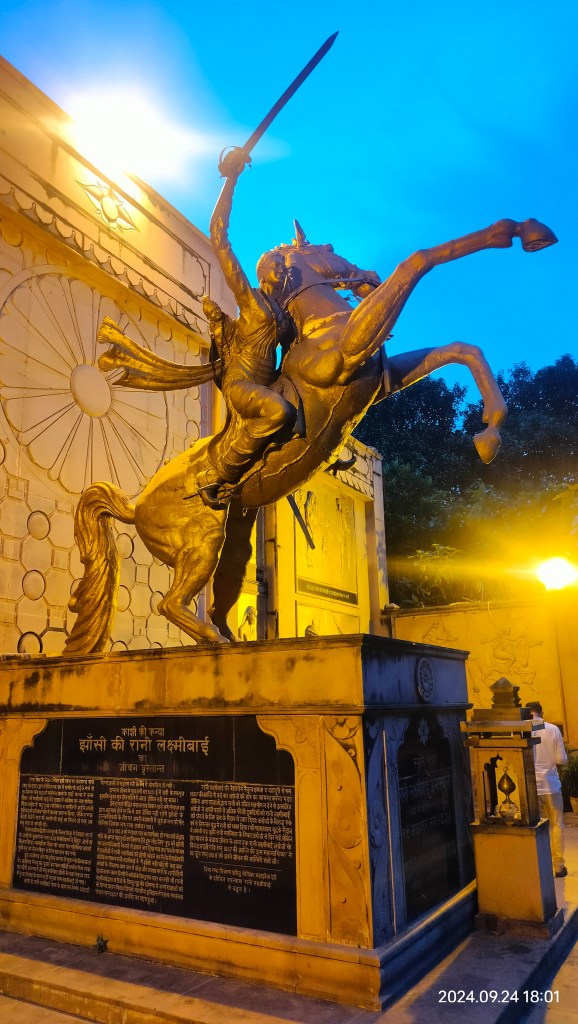
Video link of Rani Laxmibai Janmasthali of Jhansi
Attraction 2: Tulsi Ghat
A few meters from the Rani Lakshmi Bai Janma Sthali is Tulsi Ghat. This is a very sacred place where Goswami Tulsidas composed the Ramacharitmanas, which is by far the most popular rendition of the Ramayana in North India. Today, there is a small temple here that offers an excellent view of the Ganga.
I walked back to the main road and hired an auto to visit the Durga Temple.
Attraction 3: Durga Temple
This is one of the important temples in Varanasi. It is built in a striking red hue, symbolizing the power and energy of Goddess Durga, with tall spires and intricate carvings. The temple is believed to have been constructed in the 18th century by a Bengali Maharani (queen).
Attraction 4: Tulsi Manas Mandir
This temple holds historical and cultural significance and was built by Thakur Das Surekha from Kolkata in 1964. The temple is made of white marble, with verses and scenes from the Ramcharitmanas engraved on the walls throughout the temple.
[Pics from Tulsi Manas Mandir]
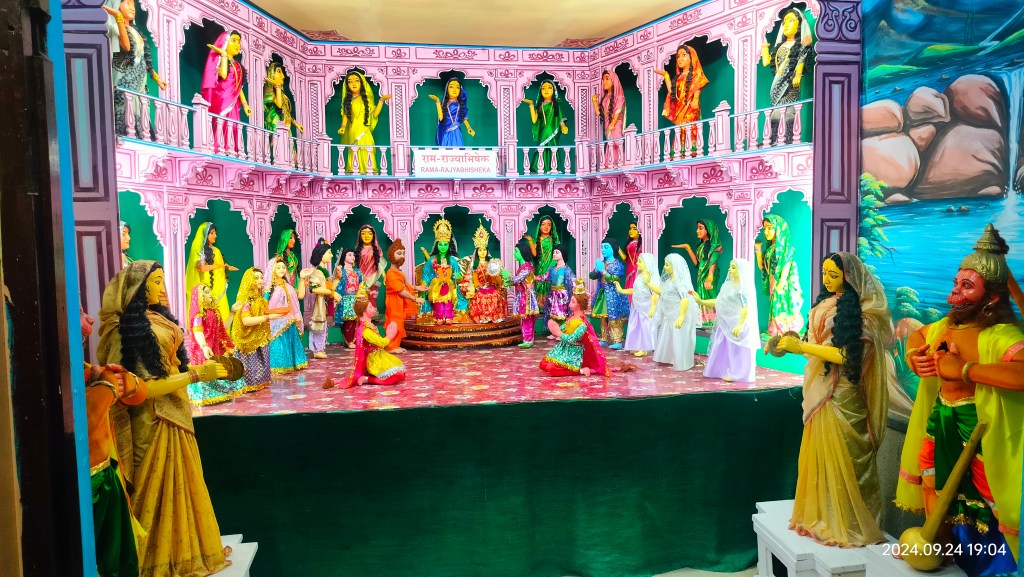
[Video link from Tulsi Manas Mandir]
We had dinner at Nathu Sweets and Restaurant, ending a long day.
25-Sep-24
I woke up at 5:00 AM and quickly travelled to Assi Ghat to witness the morning Ganga Aarti. I was hoping for a smaller crowd at such an early hour, but there were already quite a few devotees present. However, I was able to view the grand aarti, performed by five pandits in perfect unison. It was an electrifying experience to see the lamps swaying amidst the chanting of hymns and mantras.
[Video links of Ganga Aarti]
After the aarti I visited Tulsi Ghat ghat to view the sunrise on Ganga. witnessing the sunrise on the Ganga is a deeply spiritual experience. As the sun casts a golden glow across the Ganga , the rays reflect off the waters, creating a stunning visual effect. The temples bells were ringing behind me adding to devotional atmosphere
Sunrise from Tulsi Ghat
[Video link of sunrise from Tulsi Ghat]
Attraction 5: Galis of Varanasi
My next destination was the Nepali Temple on Lalita Ghat. I took an auto to Godowlia Chowk and walked the rest of the way. It should be noted that Godowlia Chowk is where all transport ends, and one needs to walk or take a cycle rickshaw for the remaining distance to the Kashi Vishwanath Temple and nearby areas.
I tried my best to follow the path using Google Maps but frequently lost my way. The lanes (called galis) are quite narrow, and it’s best to ask for directions. The locals are friendly and helpful. These galis are a fascinating labyrinth with ancient temples, small restaurants, and quaint homes around every corner. Though narrow, the galis are fairly clean without open garbage dumps. The video below gives an idea.
Unexpectedly, I arrived inside the Kashi Vishwanath Corridor! Though I had booked my Sugam Darshan ticket for 12:30 PM, I was in the corridor before 9:00 AM. I wandered around, admiring the new construction and overall infrastructure. I then bought a ticket priced at INR 150 for the Durlabh Darshan, which offers a virtual 3D experience of all the aartis conducted in the sanctum sanctorum of the main temple. The 3D experience is quite impressive, and I would recommend this 11-minute “darshan.”
The statues of Ahilyabai Holkar and Adi Shankaracharya give due respect to the temporal and spiritual founders of the Kashi Vishwanath Temple.
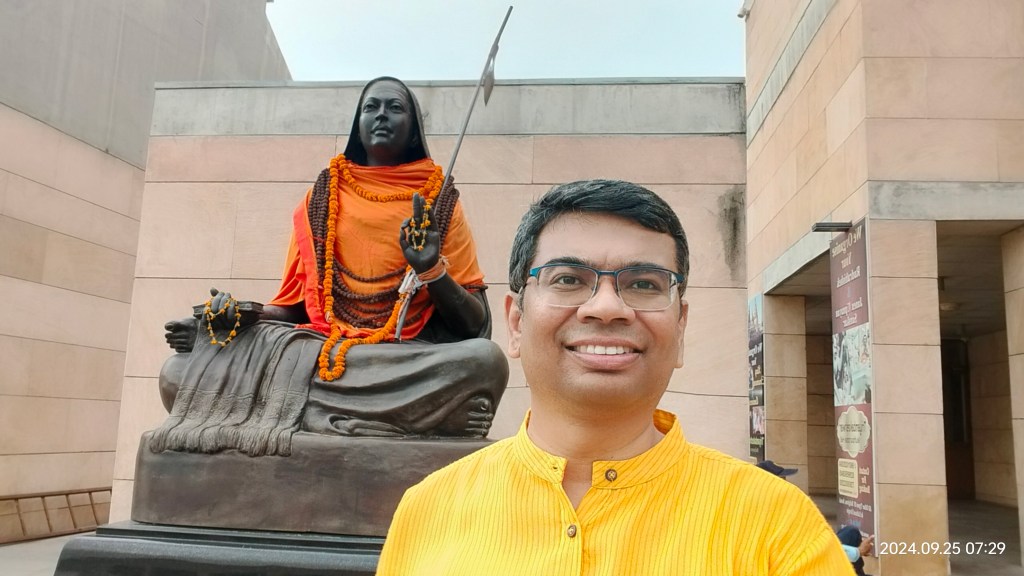
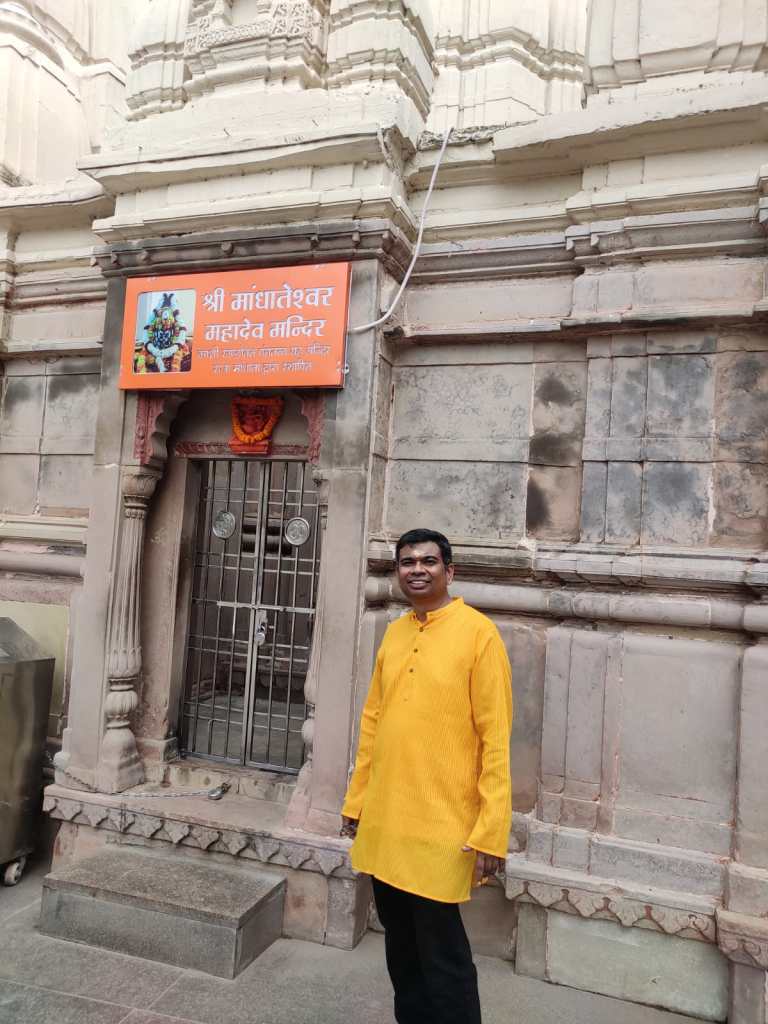
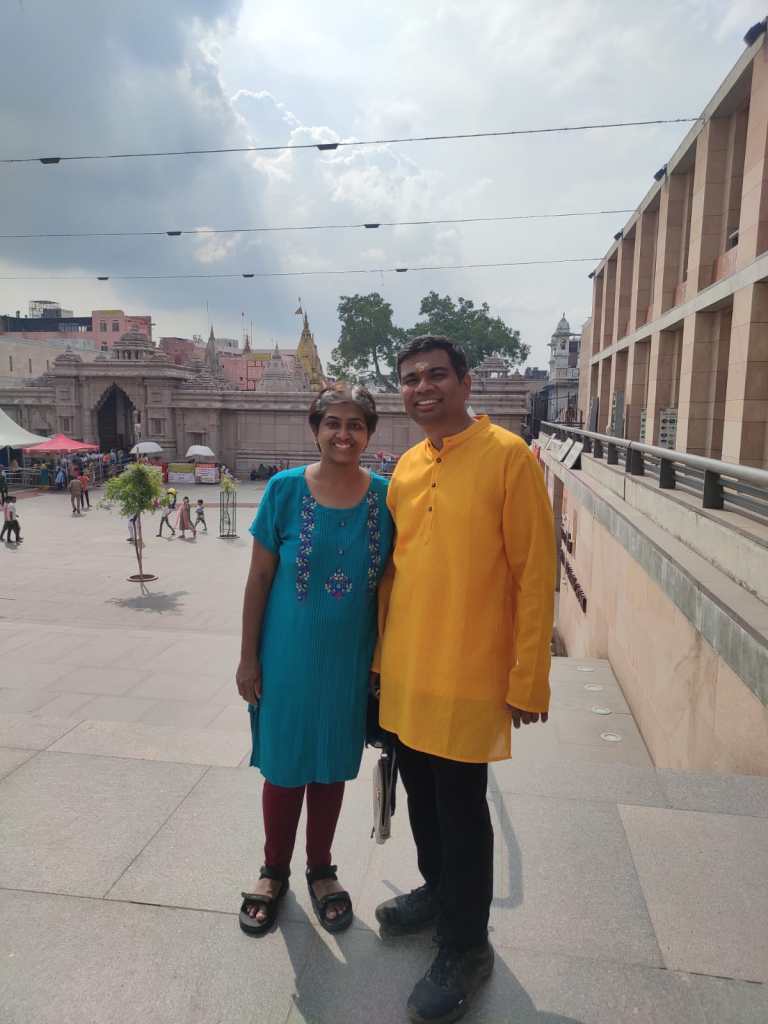
The link to the Kashi Vishwanath corridor is given below
I walked towards the Ganga, took darshan, and headed back into the galis of Varanasi. Unexpectedly, I came across Neelu Kachori Bhandar, famous for their breakfast kachoris, located in a lane called “Kachaudi Gali”! Undoubtedly, they were the best and crispiest kachoris I’ve ever had.
I visited the Man Singh Observatory, but it’s a very ordinary attraction and can be skipped.
That afternoon, around 12:00 PM, we left for the most important aspect of the entire vacation – the visit to Kashi Vishwanath Temple. I had booked Sugam Darshan tickets a few weeks earlier, hoping for an efficient darshan. Those with Sugam Darshan tickets need to enter through Gate 4 and can keep their mobiles after entering. The system and crowd management were excellent, and we had darshan of the Jyotirlinga in about 40 minutes. We also paid obeisance to other deities in the temple complex. The entire experience is documented in my blog – “Kashi Vishwanath Temple Visit.”
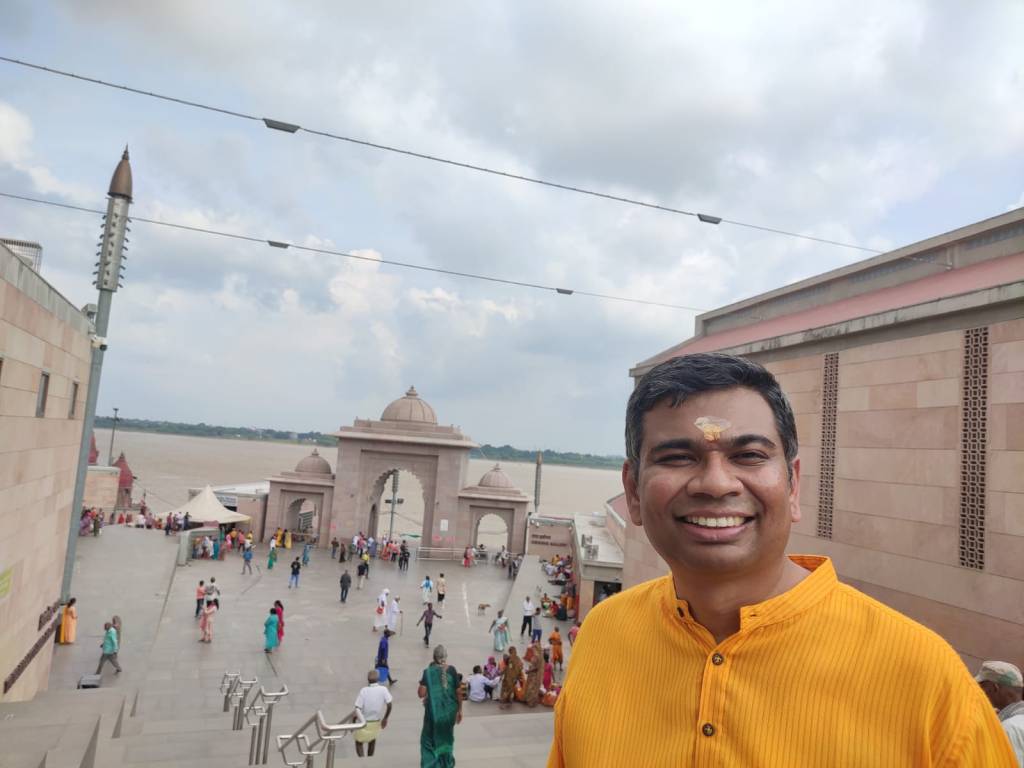
Post the darshan we had lunch in “Niyati café” in one of the galis and headed back to hotel for much needed rest
Attraction 6 : Sankat Mochan temple
This is one of most prominent temples of Varanasi and was restored and revived in 1900 AD by Madan Mohan Malviya , the founder of Banaras Hindu University. This site has a historical connection with Goswami Tulsidas who composed many of the devotional verses in this temple. This was one of targets of 2006 Varanasi bombing – in which ten devotees lost their lives. Today there is tight security and one needs to deposit mobile and bags before entering the temple.
This is quiet and tranquil temple and even the idol of Lord Hanuman has serene feature which reflects Hanuman’s compassionate and benevolent nature as a protector and reliever of sorrows (Sankat Mochan)
We ended one of the spiritually charged day – with memory of the darshan of the Jyotirlinga at the Kashi Vishwanath Temple
26-Sep-24
One of the most important activities in Varanasi is viewing the numerous ghats on the banks of the Ganga. There are a total of 84 ghats, each with its unique history and significance.
Ideally, I would have loved to walk from one end of the ghat to the other, but due to the recent floods of the Ganga, that was not possible. I had booked the Alaknanda cruise, which would take me on a large boat and provide information about various ghats.
The cruise departs at 08:00 AM and lasts for 90 minutes. As the cruise moves past each ghat, there is a recorded commentary that gives information about each of the ghats. This is an excellent way to view and learn about various historical sites along the banks of the Ganga.
The boarding point for this cruise is Ravidas Ghat, close to Assi Ghat.
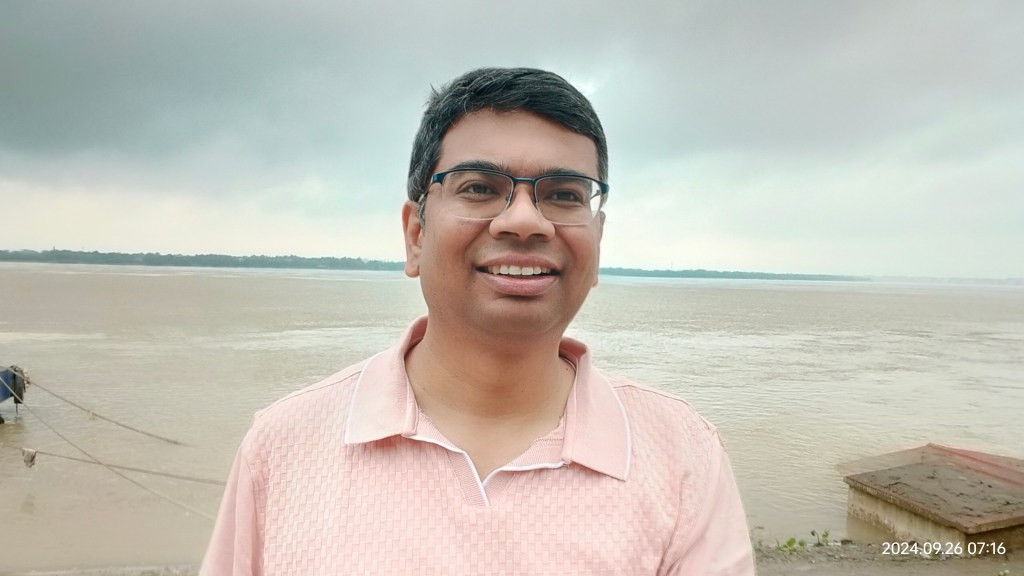
As the cruise started, I was on the top deck, taking in the enormity of the Ganga.
[Video of the Ganga river as seen from the cruise]
[Video of Dasashwamedha Ghat from the cruise]
[Video of Manikarnika Ghat from the cruise]
[Video of Chet Singh Ghat from the cruise]
I alighted from the cruise and went back to the hotel. That day, we had planned to visit the holy city of Sarnath, located about 12 KMS from Varanasi.
We hired an Uber taxi and were on our way. Varanasi is much more than a temple town; there is thriving economic activity across manufacturing, public sector undertakings, and handloom industries. The city appears to be quite prosperous, with numerous malls and showrooms and luxury cars visible everywhere. As in other cities, rising prosperity has resulted in traffic and noise pollution. We spent nearly an hour reaching Sarnath, a distance of mere 12 KMs!
There are quite a few places to see in Sarnath, which holds immense historical and spiritual significance in Buddhism. It is here that Buddha gave his first sermon after attaining enlightenment, marking the foundation of Buddhism.
I have listed a few of the places we visited in Sarnath:
[Picture of temples]
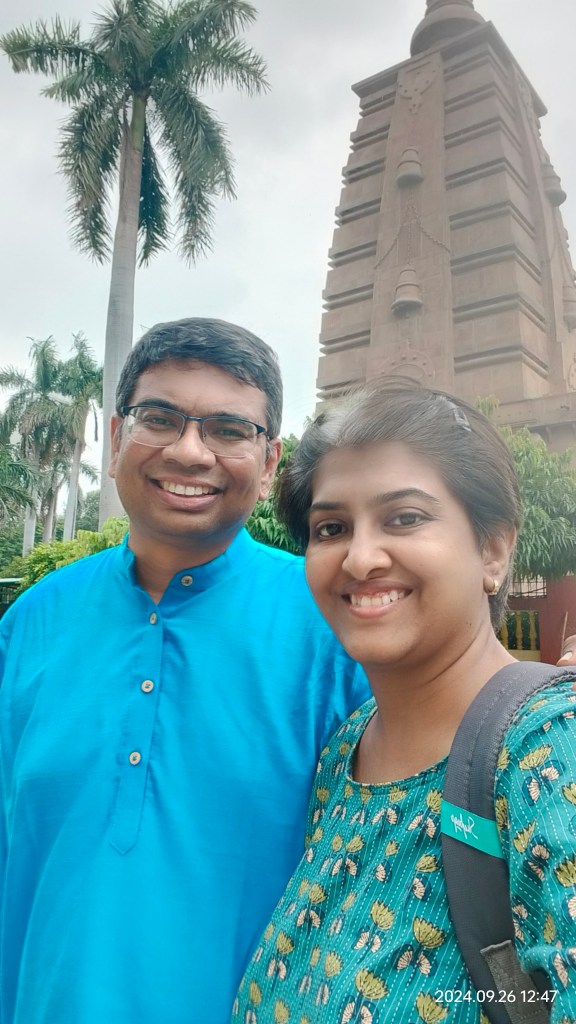
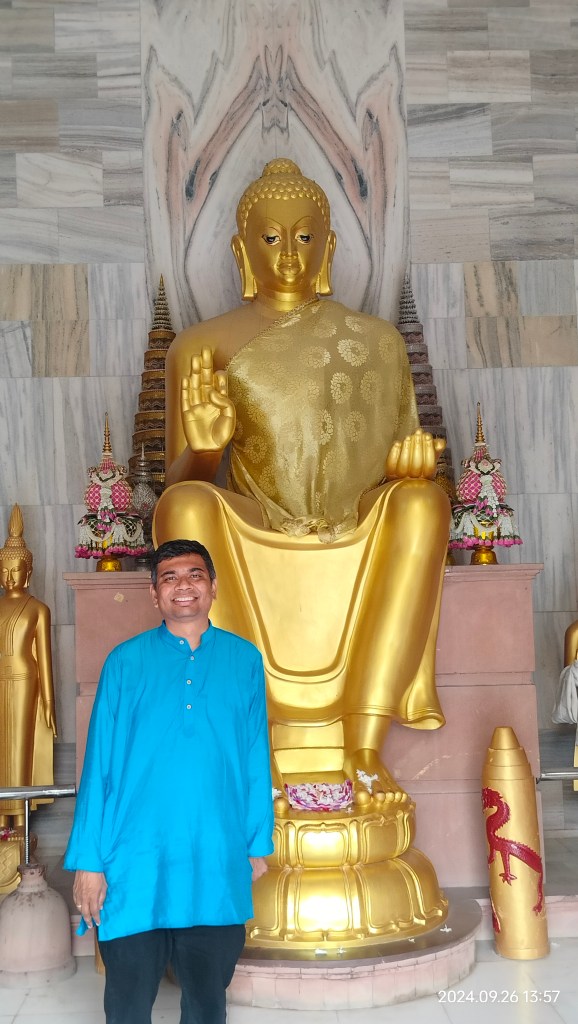
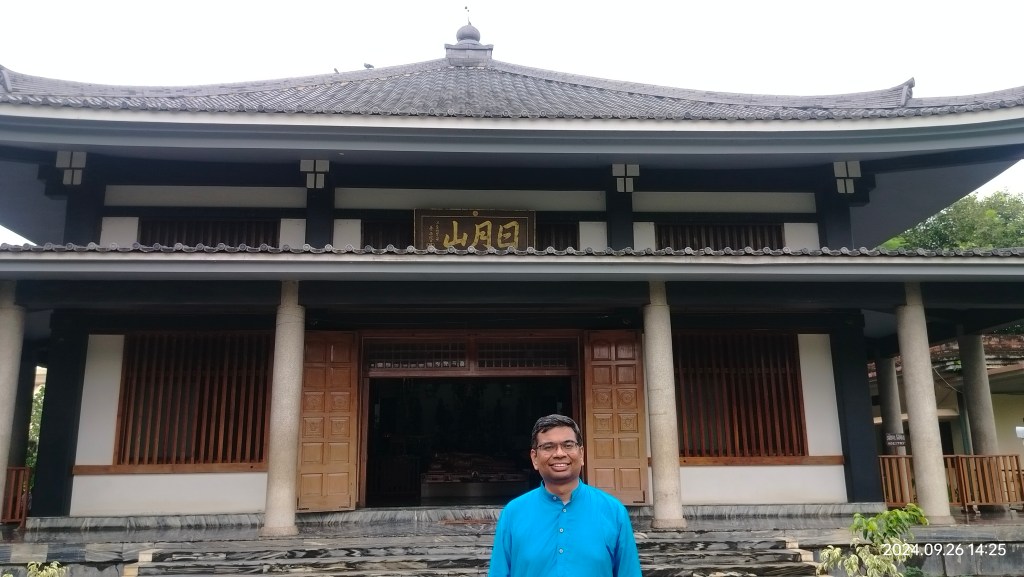
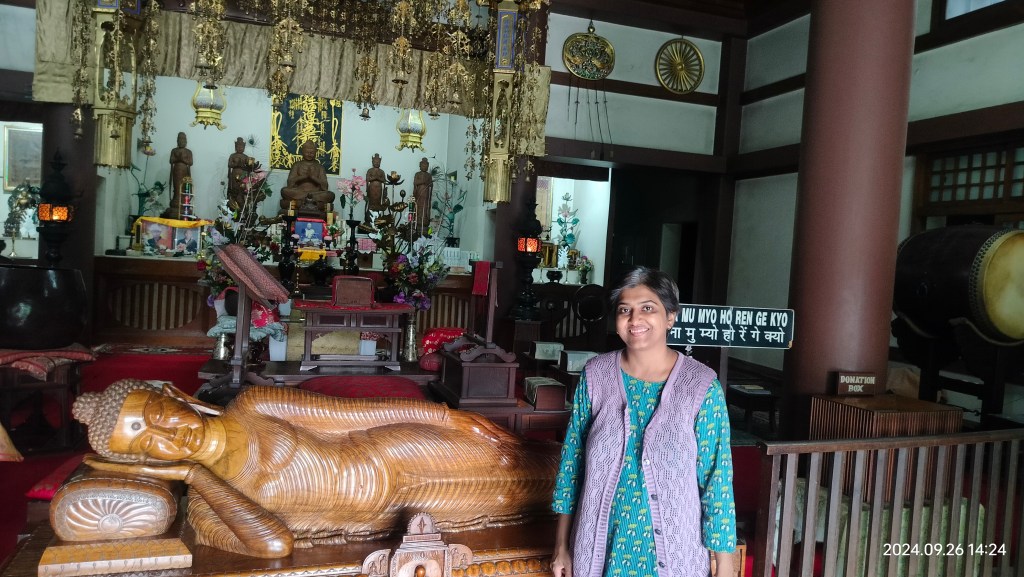
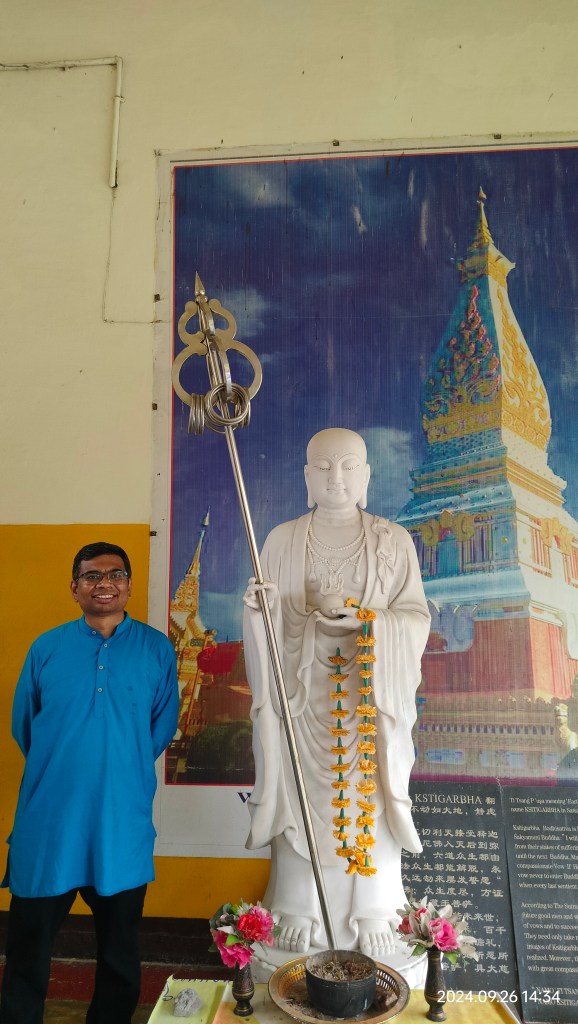
[Video link of the Thai Temple]
The Sarnath Archaeological Museum is a must-visit and contains India’s national emblem – Ashok Chakra. Also are some interesting sculptures of Lord Buddha and Shiva
We hired a taxi back to Varanasi and had lunch on the way. Overall, given the traffic condition and efforts require, one can skip Sarnath if there is time constraint.
That evening , Meenal insisted visit the famous chat shops near the main temple – Kashi chat Bhandar and Deena chat Bhandar. We had Tamatar ki -chaat and Palak papdi chat and found it quite unique
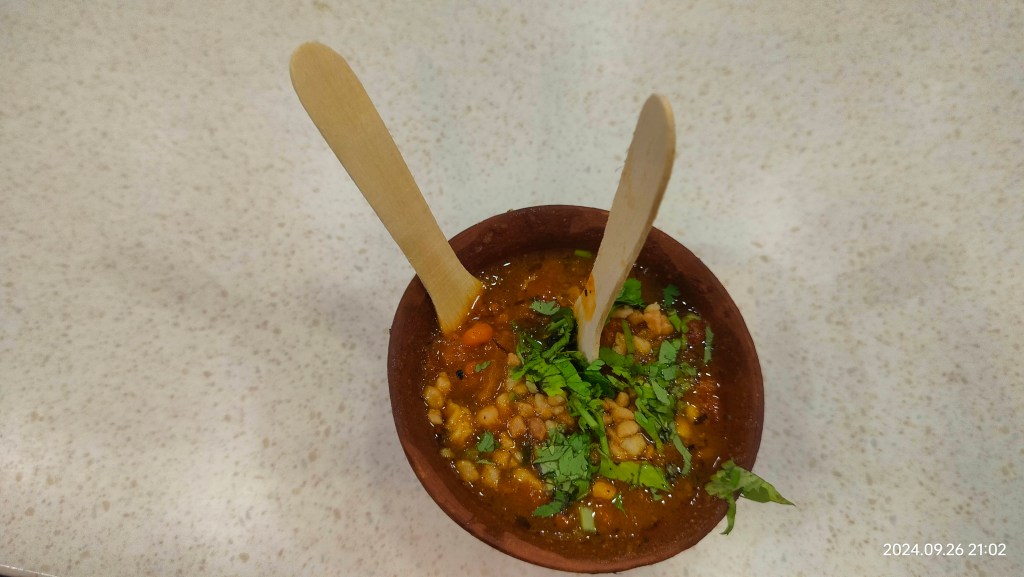
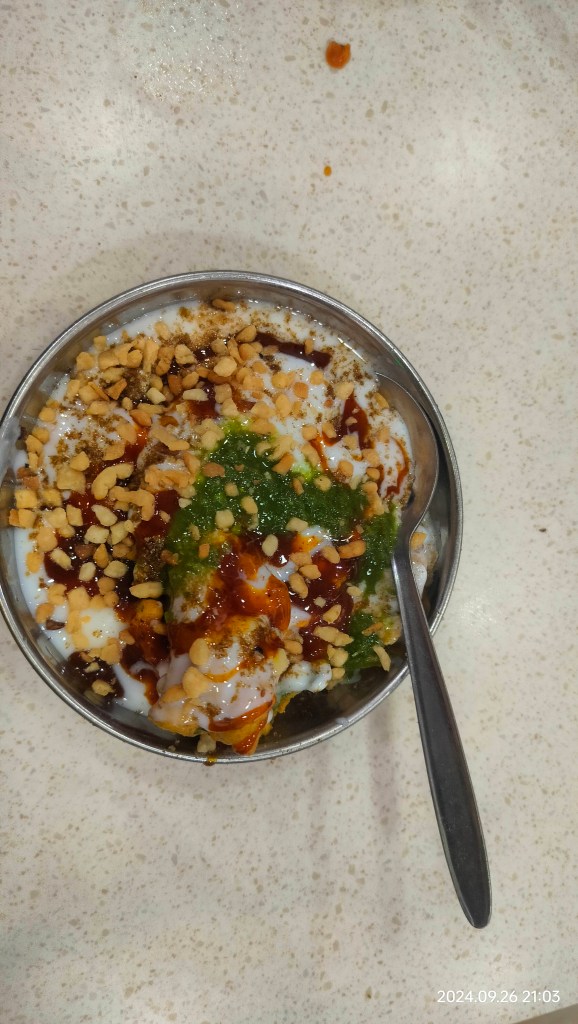
26-Sep-24
I woke early at 06:00 AM and headed towards Godowlia Chowk to view the other important temples of Varanasi.
I first visited the Kaal Bhairav Temple—a fierce form of Lord Shiva, known as the “Kotwal” or guardian deity of Varanasi. Kaal Bhairav is believed to protect the city and its people. However, there was a very long queue outside the temple even at this early hour. I paid my obeisances from outside the temple and walked to another temple in the vicinity: Mrityunjay Mahadev Temple.
Attraction 7: Mrityunjay Mahadev Mandir
This is an ancient temple dedicated to Lord Shiva in his form as “Mrityunjay,” the conqueror of death. It holds significant spiritual importance among devotees who believe that praying here can protect them from untimely death and ensure good health. The temple houses a natural water spring that continuously flows into a small pond within the temple premises.
[Link to video of Mrityunjay Mahadev Mandir]
I then walked back to the ghats and descended to Manikarnika Ghat. It is the most sacred ghat in Varanasi, known primarily as a major cremation site, and holds religious significance due to its association with life, death, and salvation.
The ghat is also a place where the religious rites for the departed are conducted. Viewing the ceremonies on mundan (ritual shaving of the head), pind daan, and shraddha can be a deeply moving experience. It makes one reflect on the ultimate reality of all living beings and the sorrow of those who are left behind.
[Link to video of Manikarnika Ghat]
I spent a few minutes in a meditative mood at Manikarnika Ghat and then made my way back to the hotel.
One should be ready to walk while seeing the temples and ghats in Varanasi. The galis are too narrow for any vehicles, and motorized vehicles are banned on many roads close to the main temple.
On way back I visited the Maa Sankata Devi Temple near Sindhia Ghat
The next destination was Banaras Hindu University (BHU), which had two attractions: the New Vishwanath Temple and the Bharat Kala Bhavan Museum.
Attraction 7: New Vishwanath Temple
Though called “New,” the construction of this temple started almost a hundred years ago, under the patronage of the illustrious Birla family. It is made mostly of marble and stands at 77 meters, making it one of the tallest temples in India. It is inspired by the main Kashi Vishwanath Temple, with Lord Shiva as its main deity. However, there are multiple other shrines in the complex.
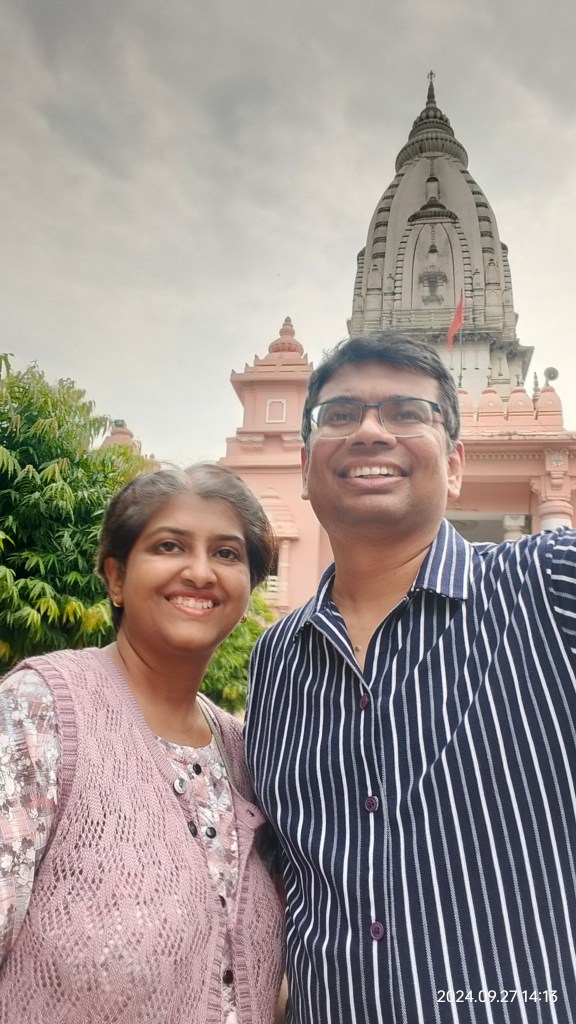
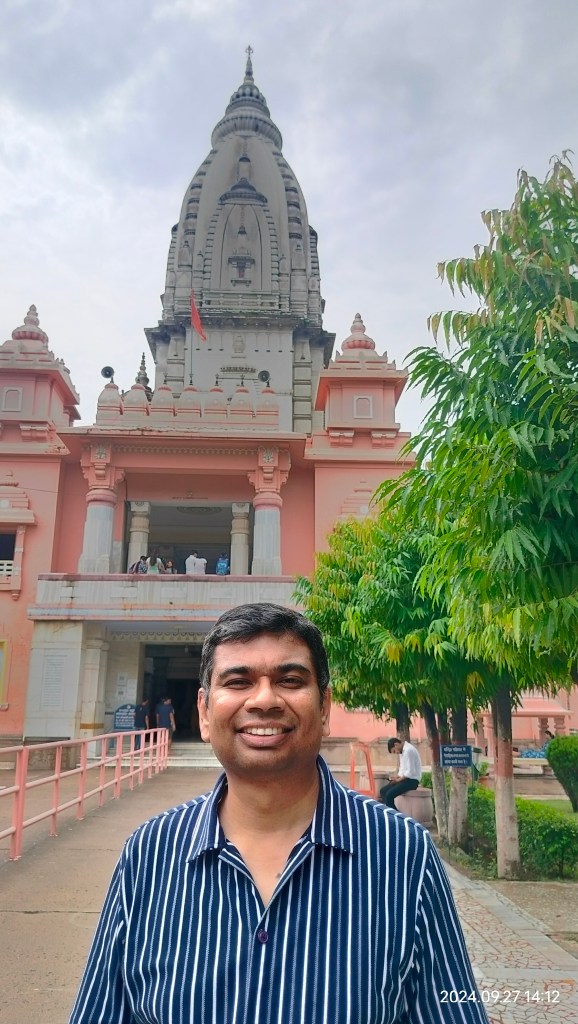
This modern, well-maintained, and sparsely crowded temple is excellent for meditation and prayers. The only “devotees” are the students of BHU, who appear to use the temple premises more as a “hang-out” than as a place of piety.
[Link to video of New Kashi Temple]
[Link to video of interiors of New Kashi Temple]
Attraction 8: Bharat Kala Bhavan Museum
This is one of the oldest museums in India, established in 1920, and has some remarkable artifacts. In the book ‘Benares: City of Lights,’ the author repeatedly references the artifacts of this museum. The sculptures and paintings are well preserved and provide good insight into medieval Varanasi.
Mobile phones are not allowed in this museum, nor in the Sarnath Archaeological Museum. Though one cannot fathom the logic, it is a welcome move. In recent times, the mobile phone has become “public nuisance number one”—with youngsters busy taking selfies and creating reels, while the older generation is on video calls or watching videos on speakers. In fact, a group of girls was creating reels within the New Vishwanath Temple!
Without their mobile phones, the students in the museum just linger for a few minutes and then depart. I was fascinated by “pata-chitra,” the scroll painting from Bengal and Odisha. These depict stories from mythology and are richly coloured. Surprisingly, the brightness of the colours lasts for decades!
The rest of the evening was spent packing and getting ready for our next destination—Ayodhya!
28-Sep-24
At 07:30 AM, we boarded a taxi to head towards Ayodhya—the birthplace of Lord Ram. While there was excitement to visit this holy site, it was a sad farewell to Varanasi.
As I left the ancient city, I was filled with reverence. It is more than just a destination; it is an experience that transcends the physical and touches the spiritual. The temple of Kashi Vishwanath, the devotees ceaselessly chanting “Har Har Mahadev,” and the shraddha ceremonies on Manikarnika Ghat—all represent an interplay of various aspects of life, death, and devotion. The memories of these moments are etched in my mind for a lifetime.
“Where should we go for a vacation?” I pondered as I had a week-long break and aimed to make the most of it.
I explored several destinations such as Pondicherry, Mahabalipuram, and even Varanasi. Varanasi topped my list, but the flight tickets were exorbitant. Due to the duopoly of Indigo and the Tata group, I have noticed that flying has become unaffordable on many routes.
Finally, we settled on Goa by default, based on my belief that “one never regrets going to Goa.”
This time, I opted to split our stay into two parts for better exploration. We planned to spend the first two days in Palolem and the next three in Cavelossim, in the central part of Goa.
On March 21, 2024, we disembarked from the Bangalore – Karwar express at the quaint Karwar railway station at 08:00 AM. This train is convenient for those traveling to South Goa as the Karnataka-Goa border is only 30 kilometers from Karwar.
After a smooth 45-minute drive, we arrived at our favourite homestay – Alba Rooms in Palolem. We had stayed here previously in Nov 2022 and appreciated its location – right next to the beach!
The weather was pleasant considering it was almost the end of March. We wasted no time and immediately went for a dip in the sea; the white sand and clean beaches always entice us for a swim.
After lunch at our usual restaurant, we rested for a while and in the evening rode to Talpona beach, around 8 kilometers from Palolem.
The beach was a typical South Goa beach, quite clean, with few crowds and fewer shops.
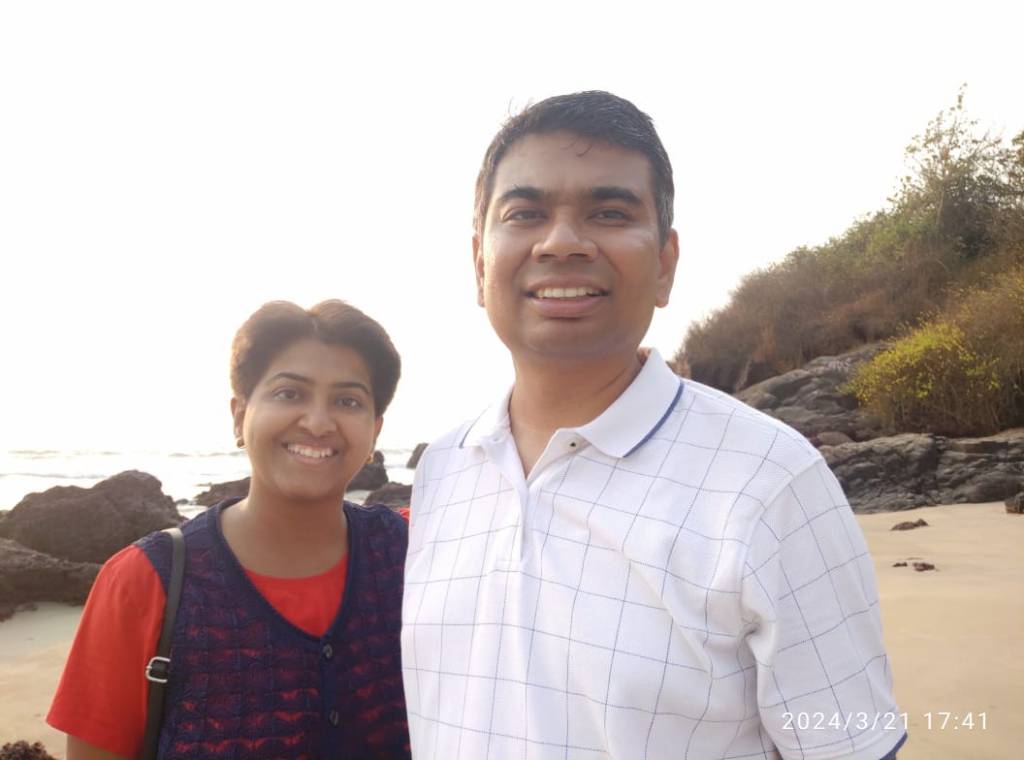
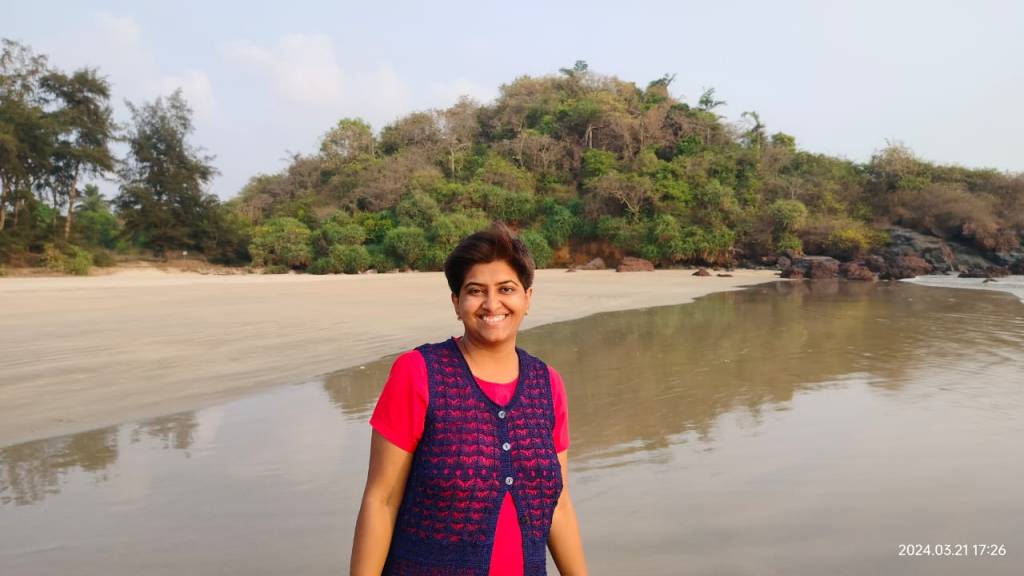
Video link to Talpona Beach is given below
To view the sunset, we went to nearby Galgibaga beach. This is the nesting ground for Olive Ridley turtles and hence commercial activity is completely banned here. It’s just long stretch of sand with Galgibaga river meeting the sea.
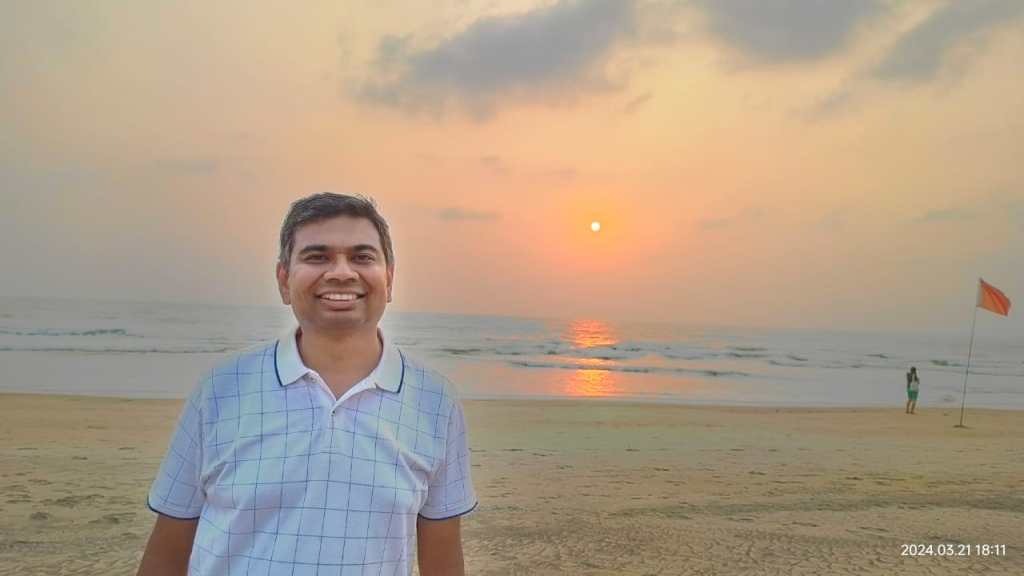
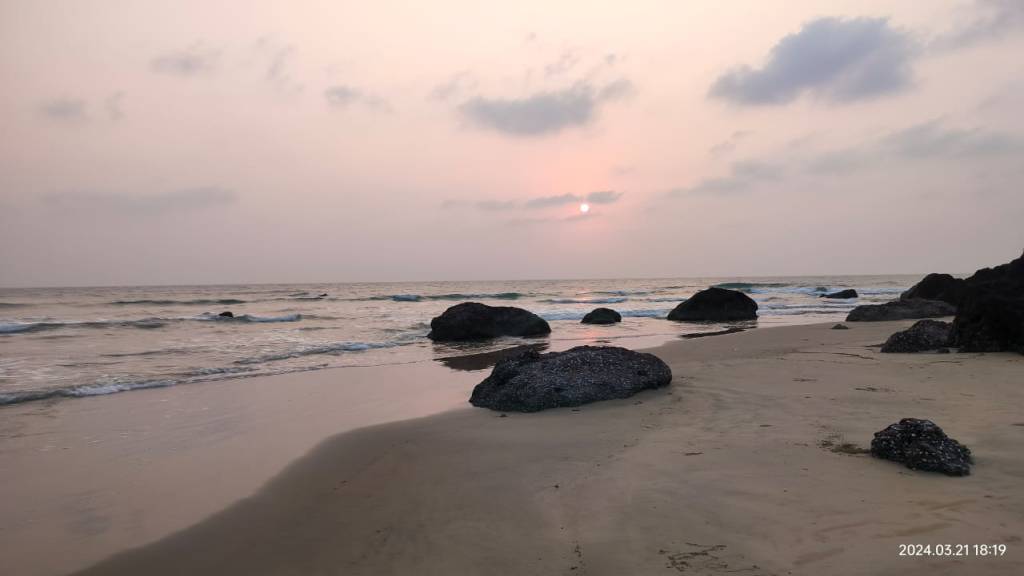
Video link of Galgibaga beach given below
That evening, our homestay manager informed us about the “Veera-mel” festival in Cancona. As part of this ritual, warriors with swords visit and bless specific houses in the village. The entire area was to be in darkness, with no lighting allowed on the road, nor inside any hotel or home. These Goan tribal-warrior customs bear unmistakable Kannada influence.
Though I was keen on witnessing these rituals, locals dissuaded me as the warriors could get quite aggressive and fearsome. Municipal authorities turned off the lights around 10:30 PM, and we spent the next couple of hours on the beach in darkness.
I heard some tourists complaining about this inconvenience, but in my view, we should respect the local customs and rituals. These traditions existed decades (perhaps centuries) before tourism appeared, and a couple of hours of darkness is a small price to pay to ensure their continuity.
On March 22, we embarked on some adventure and rode our hired Activa to a lesser-known beach – Kakolem.
These hidden beaches have gained popularity due to YouTube vloggers and Instagram enthusiasts. Equipped with the latest cameras and drones, they do an excellent job indeed!
After riding for about 15 kilometers on good roads, we reached a private property. After purchasing tickets for INR 50 per person, we proceeded towards the beach. We parked our Activa and walked for about 5 minutes to reach the cliff. The views from the cliff were spectacular.
We descended about 200 steps, passing through coconut groves, to reach the beach. The walk was not strenuous, and one could easily do it in about 20 minutes.
Kakolem beach is small, and though one can enter the water, swimming is not recommended. The highlight of this beach is the views of the water and the cliff. Post-monsoon, there are a couple of waterfalls on this beach.
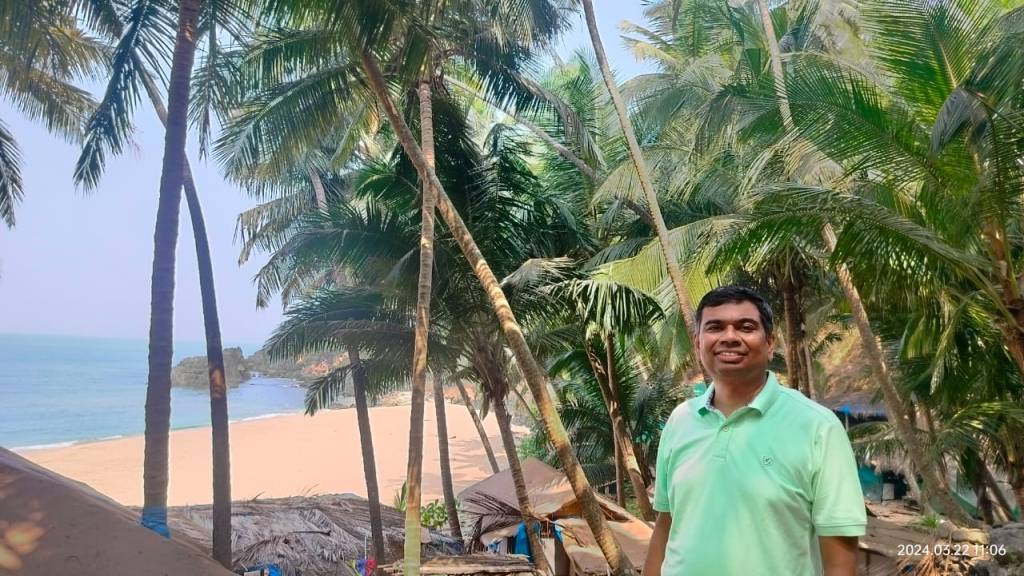
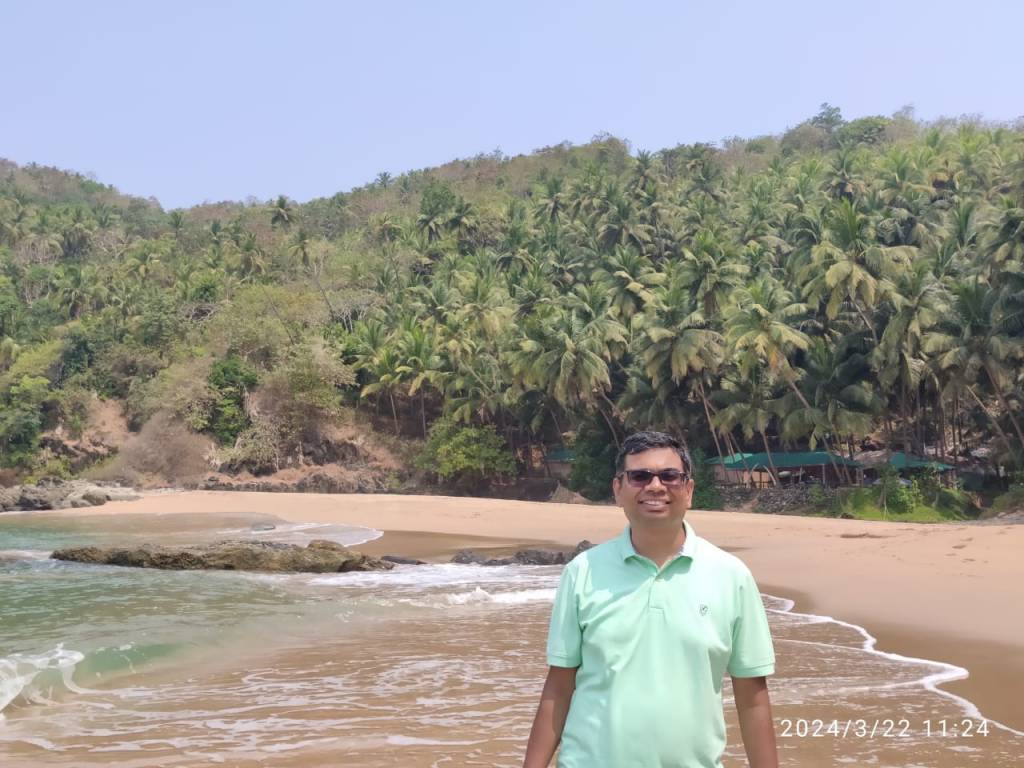
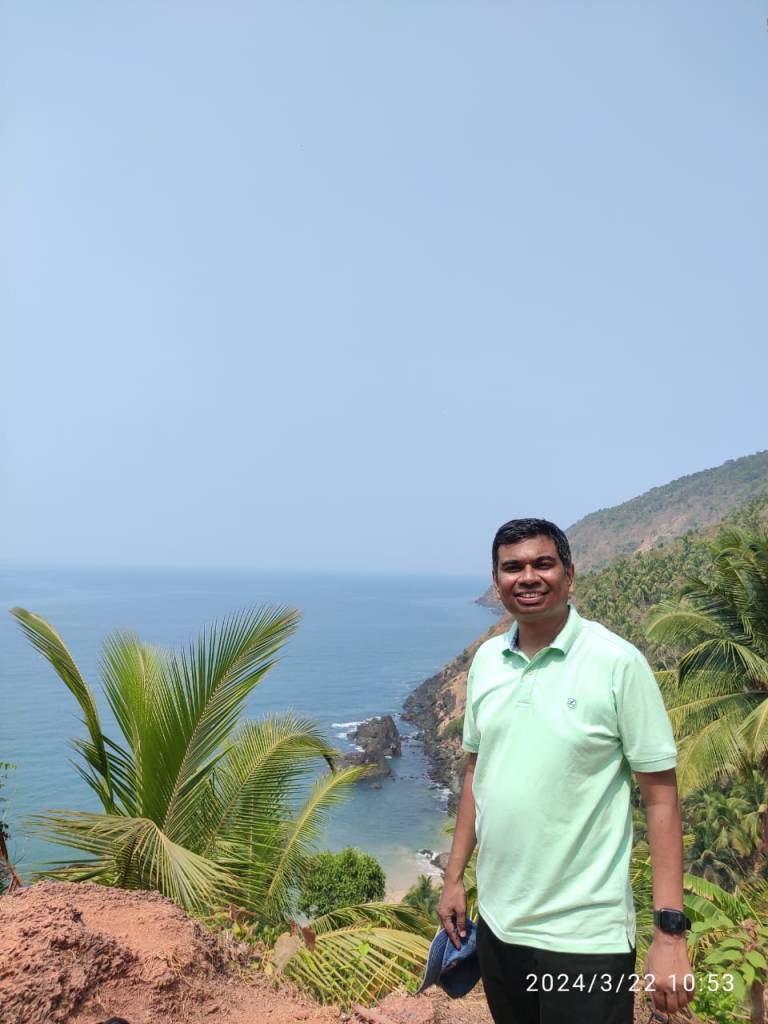
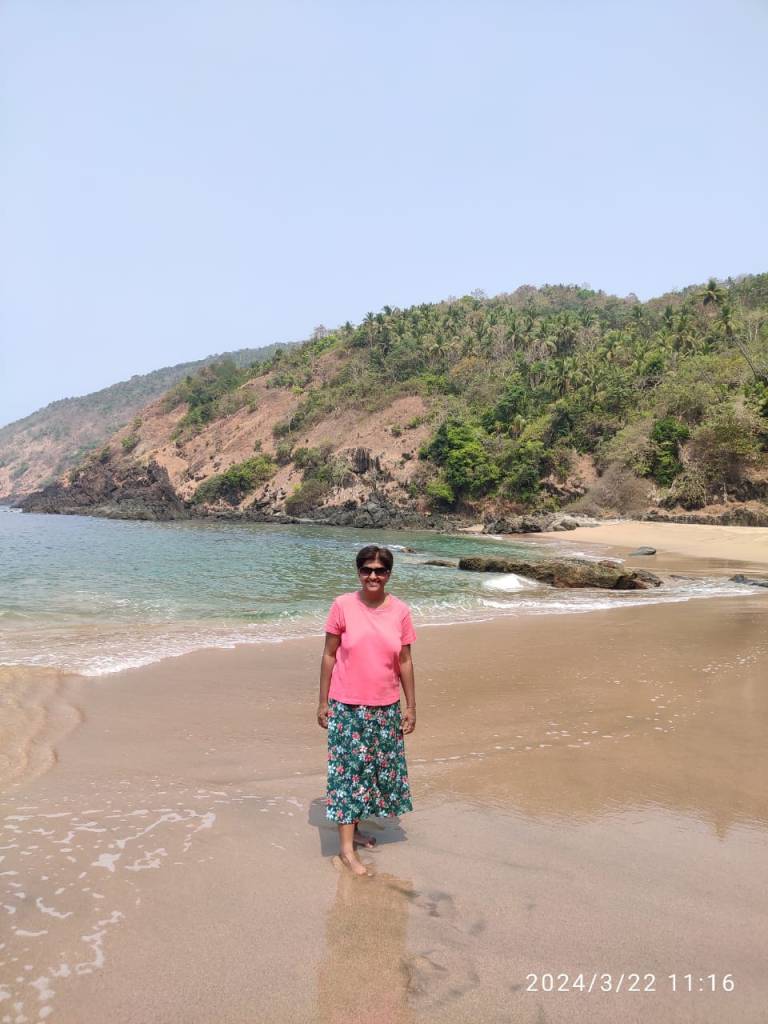
Video link of Kakolem beach given below
Kakolem beach resembles nearby Cola beach, which we had visited in 2022. However, I found Kakolem to be more serene and tranquil.
In the evening, we decided to visit my favorite beach in Goa – Rajbagh. This beach is just behind the Lalit Golf resort, and we need to ride through their property to reach it. The beauty of Rajbagh lies in the Talpona river merging with the Arabian sea.
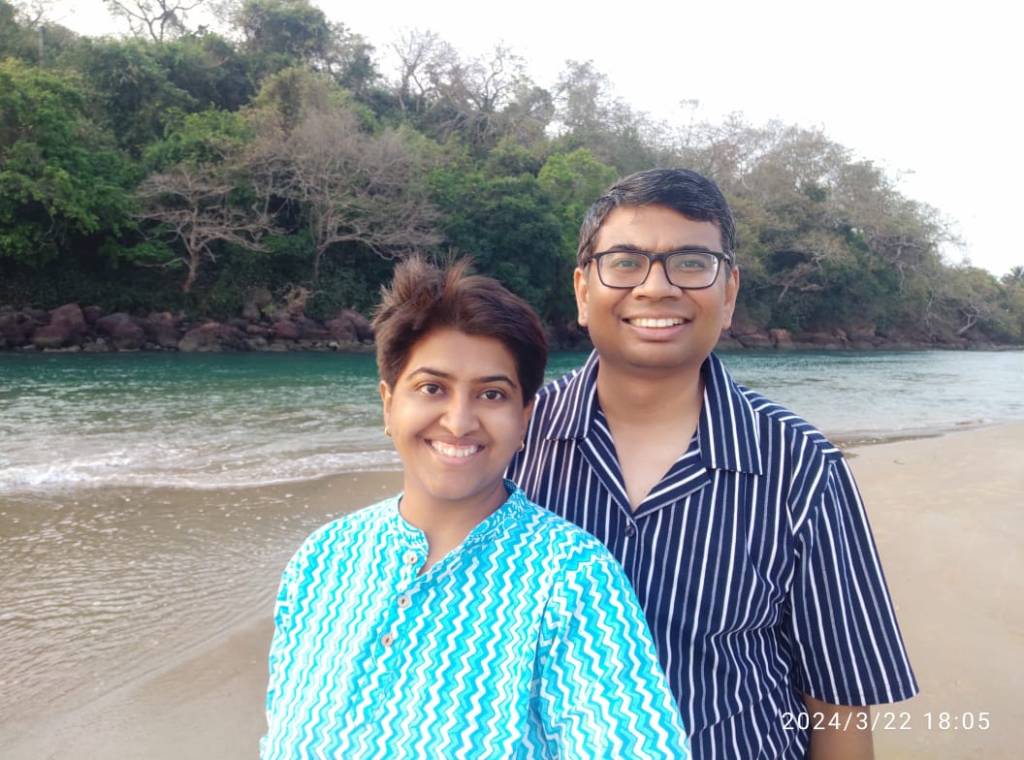
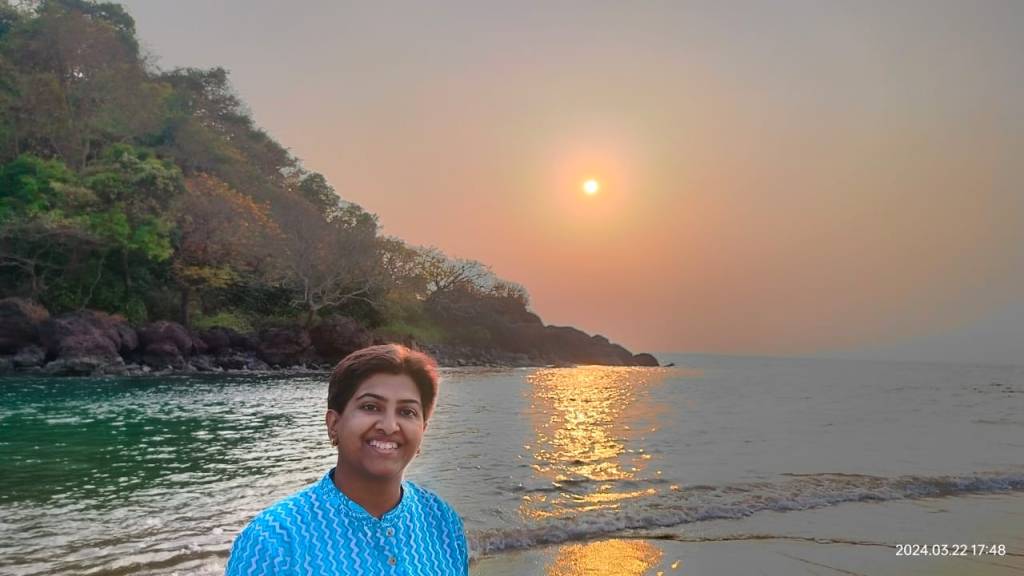
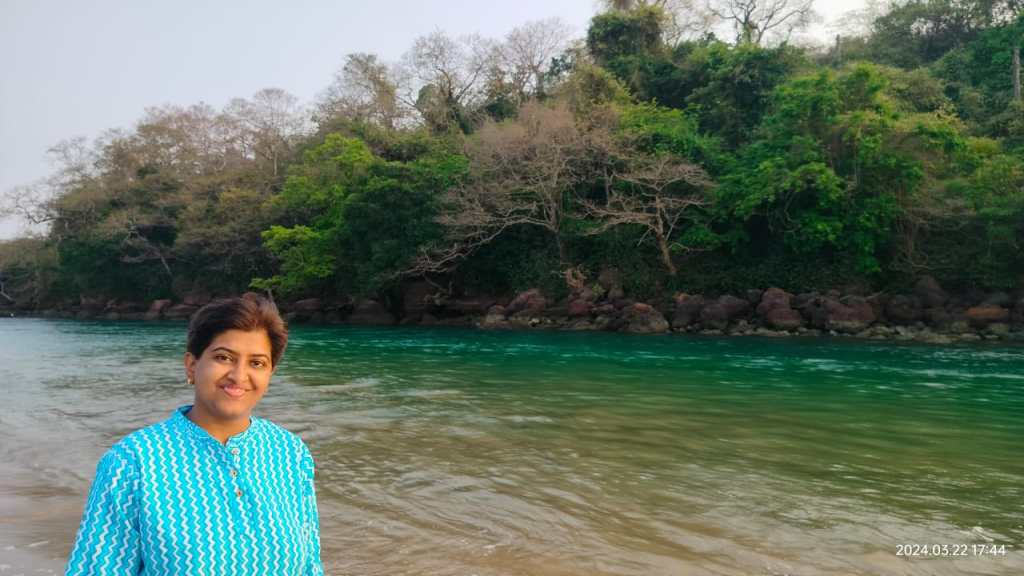
Video link of Rajbagh beach is given below
On March 23, we planned to stay in Cavelossim for the next 3 days. It is a village in South Goa close to Madgaon. We had not explored that part of Goa before and wanted to visit the nearby famous beaches of Varca and Colva.
After a smooth drive through the forest in a hired taxi, we reached our destination around 12 PM. I had booked our stay at Lobo’s Guest House, situated in a quiet village about 1.5 kilometers from Carmona beach. The location was straight out of a book – neat and tidy village, with a postman delivering letters and bread-delivery boys (called “poder” in Goa) on bicycles announcing fresh bread.
After hiring an Activa for 3 days (at INR 500 per day), we rode down to Betul beach, about 7 kilometers away. This area has many luxury resorts like Holiday Inn, Radisson Blu, Karma Haati Mahal, etc., and a few high-end shopping areas. Betul beach is another spectacular beach where the mighty Sal river meets the sea.
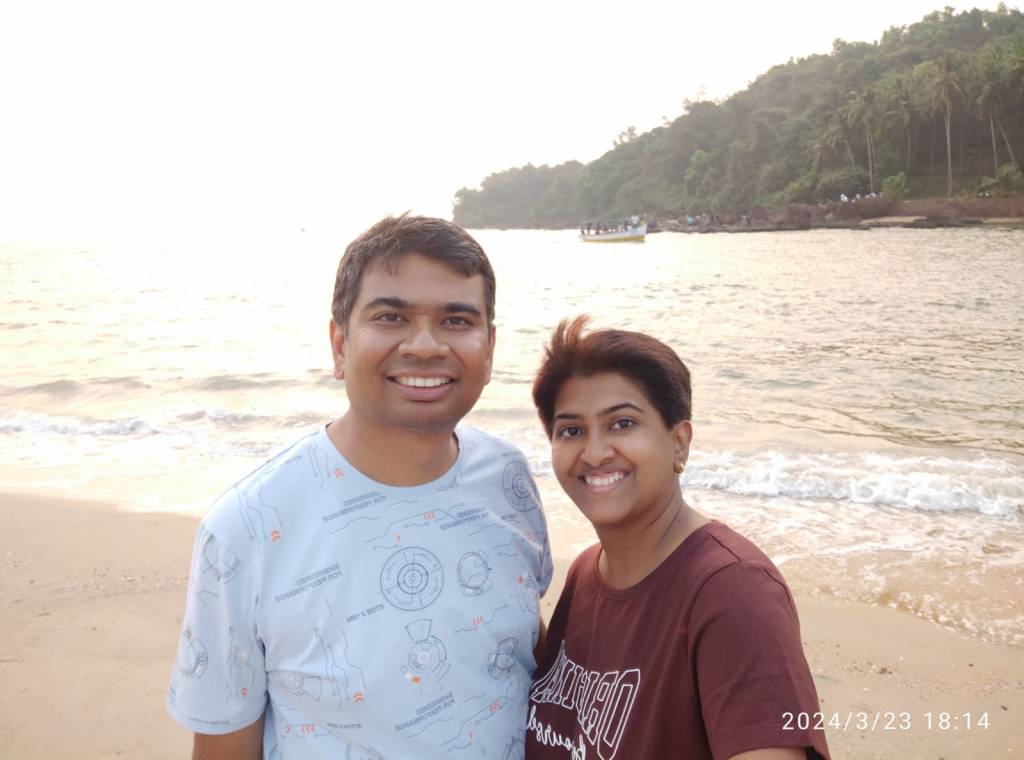
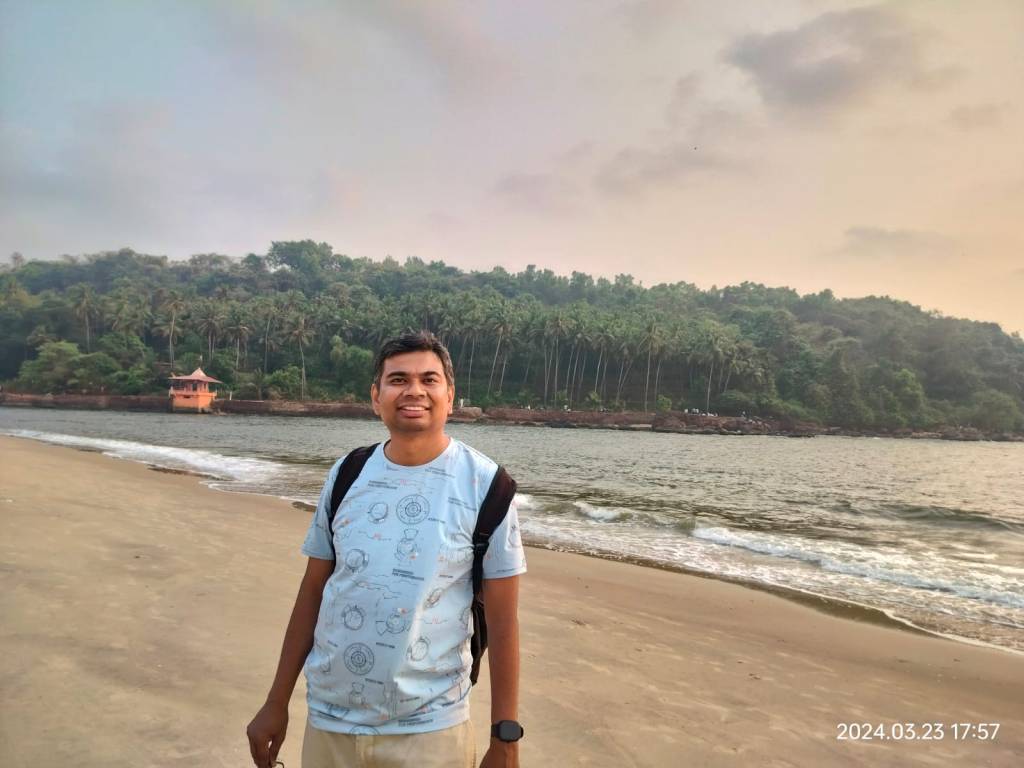
Video of Betul beach is given below
Every beach is unique, with different sands, vegetation, rocks, and infrastructure. I liked the gentle slopes and clear water of Betul beach and spent a long time walking in the shallow waters.
That night, we dined at Veggie-Delight, a vegetarian restaurant in Cavelossim. One disadvantage of staying in less popular areas is the scarcity of good restaurants. There are only a handful of restaurants in Cavelossim, and they are quite expensive compared to others in Goa.
On March 24, the morning was hot and humid, so we decided not to venture out too much in the sun. We visited the nearby Carmona beach for a dip in the cool waters of the sea. After a leisurely walk on the deserted beach, we relaxed for the rest of the afternoon.
Video link to Carmona beach is given below
For lunch, we rode to a famous restaurant known for its Goan cuisine and ordered Veg Xacuti. I liked the taste of this dish, but I was not sure if it was authentic. To me, it tasted more like the veg curry we get in Udupi vegetarian restaurants in Bangalore, with plenty of curry leaves and tomato gravy.
That evening, we rode to Varca beach, one of the more popular beaches in South Goa. After being misdirected by Google Maps (Google is not infallible!), we eventually reached the beach.
This is another long and beautiful beach, with white sands and water sports. Meenal was in an adventurous mood and decided to try parasailing. The whole idea of soaring up in the air for more than 50 feet over the sea was too bold for me. But Meenal soared like a bird and was in the air for around two minutes, enjoying the view of the entire beach and its surroundings from above!
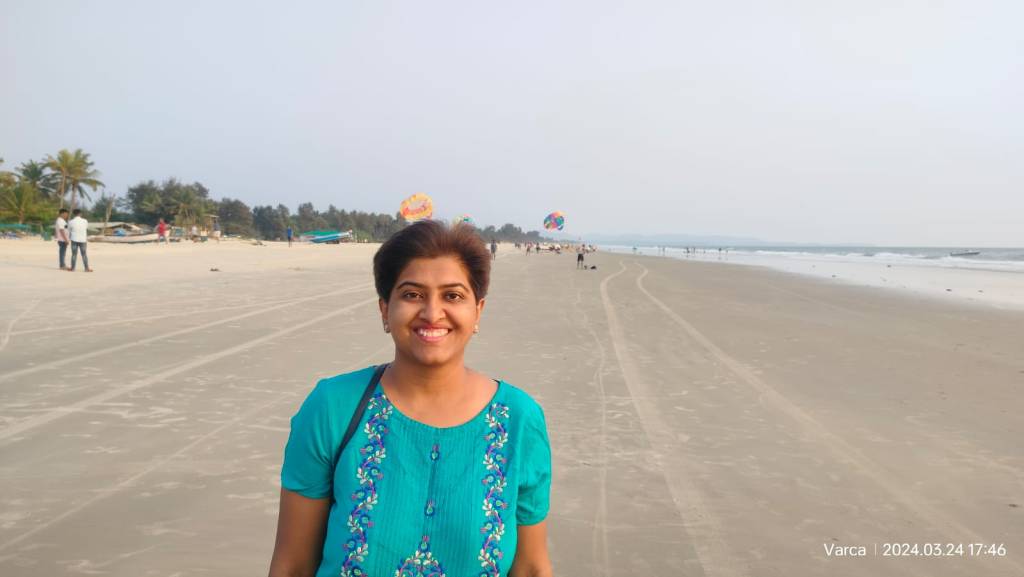
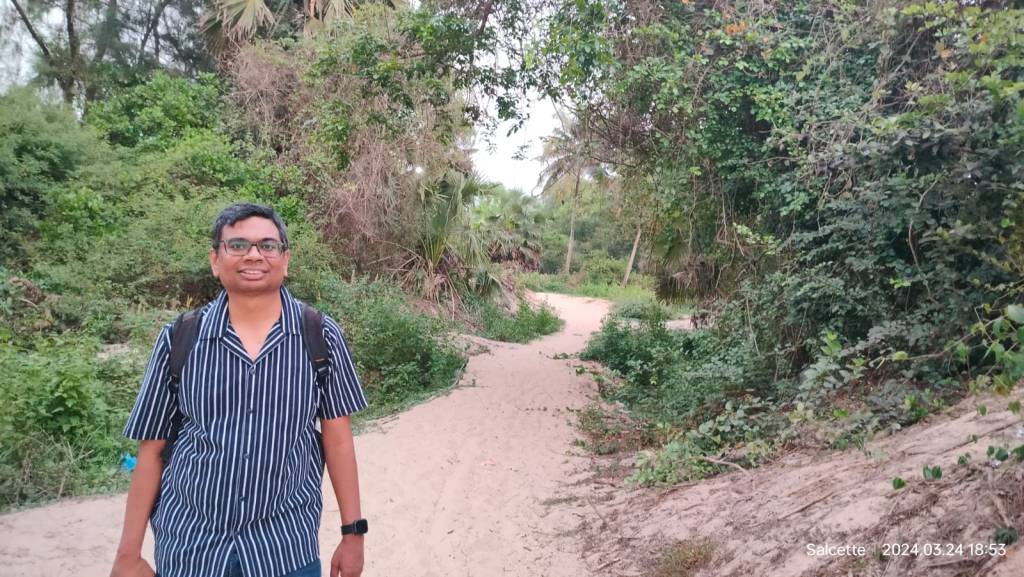
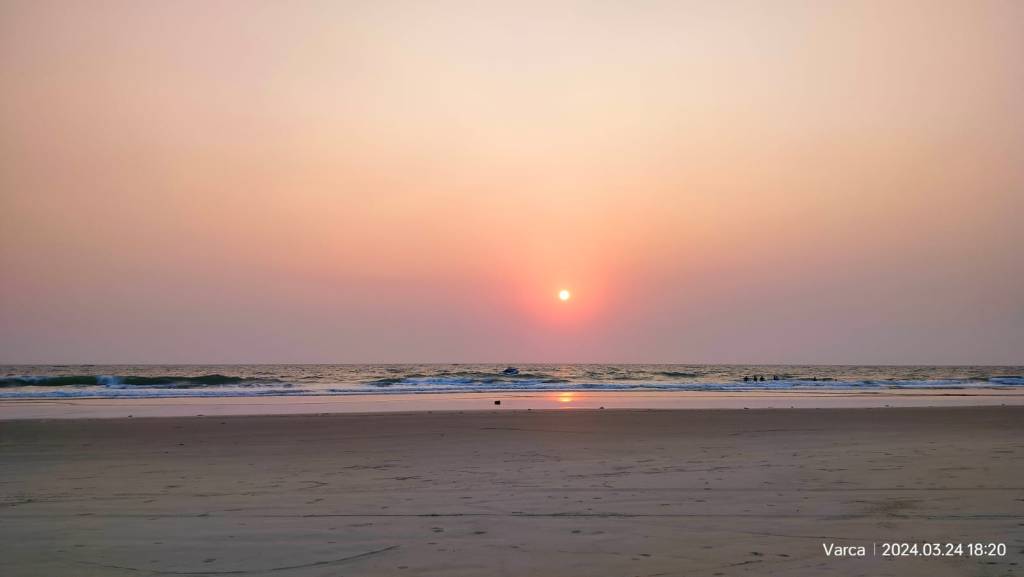
We watched the sunset from Varca and headed back to our homestay. I was quite impressed with the overall cleanliness of all the places we visited. There were cleaning crews almost everywhere, and the tourists were also cooperating by not littering. One must also commend the local government for excellent roads and good street lighting.
On March 25, our final day in Goa, we decided to visit the city of Madgaon, about 15 kilometers from Cavelossim. There is nothing specific to see in Madgaon, but it would be a change from our “beach darshan.”
Since I like museums in general, I paid a visit to the Goa Chitra Museum in Benaulim. This museum displays traditional implements, tools, and artifacts used by our ancestors. Though the entry price of INR 300 seems high, there is a personal guide for each visitor who explains the background of each artifact.
Some of the artifacts are indeed interesting, like the carriages, weaponry, and kitchen implements.
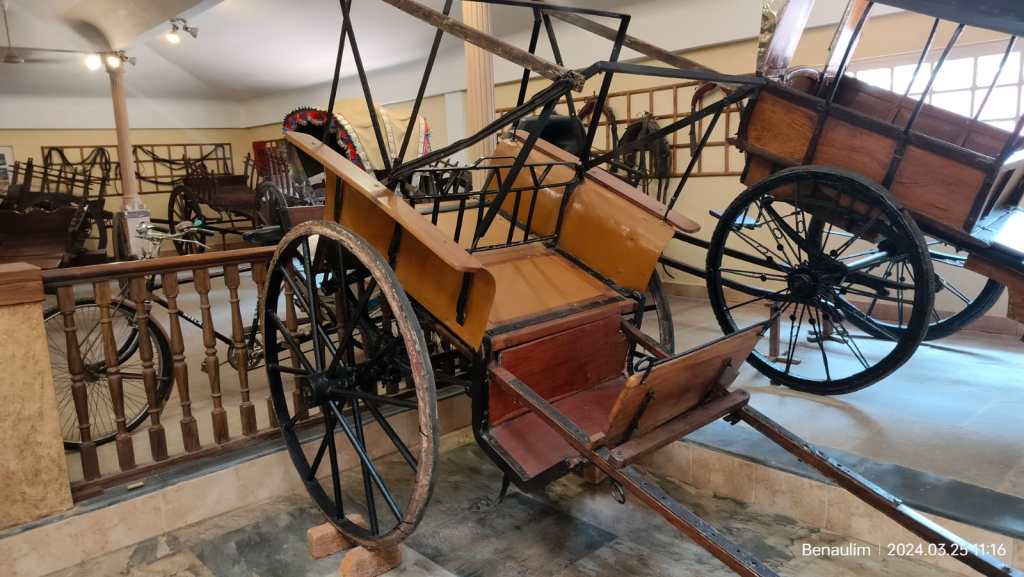
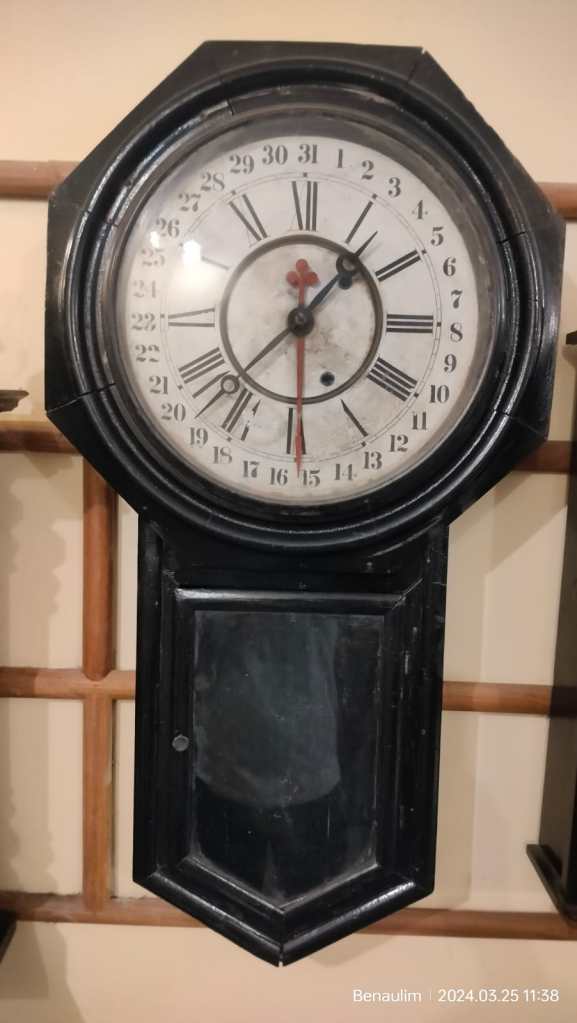
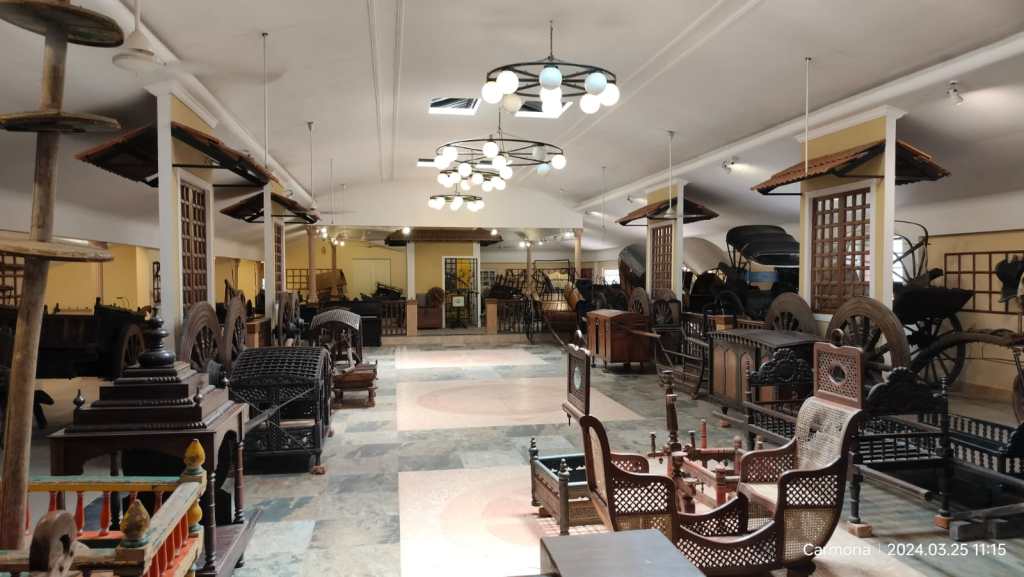
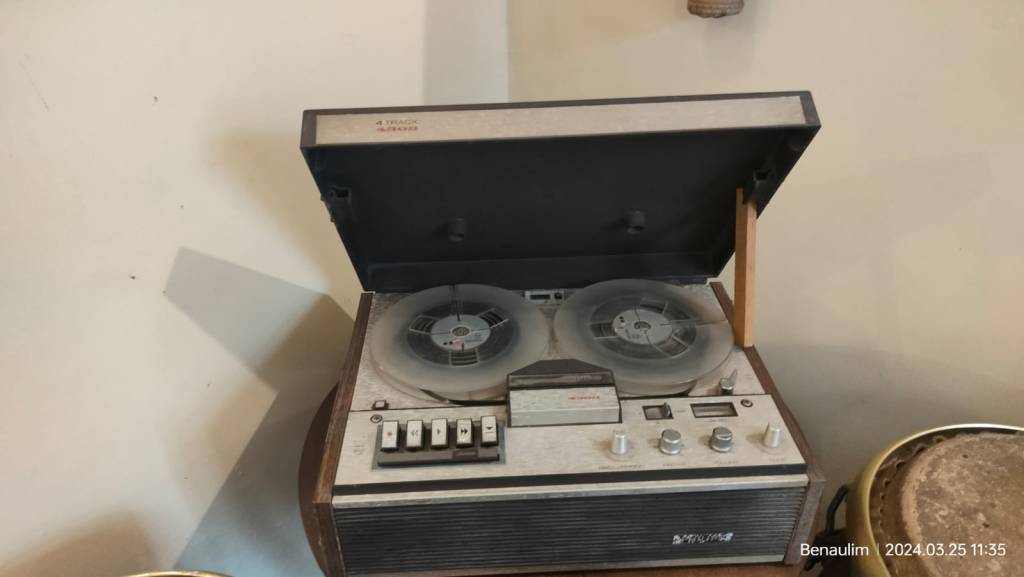
Since we visit temples on every vacation, we decided to visit the Sri Gajanan Maharaj Mutt in Madgaon. It is a well-maintained though small temple, and we received blessings there.
Madgaon is not as interesting a city as Panjim, and there is not much to see here. After lunch at the famous Navtara veg restaurant, we headed back to our homestay.
That evening, we decided to visit Betul Sunset Point, about 15 kilometers south of our homestay. Riding is a pleasure in Goa, thanks to thin traffic and good roads, and we covered the distance in about 30 minutes. The view from the cliff was mesmerizing and reminded me of Chapora fort in North Goa.
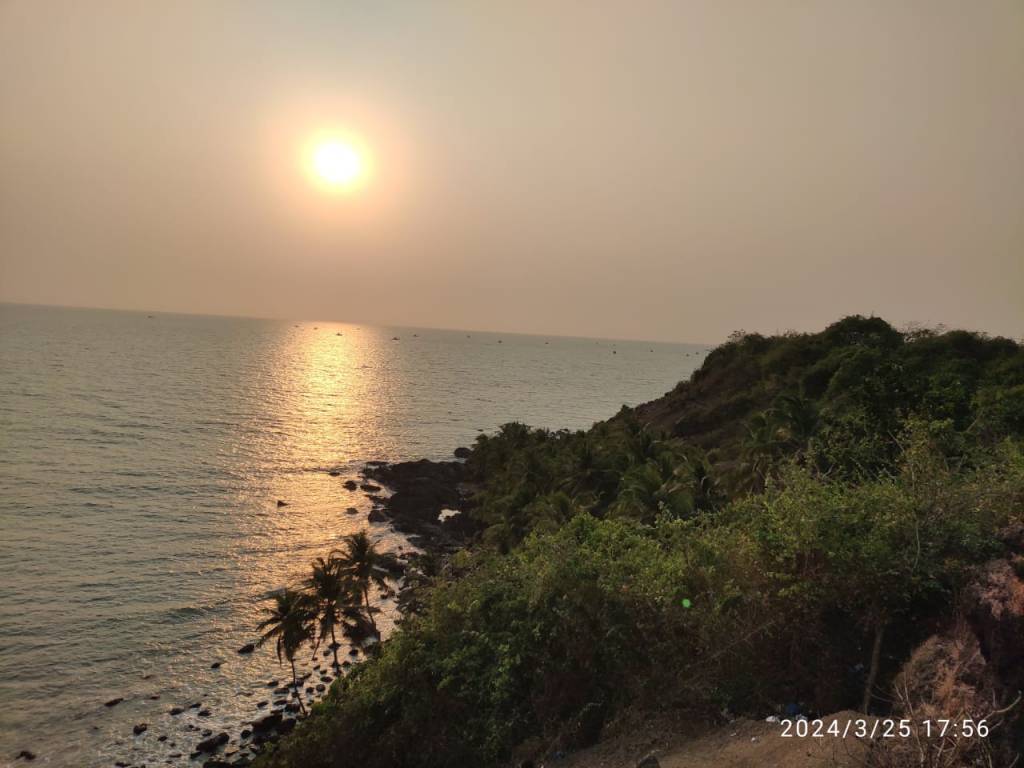
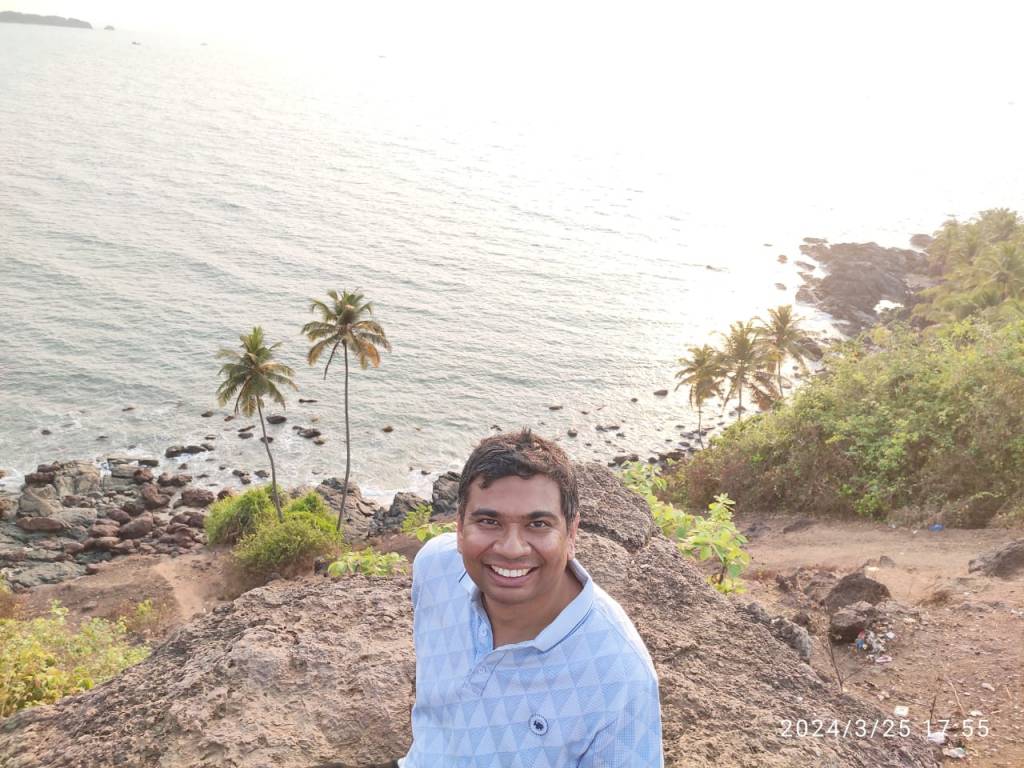
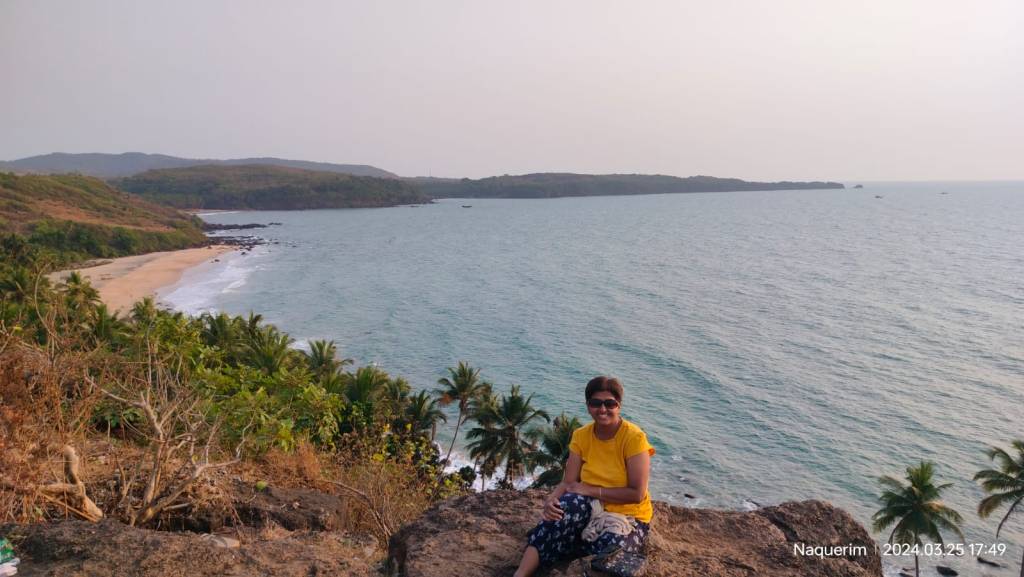
The video link of Betul Sunset view point is given here
Close by is the Betul fort. We visited that place, and it was nothing spectacular. In hindsight, we could have spent more time at the Sunset Point instead of visiting the fort.
Video link to Betul Fort is given below
Our train was at 11:30 from Madgaon railway station that evening, so after a quiet dinner, we got busy packing. I was not too happy about paying INR 700 for a drop to Madgaon Railway station, a distance of 11 kilometers. But in the absence of app-based taxis and other forms of transport, the unionized taxi is the only option.
This Goa trip would become memorable for the sheer number of amazing beaches we visited. And there were still quite a few that we could not visit! Something for the next trip.
In the last few years, many new beach destinations have gained popularity. But having visited many of these spots, I can say with confidence, “there is no place like Goa”!
Sringeri, the first Maṭha (Dakshinamnaya Sringeri Sharada Peetham), was established by Sri Adi Shankaracharya, the exponent of the Advaita Vedanta philosophy. Located on the banks of the Tunga river in the Chikkamagaluru district of Karnataka, it attracts a large number of pilgrims. It is an ancient town that derives its name from Rishyashringa-giri, a nearby hill mentioned in the Ramayana.
My original plan was to visit Jog Falls immediately after the monsoon and then drive to Sringeri. However, due to unforeseen circumstances, my plan had to be aborted twice. Finally, in November 2023, I decided to drive directly to Sringeri, skipping Jog Falls as the monsoon had receded
23-Nov-23
Since there is no direct rail connectivity to Sringeri, traveling by road is the most efficient option. Hence, I hired a taxi for our four-day trip and started at 8:00 AM on November 23rd. I believed we would reach Sringeri by 4:00 PM and have time for a temple visit on the same day.
We stopped at Sri Harsha Grand Veg at Bellur Cross for breakfast around 10:30 AM. The hotels in this part of Karnataka are uniformly good, with a high level of cleanliness, taste, and affordability. Such infrastructure makes a long car journey quite comfortable.
After a few hours, we entered Chikmagalur district – home to coffee plantations and lush green hills. The drive was very scenic, though full of twists and turns. Around 4:30 PM, we reached Hosamane Homestay in Sringeri. I loved this homestay, which is built in the middle of an arecanut plantation.
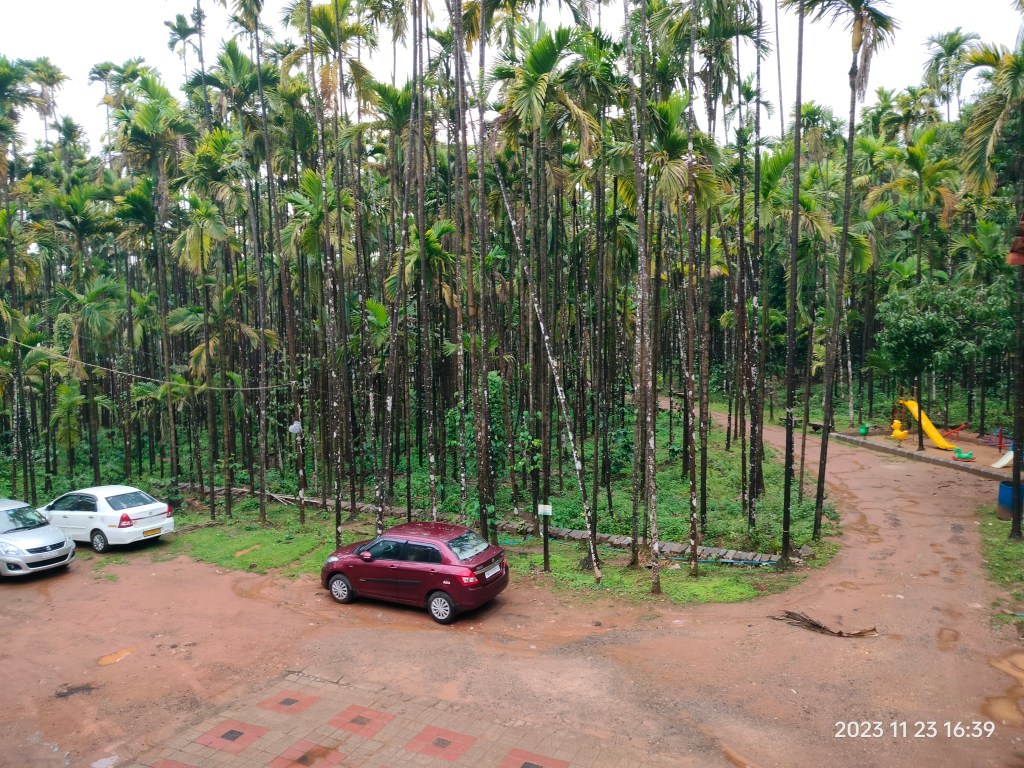
Around 5:30 PM, I walked into the Sringeri temple complex. I had visited this temple as a five-year-old and have a very faint memory of this place. The only thing I remember is running across the complex as my feet were getting burnt walking on hot tiles. Today, due to the rains, the tiles were not burning but quite wet!
The link to video of Sringeri temple complex is given below
The temple complex has two main temples – Sri Shardamba temple and Sri Vidyashankar temple – and numerous other shrines dedicated to Balamurgan, Hanuman, Ganesha, etc. I first visited the Sri Shardamba (goddess Saraswati) temple and was mesmerized by the beauty of the idol. The sandalwood idol was originally consecrated by Sri Adi Shankaracharya in the 8th century until Vijayanagara rulers installed a seated gold statue of Sri Shardamba.
Sri Shardamba temple
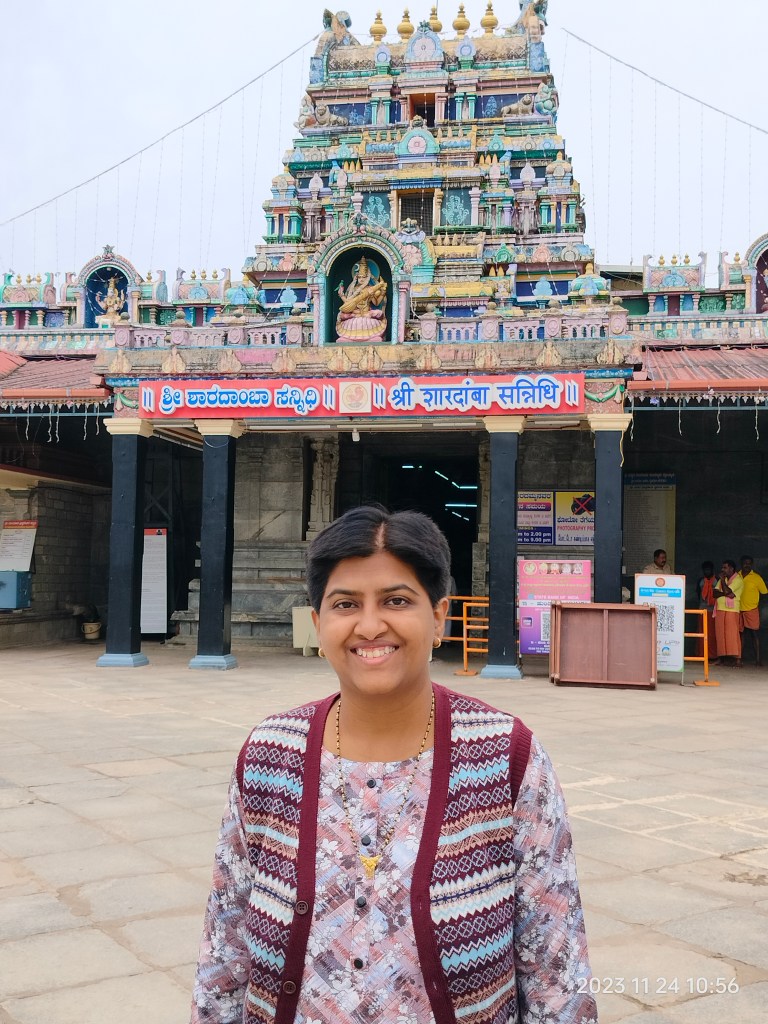
Unlike other ancient temples, it was very large, airy, and well-lit. After that, I visited the Vidyashankar temple, which was built in the 14th century, combining both Hoysala (Chalukya) and Dravidian architectural styles. The temple is dedicated to Lord Shiva and built on the samadhi of Acharya Vidyathirtha. This is an architecturally significant monument with wonderful carvings on the external walls, similar to what one sees in Halebidu and Belur. We ended the day with dinner at our homestay.
Vidyashankar temple
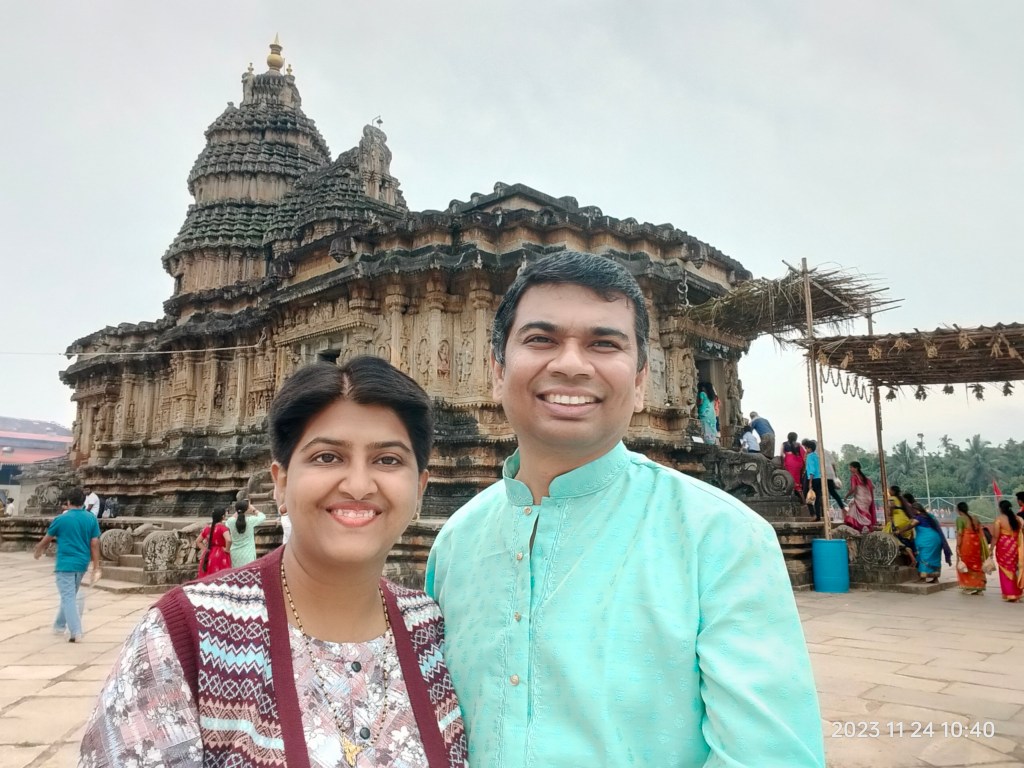
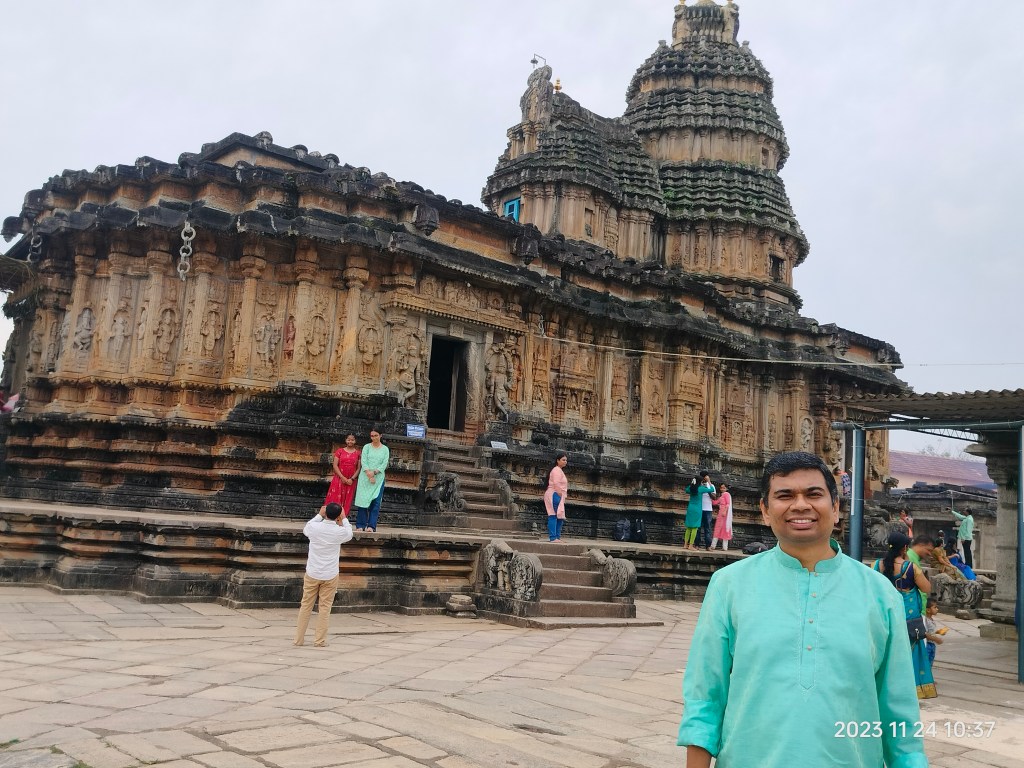
The link to video of Vidyashankar temple is given below
It had been a long day for us – it took around 8 hours to cover the distance of 320 km, primarily due to the winding roads in Chikmagalur district. The quality of roads is pretty good throughout the journey.
24-Nov-23
I had been looking forward to this day for a while – the day when I could get darshan of the current Shankaracharya of Sringeri. There is a dedicated building called ‘Guru Nivas,’ where Swamiji gives darshan to devotees. Around 11:30 AM, we were seated in the gigantic hall, and Swamiji walked in. Sri Vidhushekara Bharati – the 37th Shankaracharya (designate) of Dakshinamnaya Sri Sringeri, had a regal presence. The austerity and brilliance of Swamiji blazed forth, and we paid our obeisance to him.
Prior to that, we spent time visiting the main temples again and praying at other shrines. The temple complex spans both banks of the Tunga river. Also of interest to the children are two temple elephants
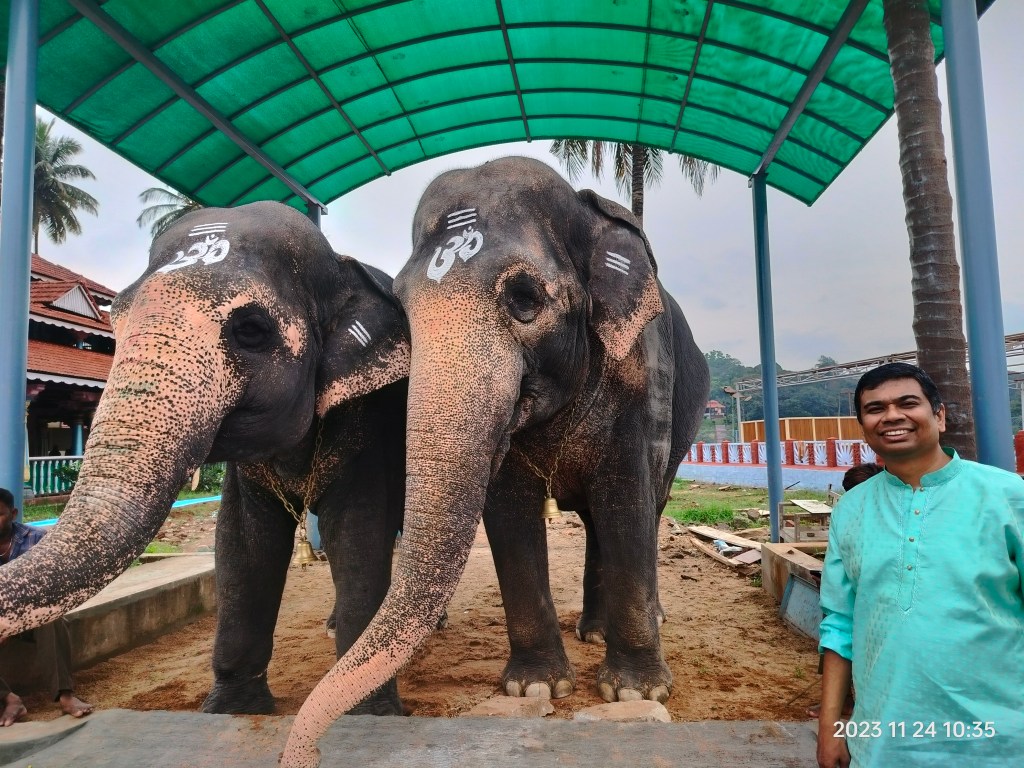
The link to video of Tunga river is given below
Around 12:15 PM, while crossing the Tunga river, the fragrance of sambar reached our nostrils. There was no need to look for signboards to the dining hall. We just followed the smell and took our seats for the Mahaprasad. The simple meal of rice, rasam, sambar, and paysa (kheer) was hot, fresh, and tasted heavenly. I have seen this institution of free Mahaprasad in many temples in Karnataka. Quite laudable.
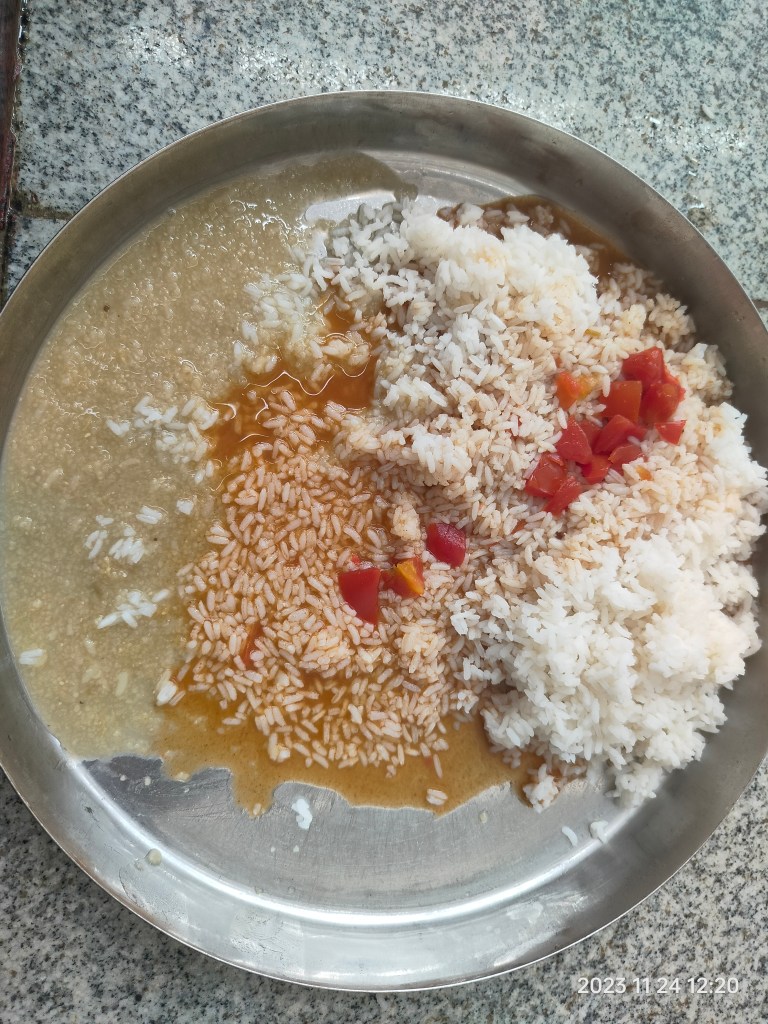
After lunch, we decided to visit the Srimane falls about 15 KMS from the temple. This area has numerous falls and viewing points. However, I preferred Srimane as there is no trek involved, and we can take the car till the very end.
We arrived at the falls parking lot and walked around 50 steps to the actual falls. There was plenty of water, and we could get drenched in it. The infrastructure was good, with changing rooms, washrooms, parking, and small shops for snacks.
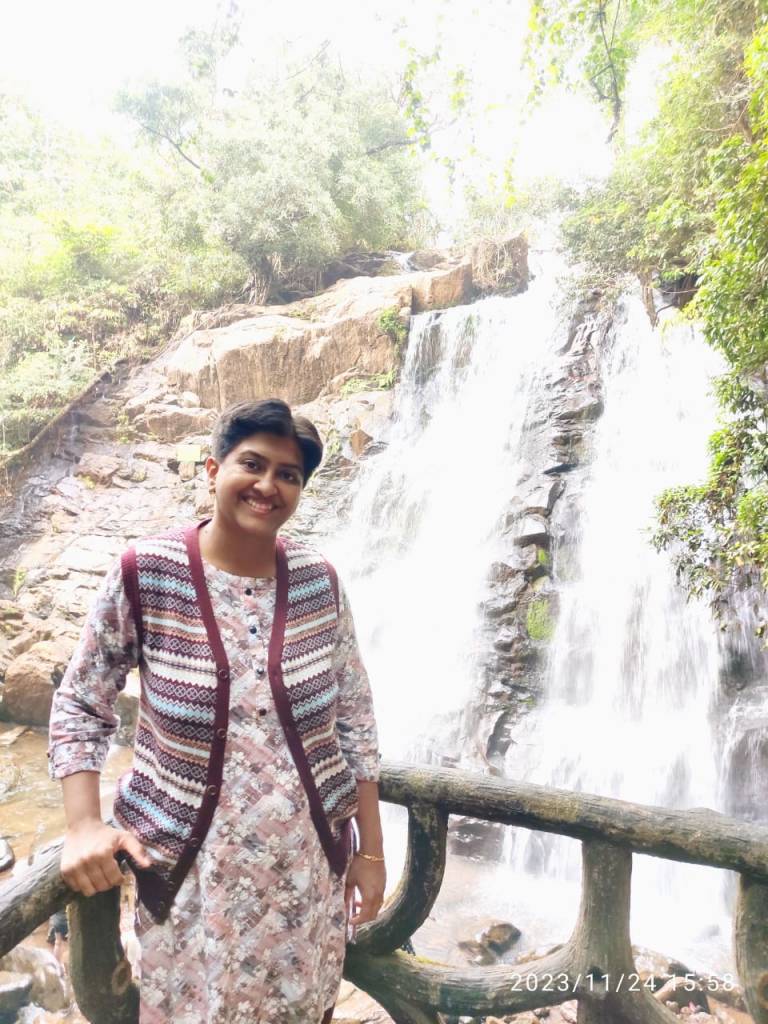
The link to video Srimane falls is given below
In Sringeri, we visited the famous ‘Holla Maruti Tiffin Centre’ – a family-owned hotel serving food on a banana leaf. The seating is on the floor and gives the restaurant a very homely atmosphere. The menu is limited to poori, idly, and bonda – we tried bonda and liked the taste. A definite visit when one is in Sringeri.
Around 7:00 PM, we went to visit the ‘Tunga aarti’ conducted on the banks of the Tunga river in the Sringeri temple complex. It is similar to the Ganga aarti of Haridwar, but I found Tunga aarti to be more elaborate.
A beautifully decorated boat was sailed from the northern bank of Tunga to the southern bank. Sri Vidhushekara Bharati – the Shankaracharya of Sringeri, started the aarti of the deities and took a yogic pose on the specially designed seat. The other brahmacharis then performed the aarti of the river. It was a spectacular sight, accompanied by melodious drums and other instruments. A sight to be seen!
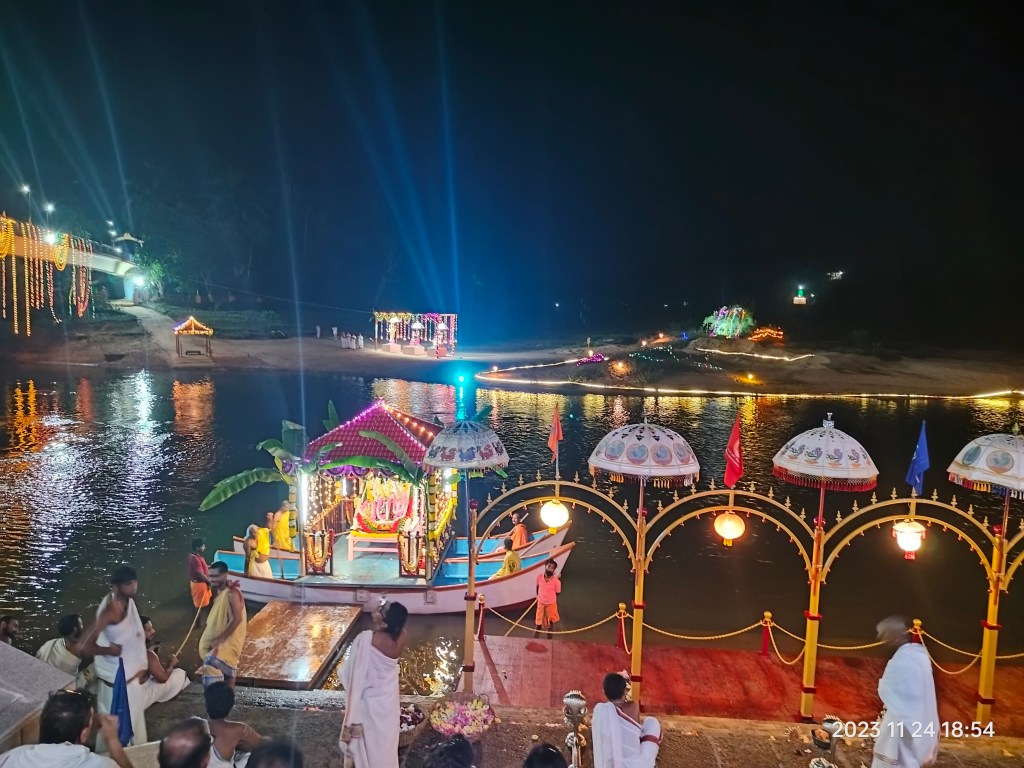
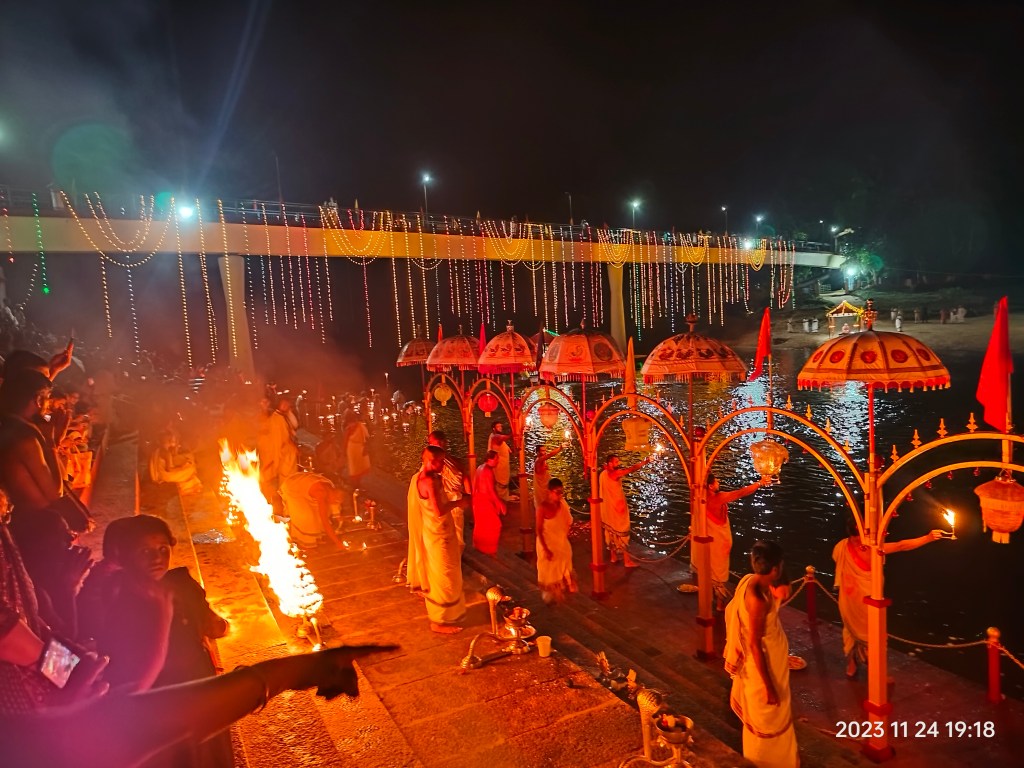
The link to video of Tunga aarti is given below
The temple was well-lit, and we had the final darshan of the deities that evening. We ended our day having dinner at Hotel Sharada Comforts – and were pleasantly surprised to get good quality north Indian dishes!
25-Nov-23
I had planned to take an overnight stay on our way back from Sringeri to Bangalore. I booked our stay at KSTDC Valapuri Belur. Although I had seen Halebeedu and Belur earlier, it was a good opportunity to visit these temples again.
We bid adieu to Sringeri at 10:30 AM and drove through the picturesque Chickmaglur district. I was surprised to see the tea gardens in addition to coffee plantations.
We reached Belur around 1:00 PM, and after lunch and some rest, we walked over to the famous Chennakeshava Temple. This temple was commissioned by King Vishnuvardhana of the Hoysala dynasty in the 12th century AD and was built over three generations.
We hired a guide who showed us the intricate details of the carvings on the external walls. Belur is famous for depicting the everyday life of medieval India – dancing, hunting, temple celebrations, etc. The Garbha-gruha of the temple is also fascinating.
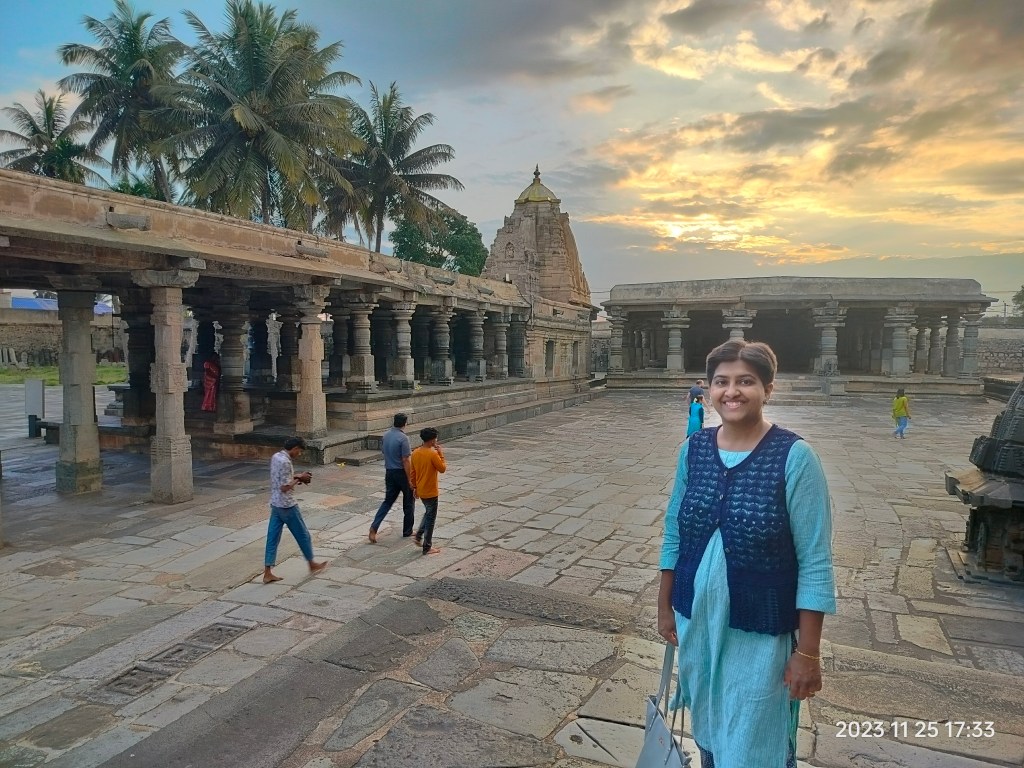
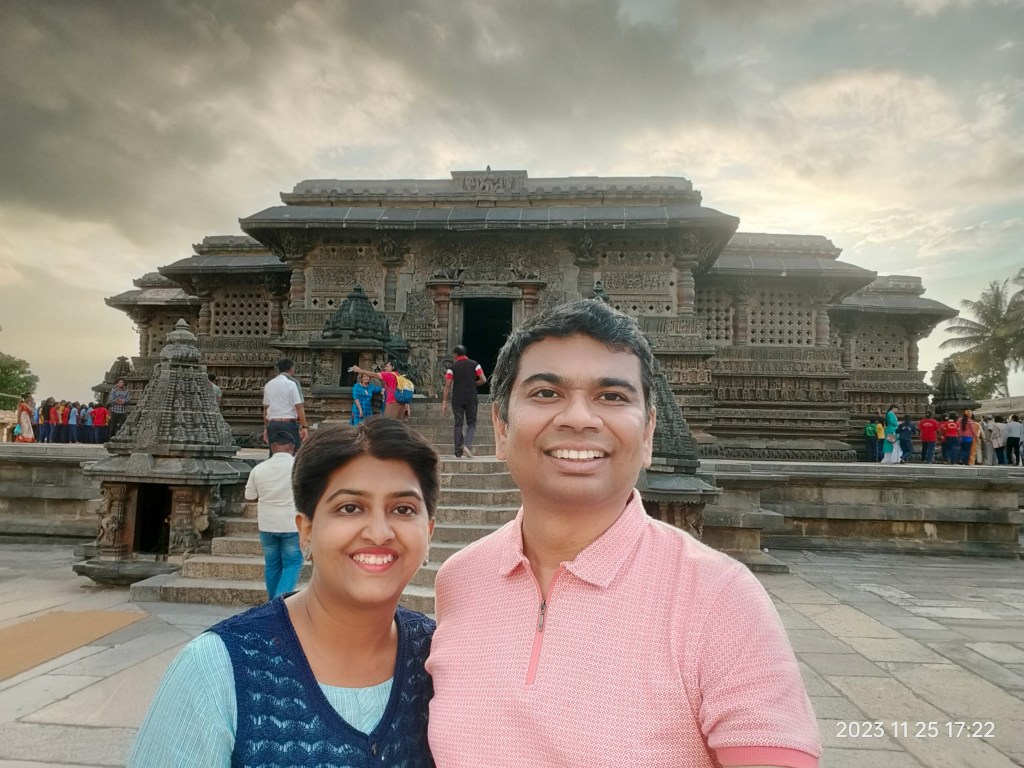
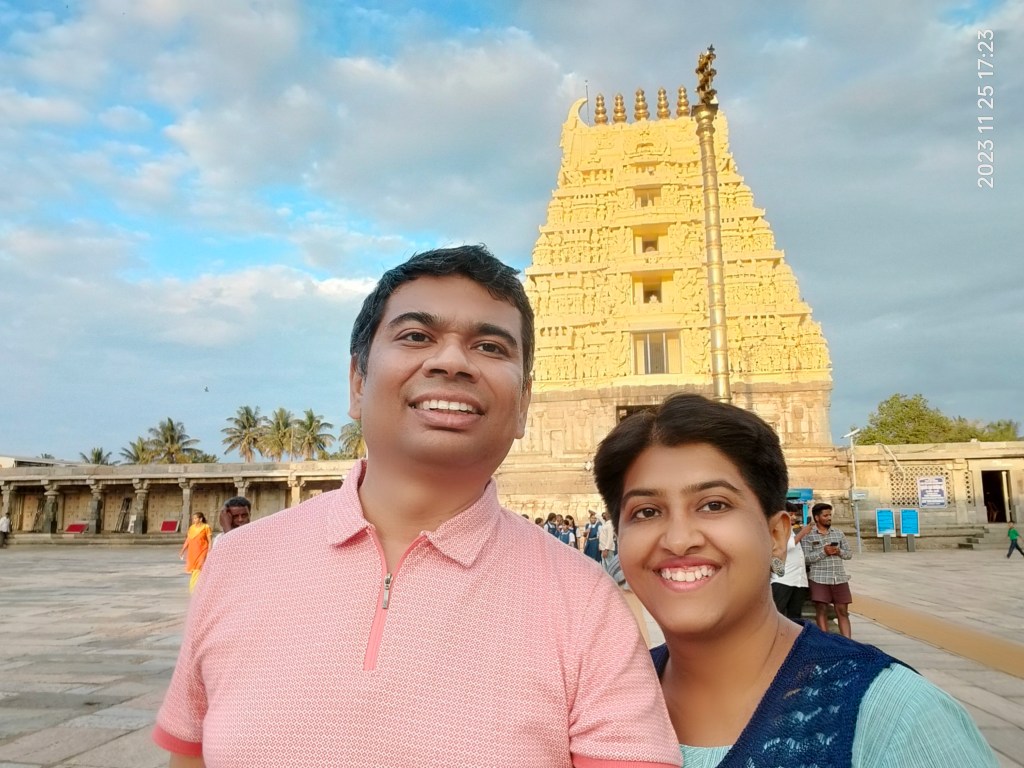
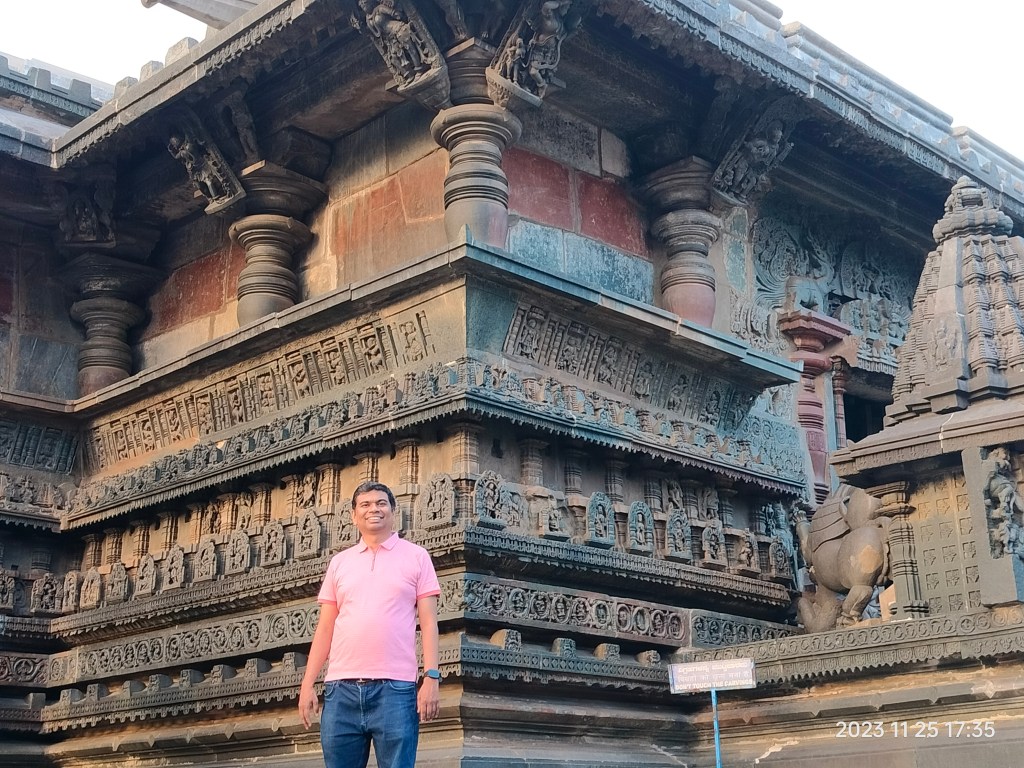
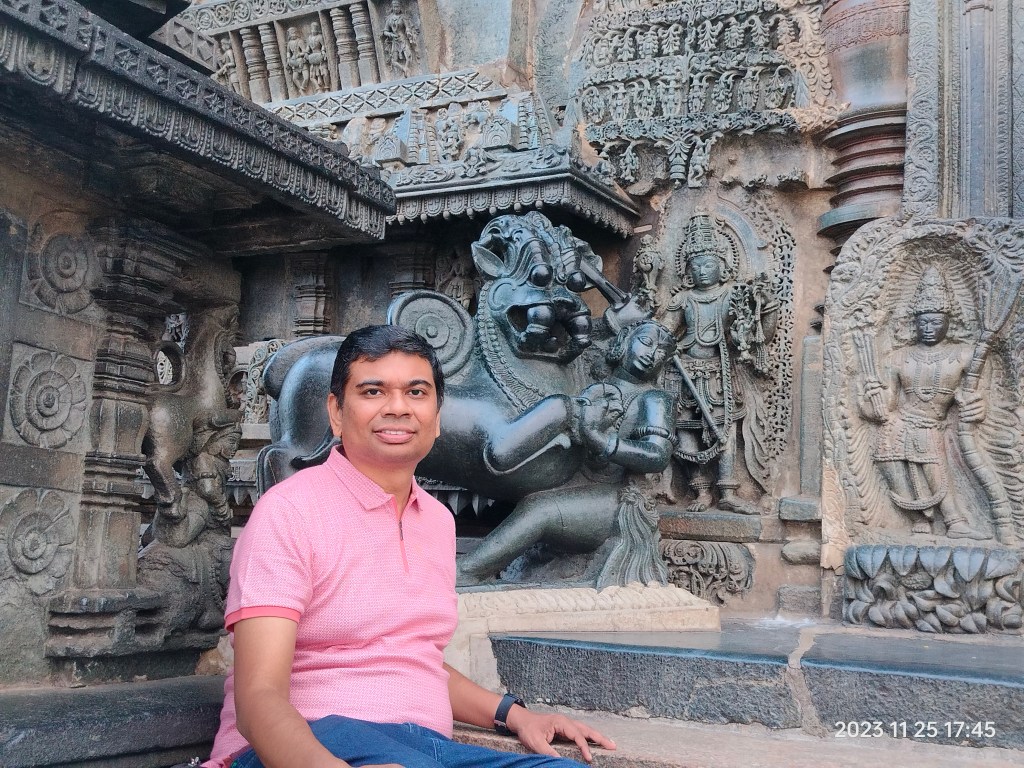
What intrigued me is the smaller temple right next to the main Kesava temple. This smaller temple was built as a “model” – a miniature version of the main temple. The gopura at the entrance of the temple complex is a magnificent example of Dravidian architecture, which was built by the Vijayanagar dynasty in the 14th century.
The link to video of Belur temple is given below
After admiring the temple, we walked back to the hotel after purchasing a few ceramic kitchenware items. In today’s “One India,” kitchenware for sale in rural Karnataka comes all the way from Rajasthan!
KSTDC Belur is a professionally run hotel, and we had a good stay there. Even the restaurant is pretty good
26-Nov-23
The next morning, I left for Halebidu to view the famous Hoysaleswara temple. This historic temple construction started around 1121 CE and was completed in 1160 CE. Unfortunately, it was sacked and plundered by Muslim invaders – Allauddin Khilji and Muhammad bin Tughlaq.
During the British era, the temple complex was restored and repaired. Some of the existing panels were used to decorate the outer walls, though the shikara was lost forever. I arrived at the temple complex around 08:30 am and was the only tourist at the site. The atmosphere was quite serene, befitting a Shiva temple. Though the main deity of this temple is Lord Shiva, there are numerous themes related to Vaishnavism and Jainism. The main attraction is the artwork on the outer walls depicting scenes from Ramayana, Mahabharata, and Puranas. While Belur’s artwork focuses on day-to-day life, Halebidu is dedicated to religious themes.
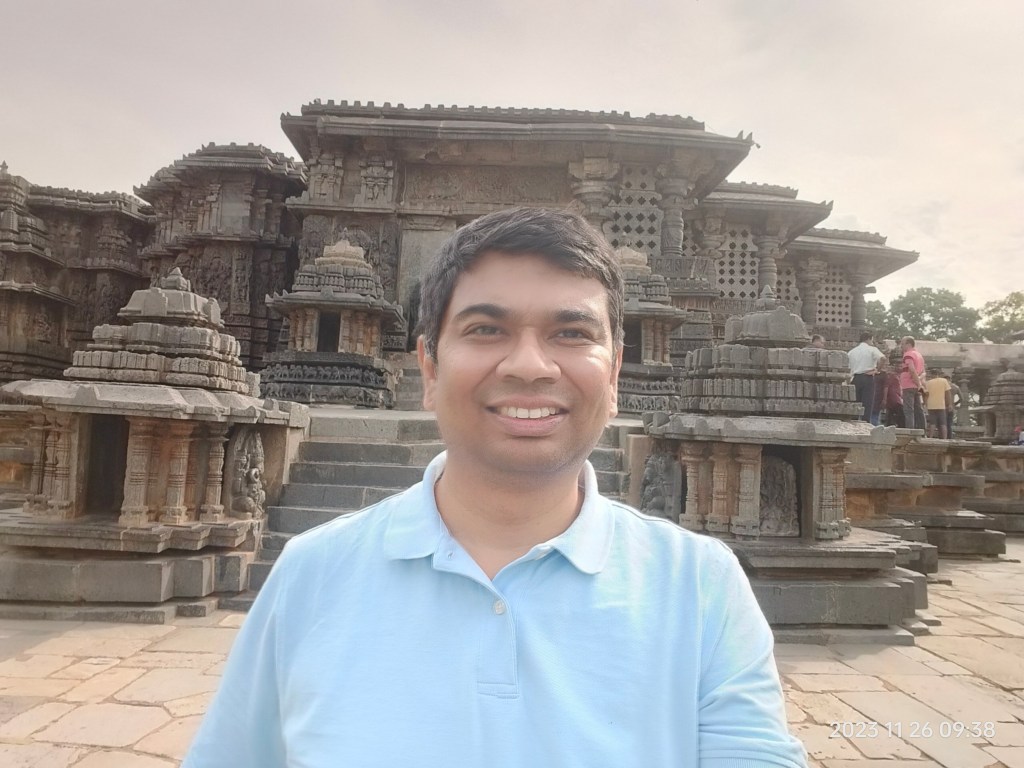
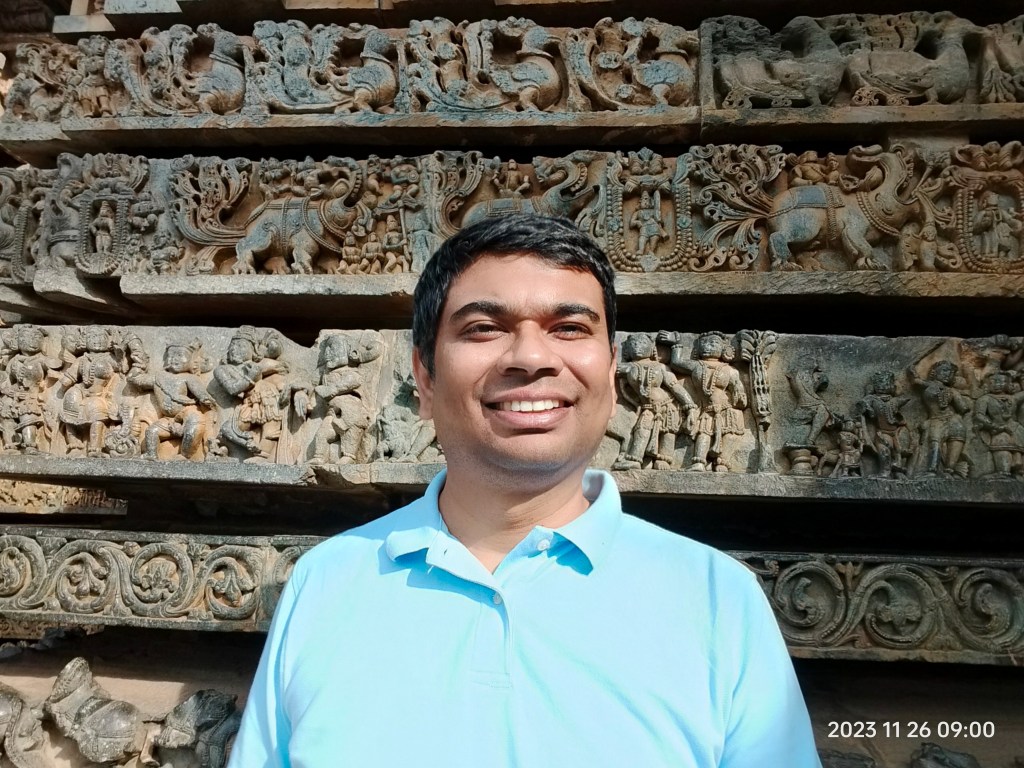
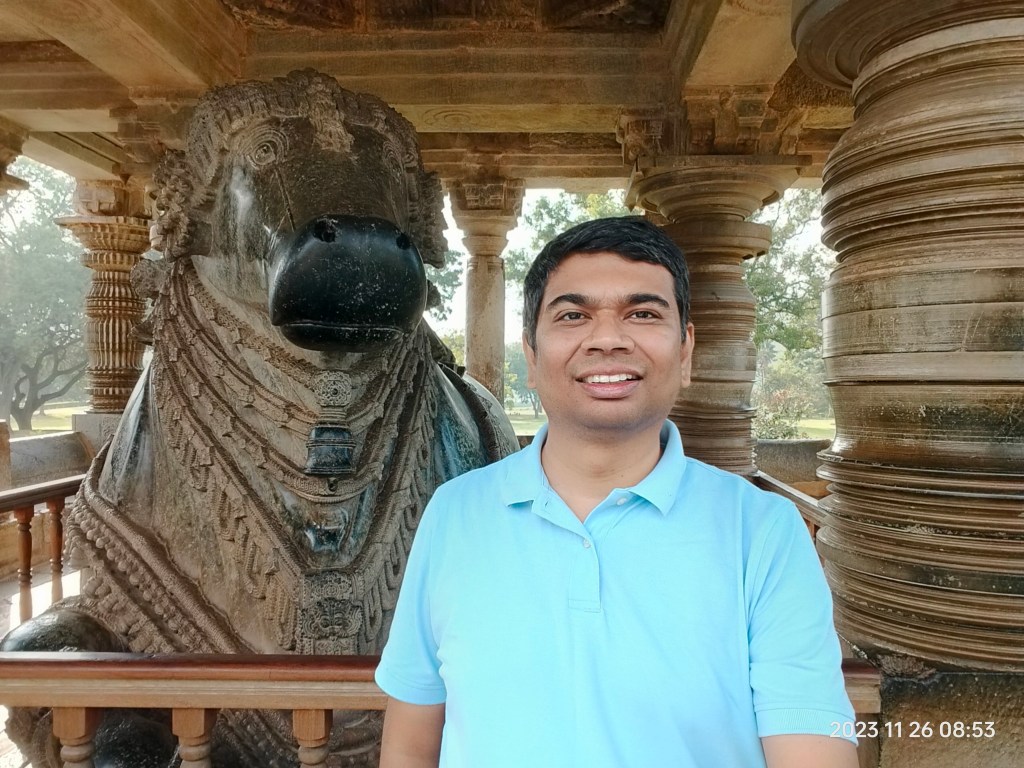
Being a Shiva temple, there are two magnificent sculptures of Nandi in the complex. It’s highly recommended to visit the ASI government museum inside the Halebidu temple complex. There are numerous sculptures that one can observe up close. Also of interest is the ‘inscription hall,’ which provides details on the various artworks of the temple. Both these museums are quite informative and well-maintained.
After spending about 1.5 hours, I headed back to Belur. Post check-out from Belur, we were on our way back home. Belur is only four hours away from Bangalore, and the new tolled roads are excellent. We stopped for lunch at Dhurvatare restaurant at Bellur Cross (not to be confused with Belur!) and had an excellent lunch. We had no challenges regarding food throughout the trip!
This short trip was a combination of piety, natural beauty, and architectural marvels. But the highlight was undoubtedly visiting Sringeri and taking blessings from the Shankaracharya. And the aarti of the Tunga river is something that will remain in my memory forever!
There are various reasons why one chooses a particular destination for vacation. It is usually recommendation from friends, seeing travel shows or book related to that subject. In my case, I chose Badami as I heard about it during my Hampi trip and planned to visit it.
Badami is an ancient city which was seat of the Chalukya empire from 6th to 8th century AD. Under the Chalukyas, Badami emerged as one of the regional centers of art, literature and religion. They are credited with construction of series of rock-cut cave temples and built other major temples in neighbouring villages of Aihole and Pattadakal.
Badami is often compared to Hampi, which is around 150 KMs to its south. However, while Hampi is a bustling tourist town, Badami is comparatively unknown place. It is a sedate and quiet place, with strong local flavour which in not yet influenced by tourism.
Another main attraction for the devotees is the Banashankari temple around 5 KMS from Badami town.
Having decided the destination, we booked our stay in Mayura Chalukya KSTDC hotel, a Karnataka State Government run enterprise. These hotels are in almost all the popular tourist destinations in Karnaktaka and usually meet the basic standards.
14-June-23
On evening of 14-Jun-23, we boarded the Yeswantpur-Vijayapura express which was to depart at 09:30 PM. Surprisingly, it was delayed by 1.5 hours at the starting station itself ! In the last couple of years, I have rarely experienced train delay and hopefully this delay was an aberration.
Next morning, we alighted at the quaint station of Badami at 10:30 am. The fact that the station is surrounded by fields (without any building in sight) reflected the size of this town. After a drive of 5 KMS we arrived at Mayura Chalukya KSTDC hotel and were amazed at the size of the hotel room. This was the biggest room I have ever checked-into ! After a quick break we headed towards the Northen Hill of Badami.
My only agenda was to view the Archaeological Museum at the foot of the hill and climb a few steps to view the Agastya lake from an elevation. For this I hired an auto rickshaw for to-and-fro trip from the hotel. After passing through slum-like residential area ( with pigs running around), we reached the Northen hill. The squalor and dense human habitation next to heritage monuments is a problem in and around Badami. The local government needs to improve this aspect in order to promote tourism.
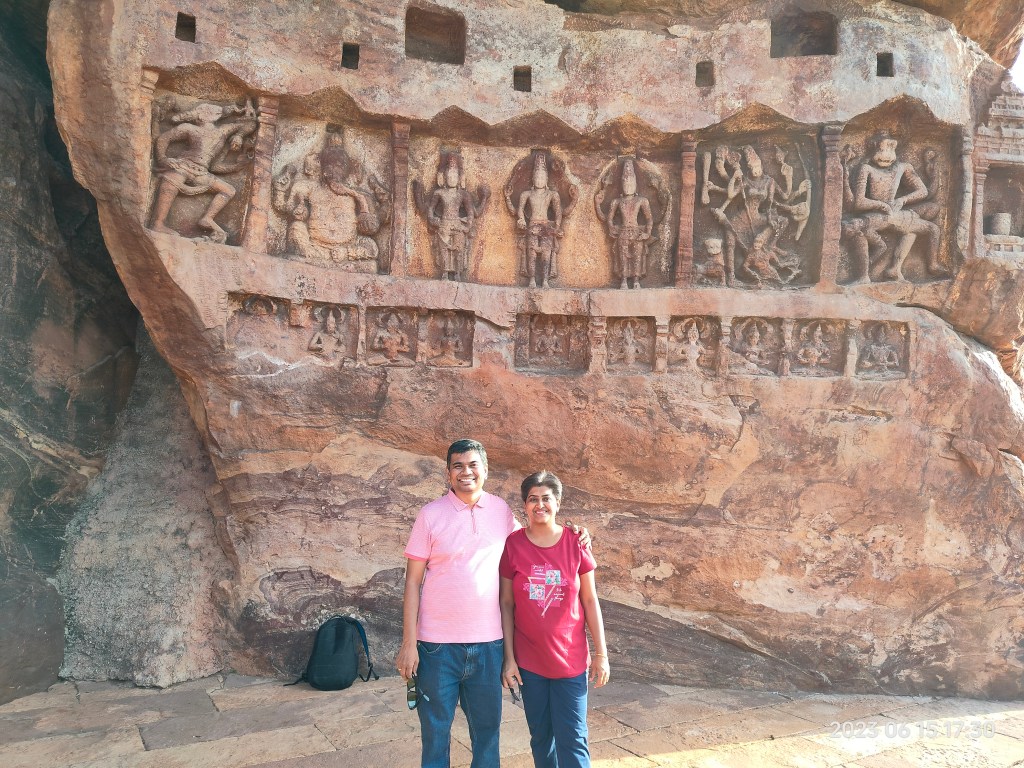
The museum is not very large with four galleries and provides information about the various dynasties that ruled the region. Once outside, there are steps that takes one to the top of the hills. This served as a fort at one point of time and there are also a couple of important temples with excellent stone carvings.
We walked up a few steps and made my way through narrow pass to reach a plateau. There are two mandaps here and no signage of what was its purpose. The views from this vantage point are quite spectacular. I then ascended few more steps to a Shiva temple which is now in disuse.
Link to the video from Mantapa Plateau is given below
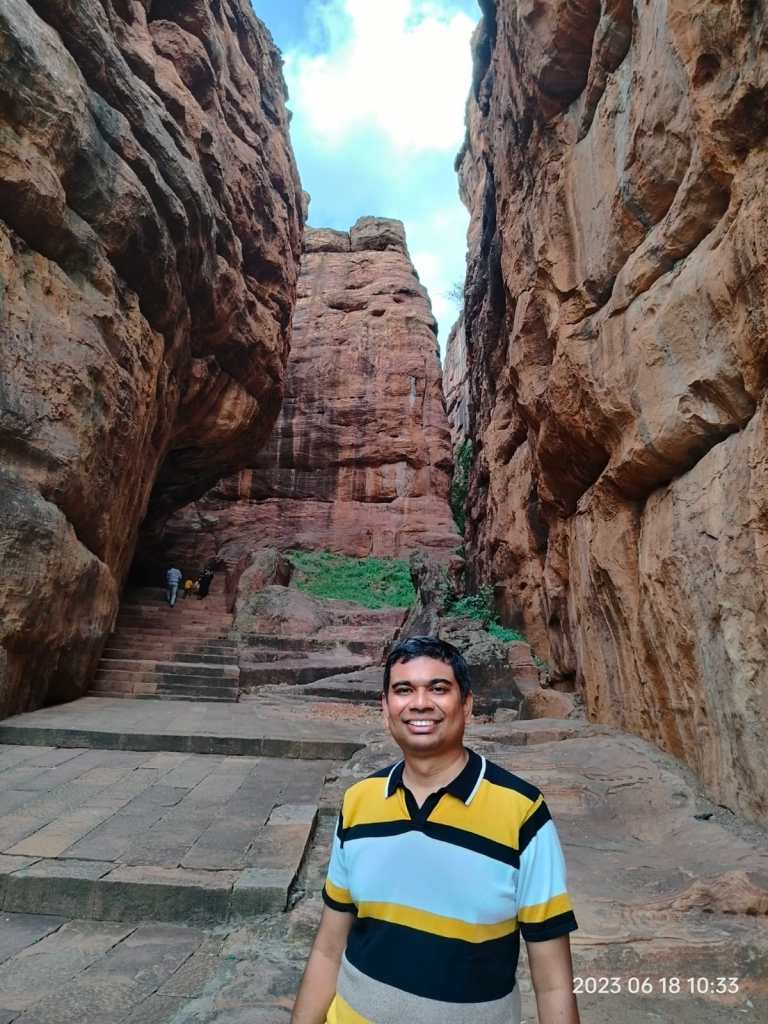
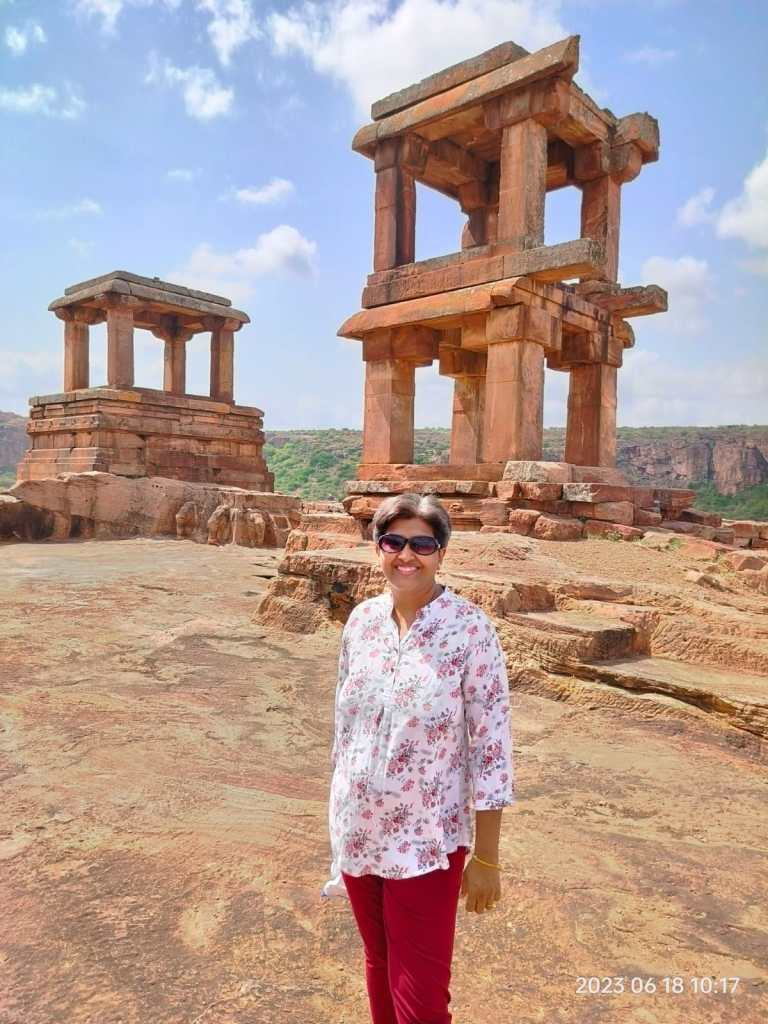
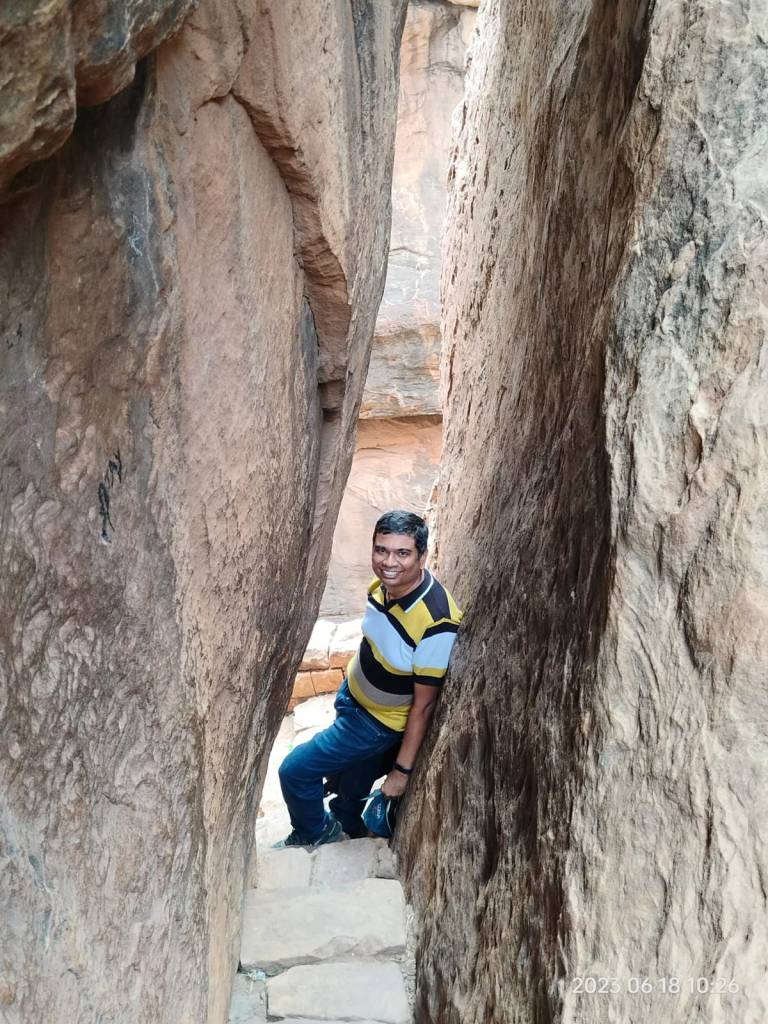
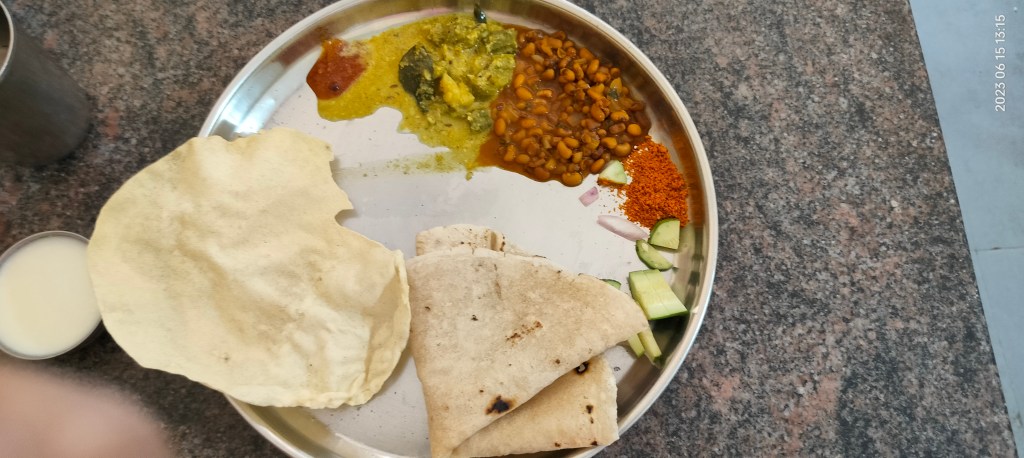
It was around 1 PM and we found it prudent to descent and head for lunch. This part of Karnataka is famous for its “Lingayat Khanavalis” – vegetarian restaurants which serve Jowar rotis ( rotis made from sorghum millet) with vegetables and dal. This meal is quite healthy and we dined in these khanavalis during our stay.
In the evening, we visited the Bhutanatha temple complex on bank of the Agastya lake build during 7th century. This is a group of temples on the eastern bank of Agastya lake with splendid view of the hillocks behind it. This temple and adjoining Mallikarjun temple are dedicate to Lord Shiva.
Link to the video from Bhutanatha temple complex is given below
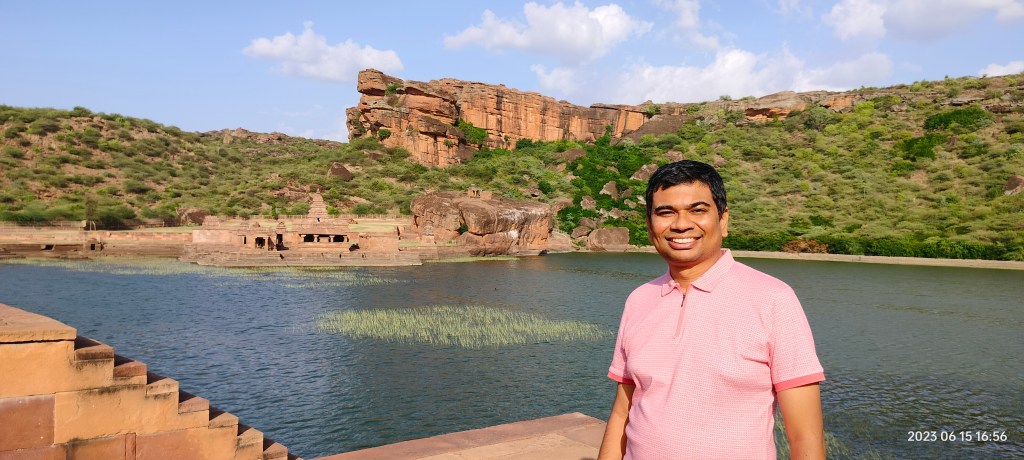
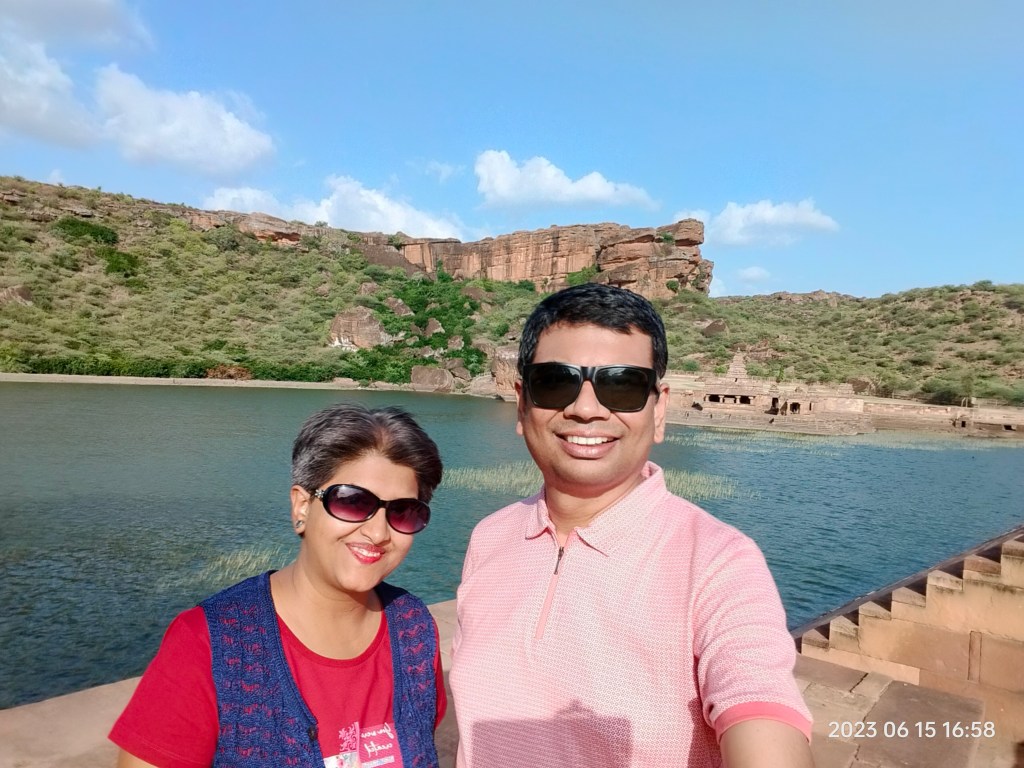
It was very pleasant to walk besides the lake and watch the huge boulders .Behind the temple, there are Dasavatara sculptures on the face of the hillocks. A pleasant place to spend an evening !
After dinner at “Veerabhadreshwara Lingayat Khanavali”, (the owner speaks five languages and customizes the spice level on request !) we called it day.
17-June-23
On this day, we had planned to visit the historical site of Pattadakal and Aihole which are about 17 KMS and 35 KMS from Badami respectively. We hired a private taxi and set out at 09:30 AM.
The roads in this part of the state are pretty good and it was pleasant drive to ancient city of Aihole. The surrounding fields and traffic-less drive was change from traffic clogged roads of Bangalore.
Aihole was earlier called Aryapura and was an important centre for Chalukya’s between 6th to 12th century AD. Legend has it that this was a “sculpture school” for artists in Chalukyan empire and hence we find temples of different designs here.
The main temple complex here is called “Durga temple” – Durg – means fort and this is temple dedicated to Lord Vishnu. There are no religious activities that take place here and entire site is managed by Archaeological Survey of India.
The Durga temple has a unique shape – it is semi-circular and resembles India’s old parliament building. There are major sculptures of Dashatavar inside this temple including Varaha, Narasimha etc. We would see similar (but much larger) sculptures in Badami cave temples.
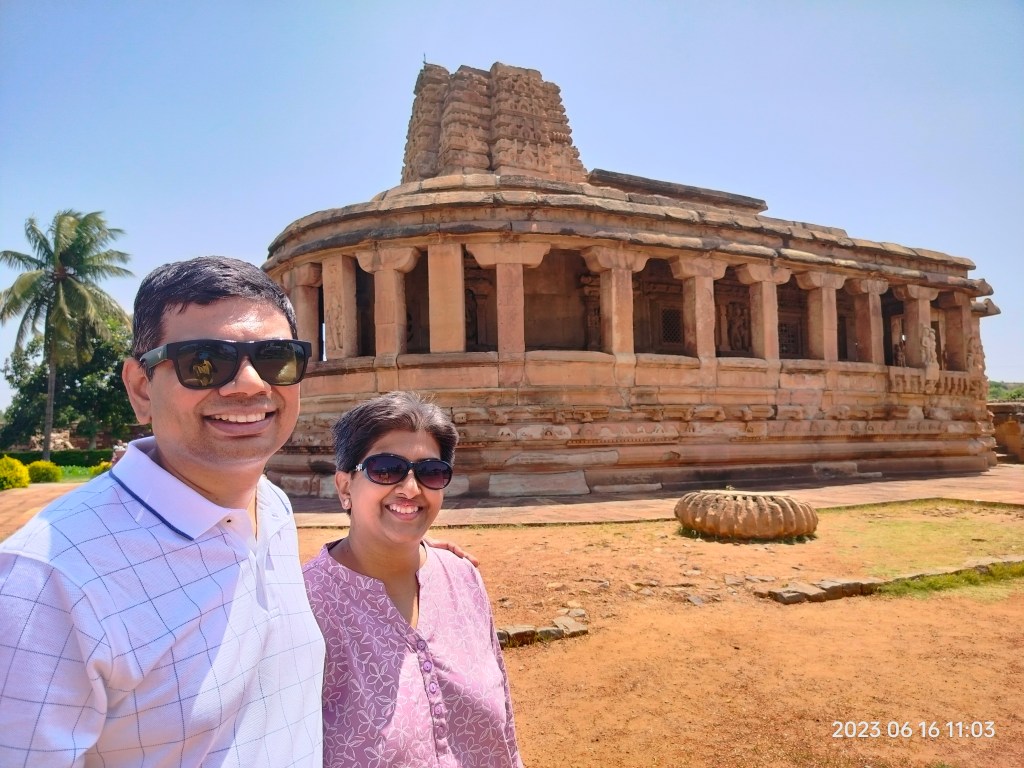
There are other temples in the complex, notably Lad Khan Temple dedicated to Lord Shiva. This was named after a general of Adil Shahi sultanate who had made this temple his home. We had hired a guide for INR 500 who explained us the significance of each structure in the temple complex. More than the information he provided; we found his skills in photography more useful. These guides take pictures with excellent backgrounds !
Link to the video from Aihole temple complex is given below
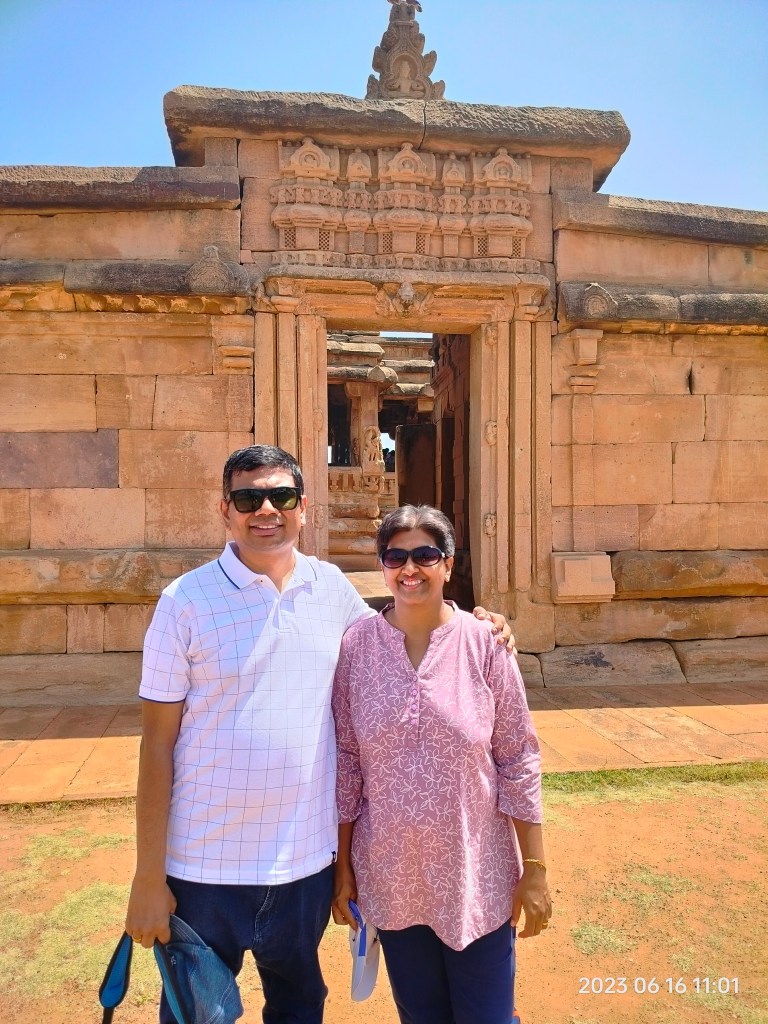
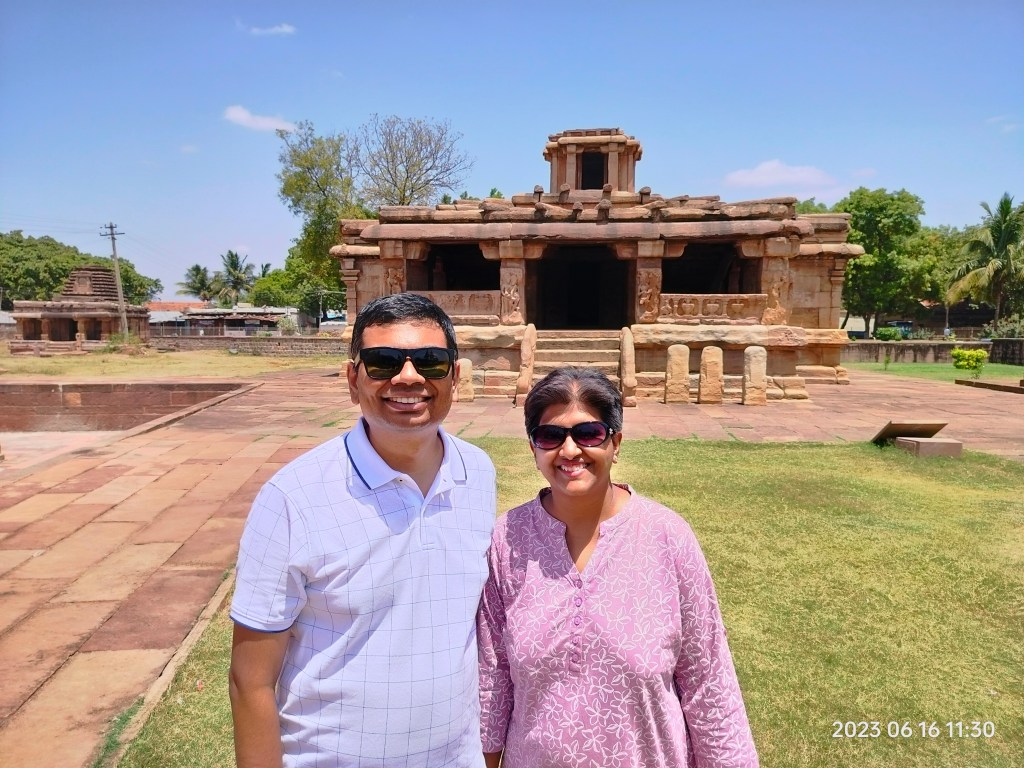
We then visited the Ravaphadi cave temple, dedicated to Lord Shiva. This style of “cave temples” we would see in detail in Badami over next couple of days.
Bidding adieu to Aihole we drove to Pattadakal, around 17 KMS towards Badami. On both sides were fields, desperately awaiting rainfall. Bagalkot district is drought prone and agriculture here is primarily dependent on rains.
Arriving at Pattadakal, we lunched at a small restaurant with impressive name “Shri Mahaakuteshwara hotel”. The lunch was staple of Joald rotis and sabzis and we were ready to now explore the Pattadakal temple complex.
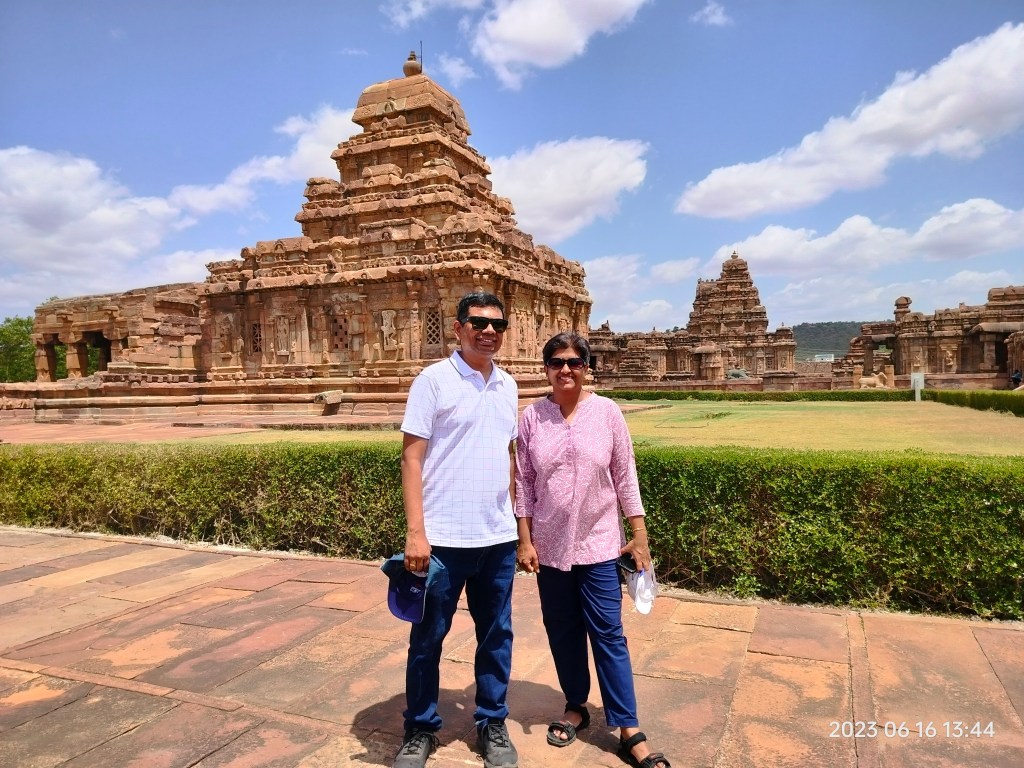
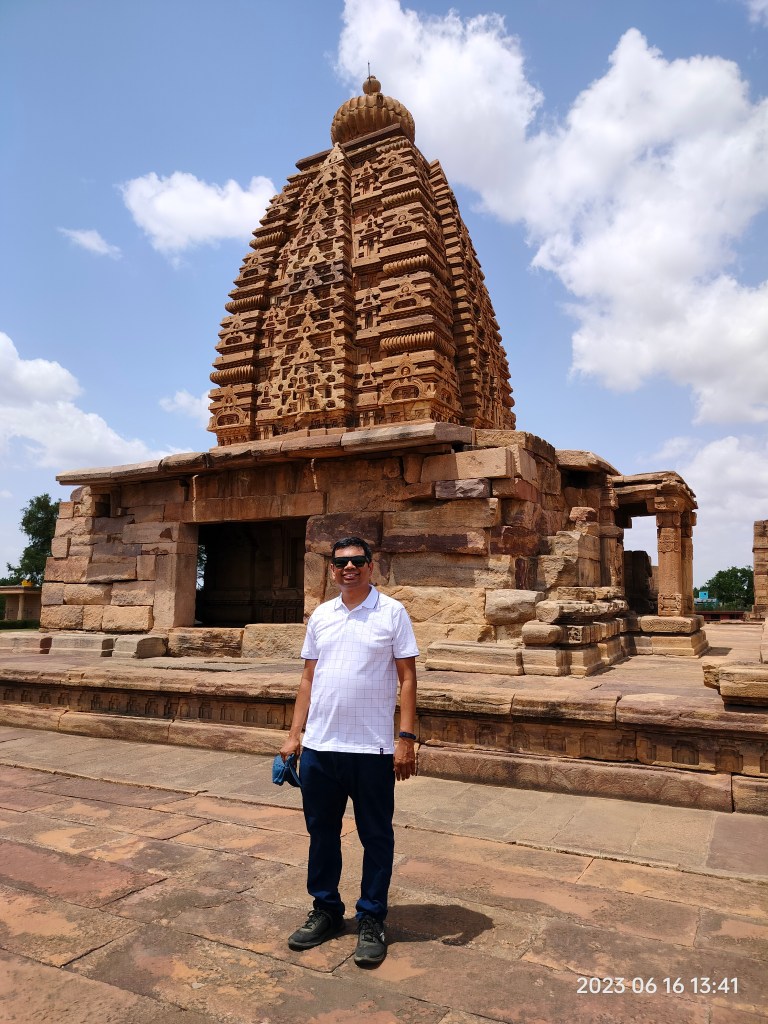
The Chalukyas had reached their zenith of architectural style at Pattadakal and this is reflected in the temples here. It has a cluster of ten major temples, which showcase some striking architectural features. Pattadakal has temple architecture from Dravidian, Nagara (North Indian) and a mixture of both styles in its temple complex; a reflection of the exchange of ideas between different parts of Bharat-varsh.
Link to the video from Pattadakal temple complex is given below
All the temples here are dedicated to Lord Shiva and I found the Mallikarjun temple and Virupaksha temple most impressive. These have the separate Nandi mandapa, antarala (antechamber ), mantapa (large hall supported by pillars) and the garbhagriha (sanctum sanctorum).
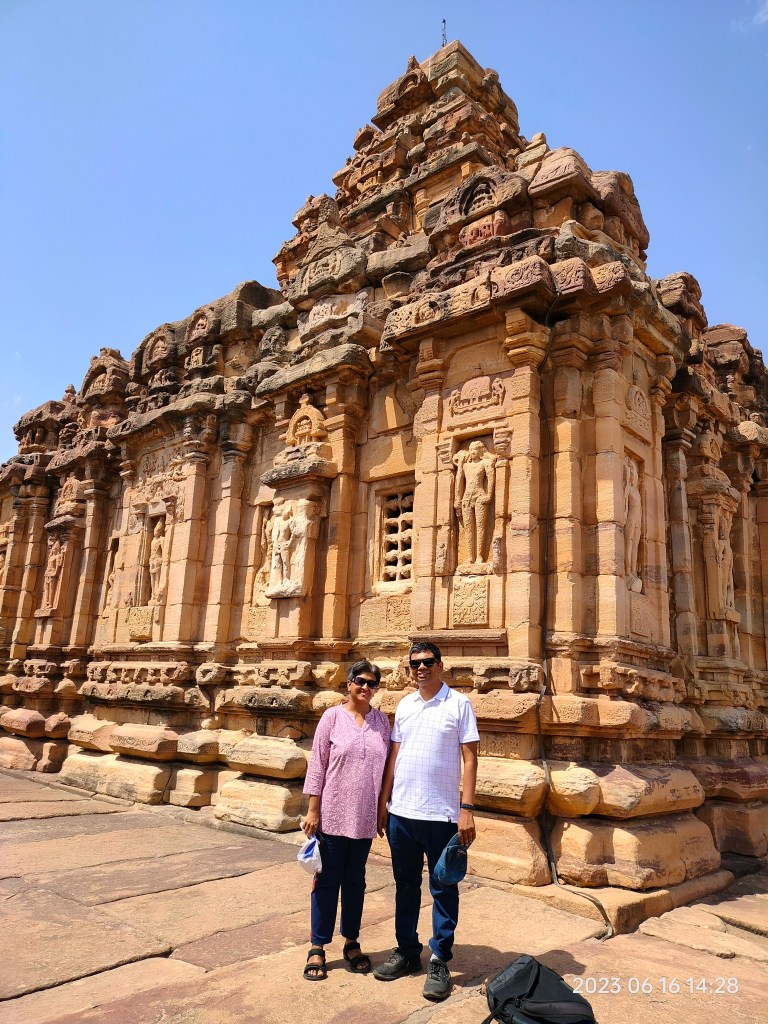
No worship takes places in Pattadakal temples ( except for Virupaksha). Weather, time and foreign invaders have destroyed much of what was once a spectacular architectural marvel.
Both Aihole and Pattadakal temple complex are well maintained by ASI with good washrooms, walking tracks and detailed information boards. Even in harsh summer, it was soothing to see well-manicured lawns here.
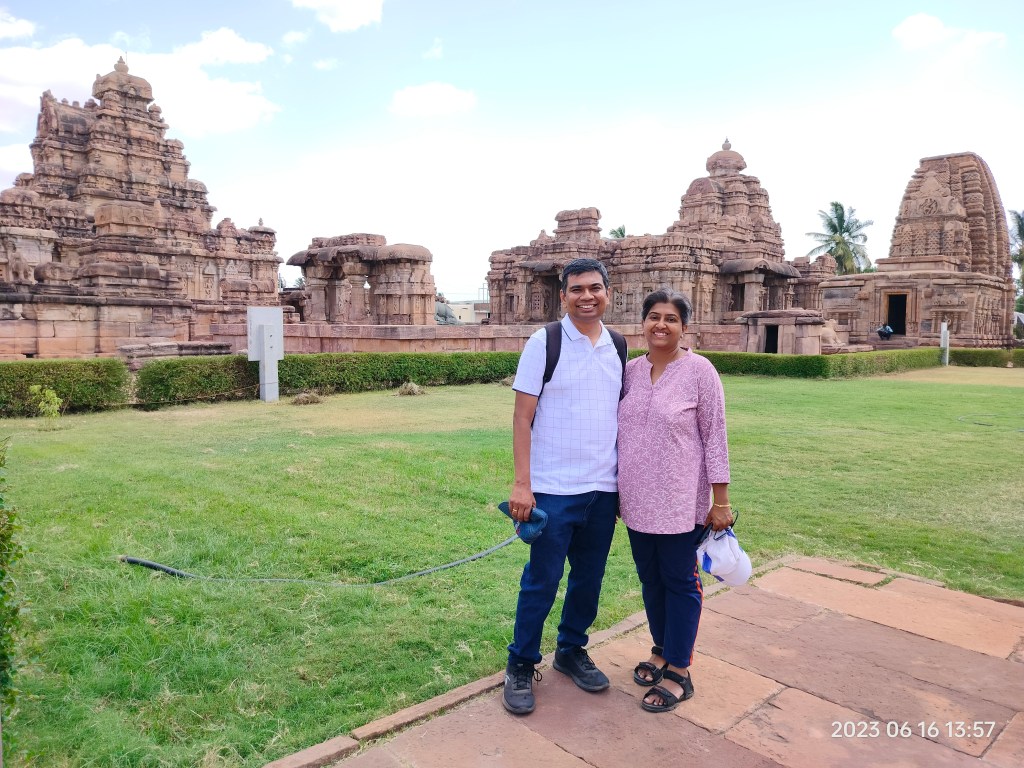
We arrived at our hotel in Badami around 4 PM after a day well spent.
18-Jun-23
The main attraction of Badami is its cave complex. At 10:00 AM, we left to visit the caves which are about 1KM from the main town.
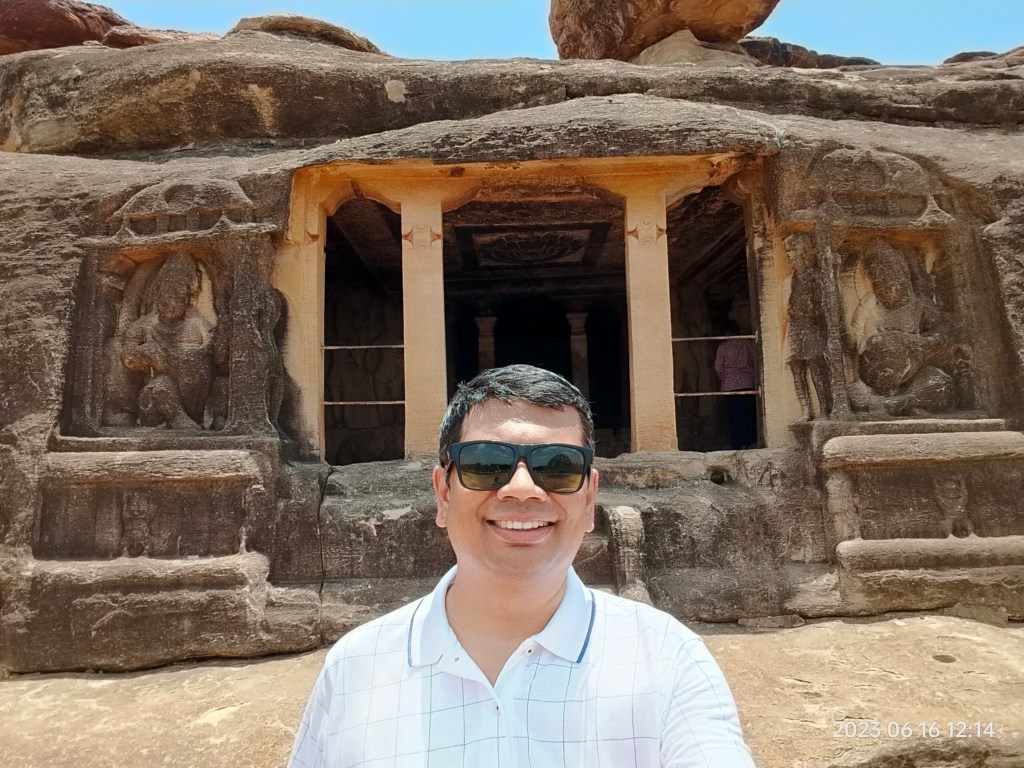
These are ancient caves dating from 6th century CE. There are four caves in total –Cave 1 dedicated to Lord Shiva, Cave 2 to Vishnu, Cave 3 to Mahavishnu and Cave 4 to Tirthankaras, the revered figures of Jainism.
One need to climb around 200 steps to view all the caves. The views from the summit are spectacular, with clear view of Agastya lake and Badami town.
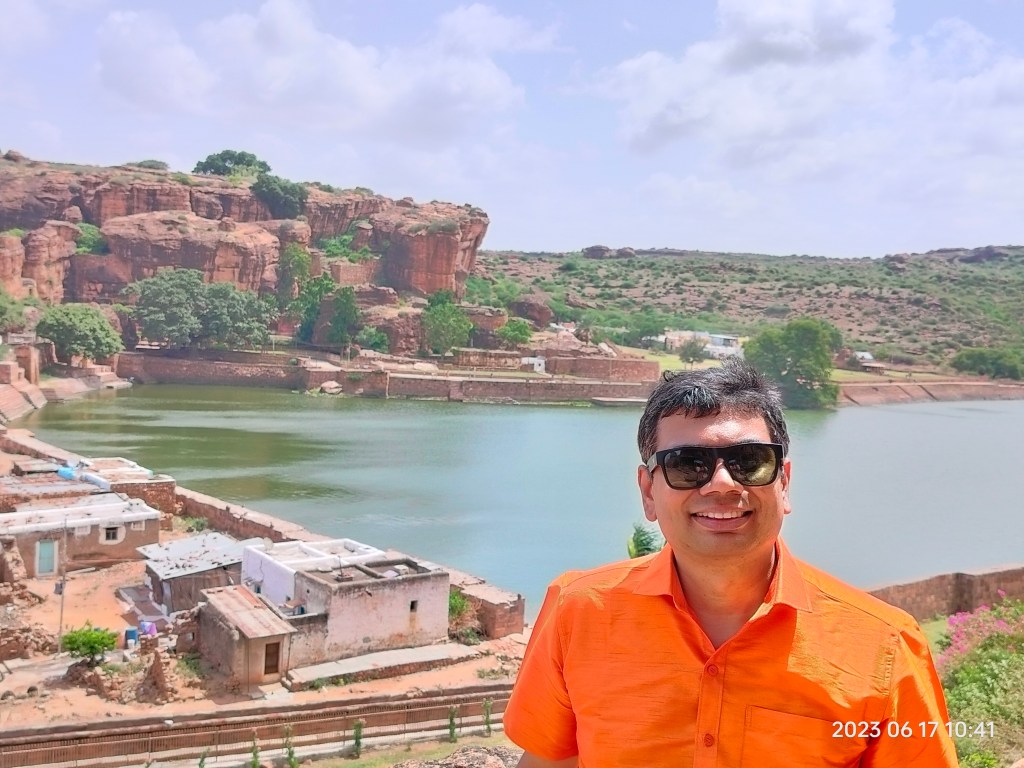
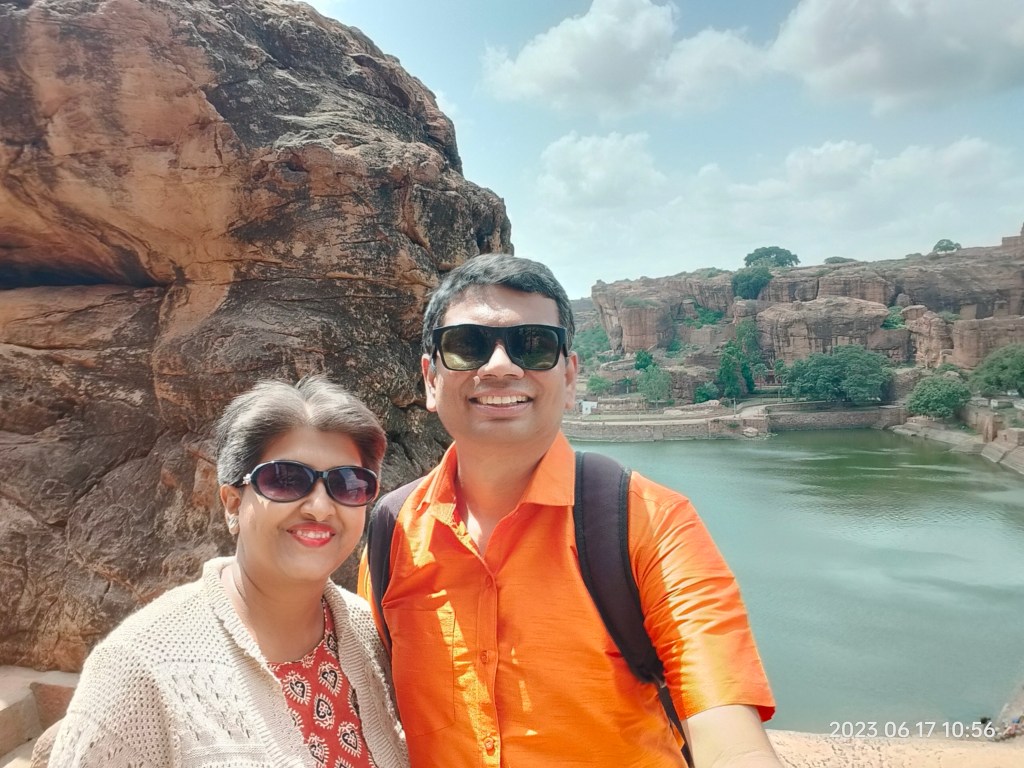
The caves are not very large but the sculptures are amazing. The details of each cave are given below
Cave 4 – This case is dedicated to Jainism and has many carved images of Jain Tirthankars. In the sanctum santorum, Lord Mahavira is depicted in a sitting posture.
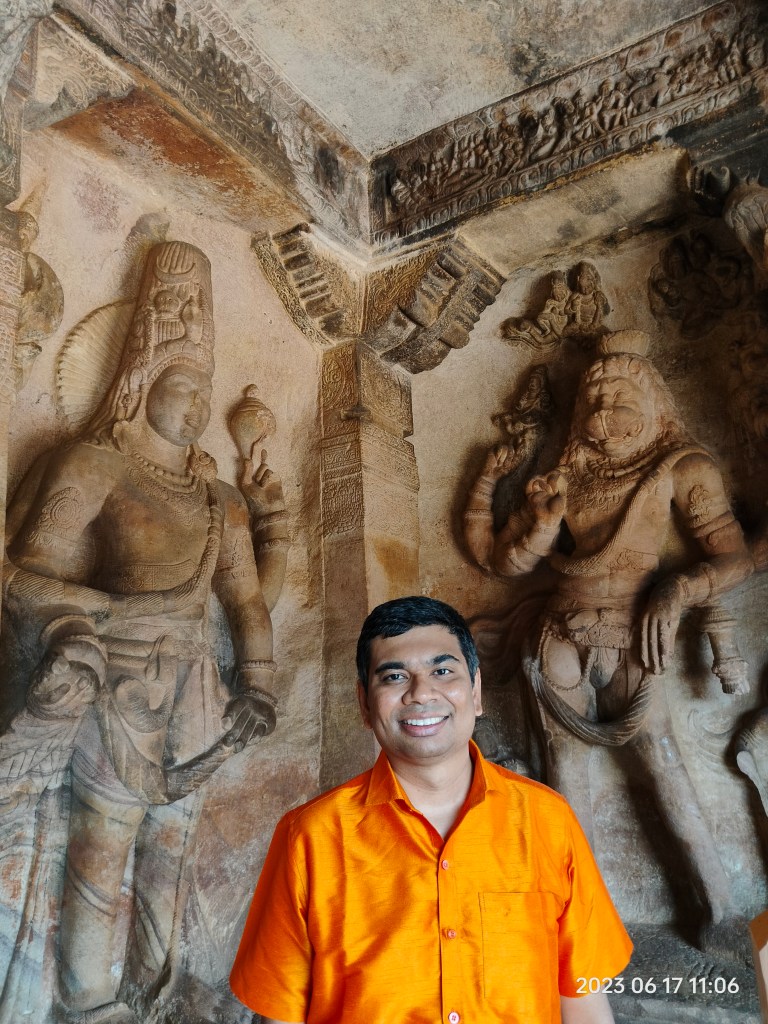
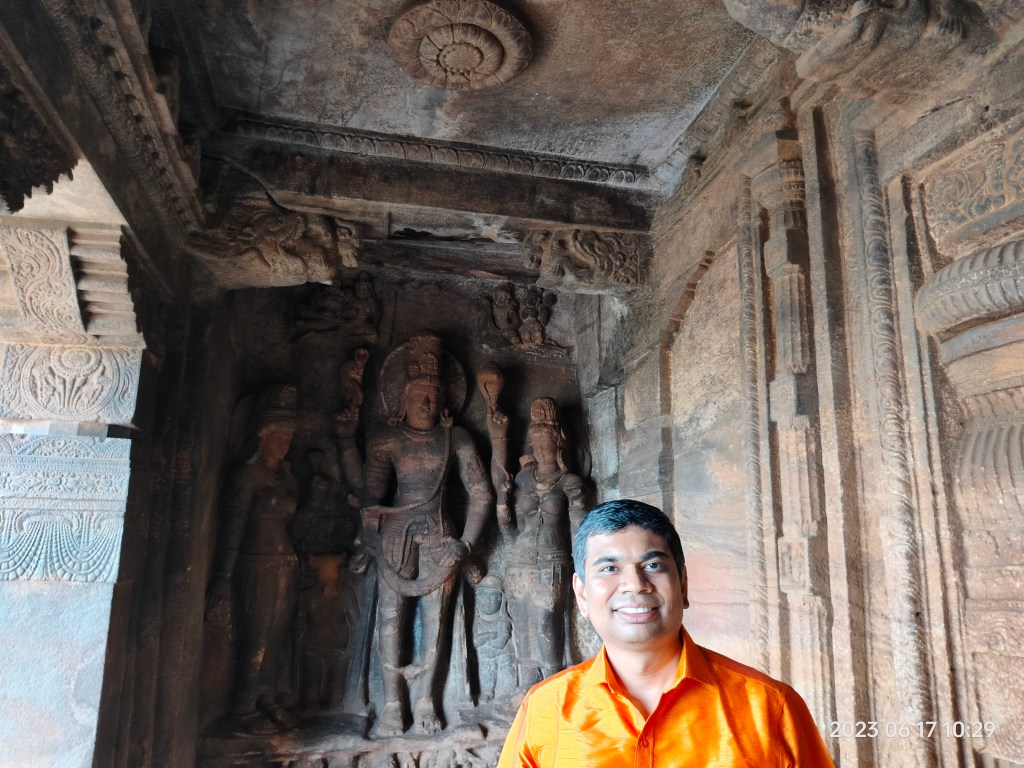
Though the overall maintenance of cave complex is good, there are bats flying around inside the caves . Also, there is strange unpleasant odour (bat droppings ?) which make it impossible to linger inside caves for more than few minutes. Thankfully most of the carvings are on outer side of the caves.
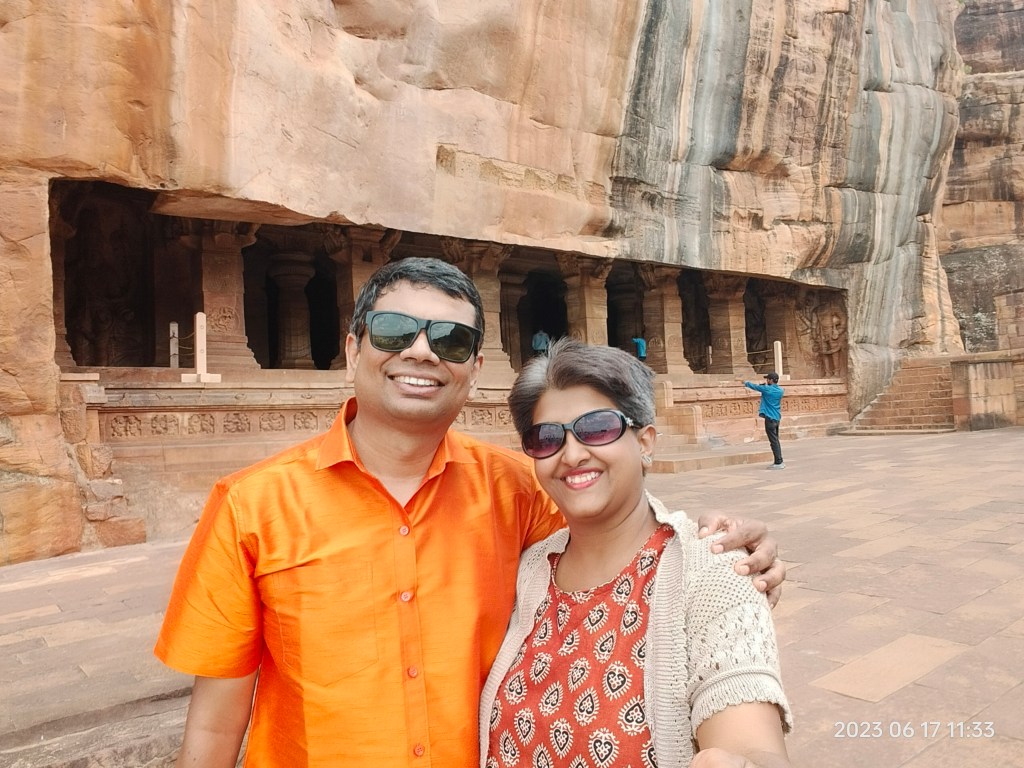
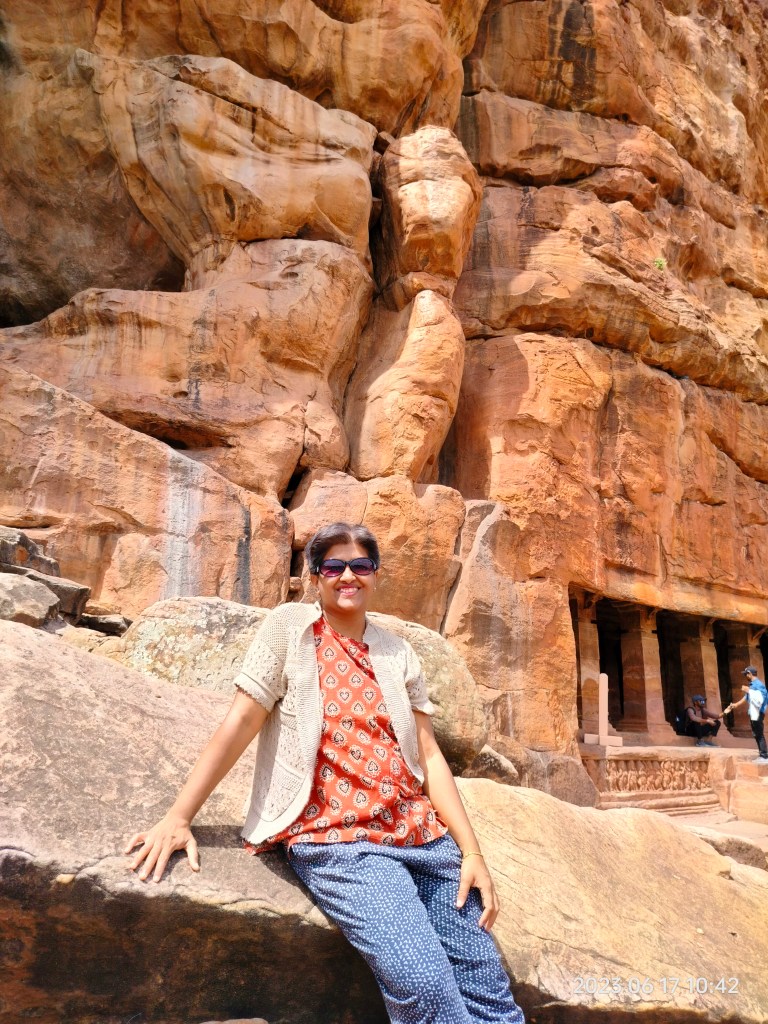
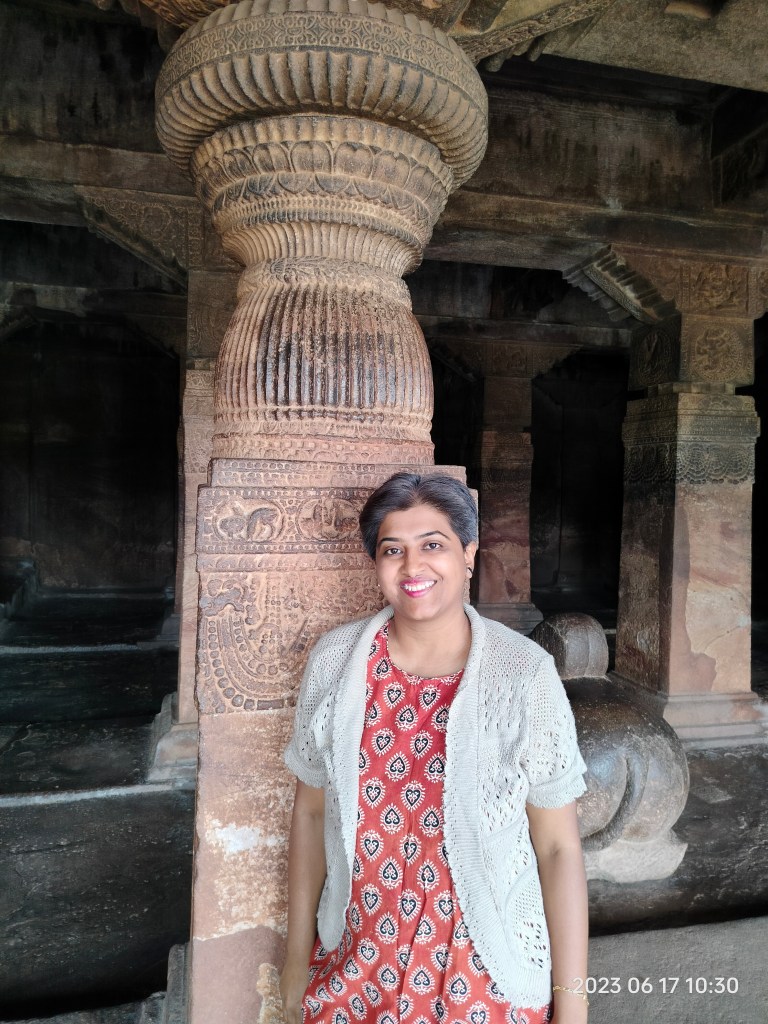
Link to the video from Cave-3 is given below
There was enormous rush of tourists which surprised me, since June is not tourist season. On enquiry, I found the crowd surge was due to free bus pass for women travellers. Rather than seeing the attractions, the focus of young women appeared to be on photo shoots and videos ! I did not envy the job of security guards who had to manage the crowds.
We then proceed to visit Banashankari Amma Temple dedicated to Goddess Banashankari or Shakambari, an incarnation of the goddess Parvati. It is located at Cholachagudd, about 5 km away from Badami Caves. This Goddess is family deity of many families in Karnataka and Maharashtra and hence attracts large number of devotees. Though not architecturally significant, one can feel the presence of divinity in temple premises. After seeking blessings of the goddess, we headed back to Badami.
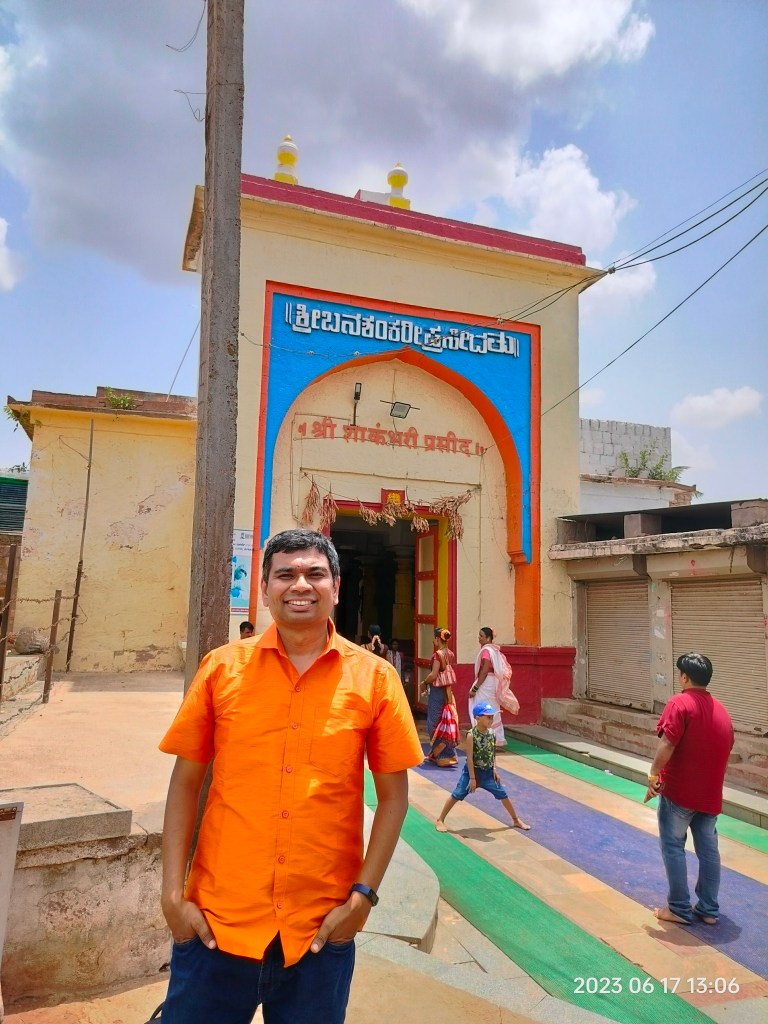
We had lunch at another Lingayat Khanavali ( was as good as any other) and went back to hotel. Due to oppressive heat, we could be outdoors only in the morning and preferred to rest in afternoon
18-Jun-23
This was our final day in Badami and we had planned to visit the Northen Hill – on which are two Shiva temples and remains of a military fort
The weather was clement and suitable for our ascent. This hill is made of many huge rocks and one must make way through narrow passes between boulders. Our first stop was at a plateaus with two mantapas. The view from this point is quite spectacular with Agastya lake and Bhootnath temple complex clearly visible. Next, we visited a temple known as Lower Shivalaya which is now in ruins.
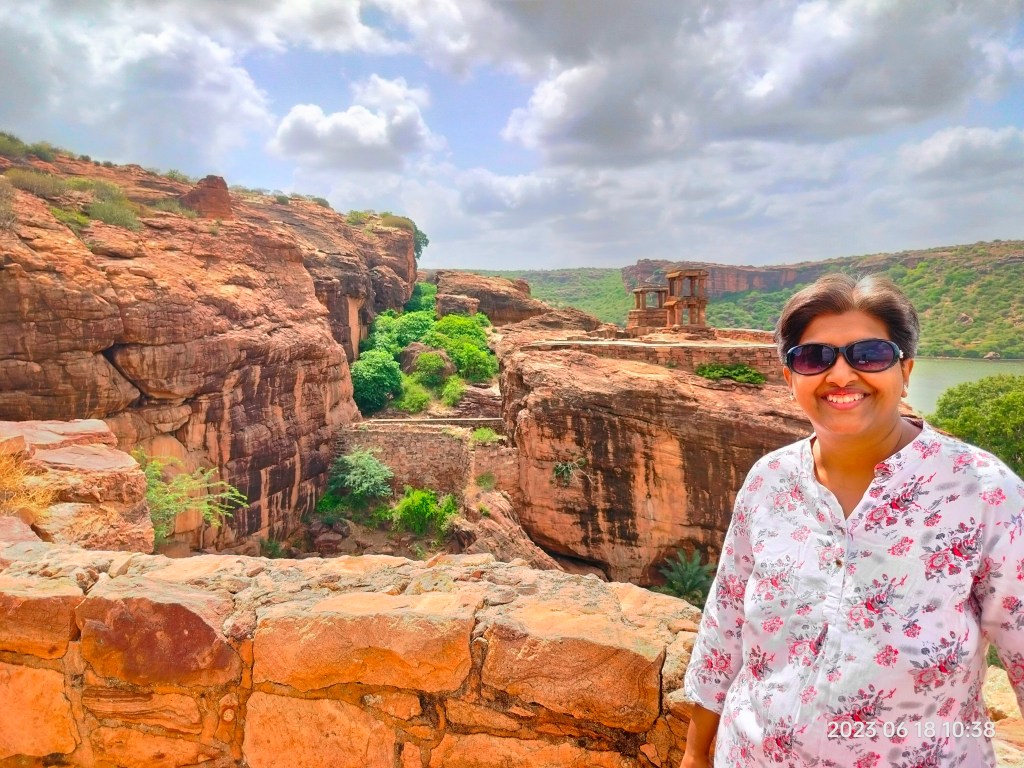
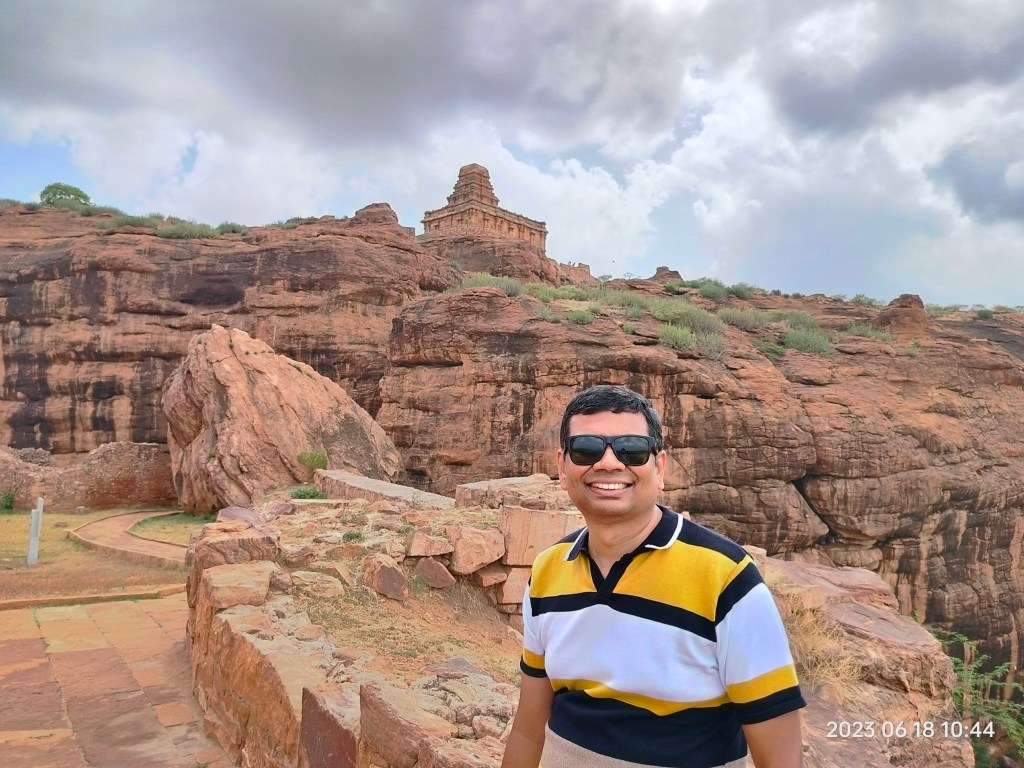
As we walked up to the Upper Shivalaya, the views of the surrounding boulders were impressive. Some travellers have compared this landscape to Petra in Jordan with its passes and gorges.
Link to the video from Northern hill is given below
On top of the hill is a plateau on which is Upper Shivalaya temple. The carvings on the walls of this large temple quite elegant.
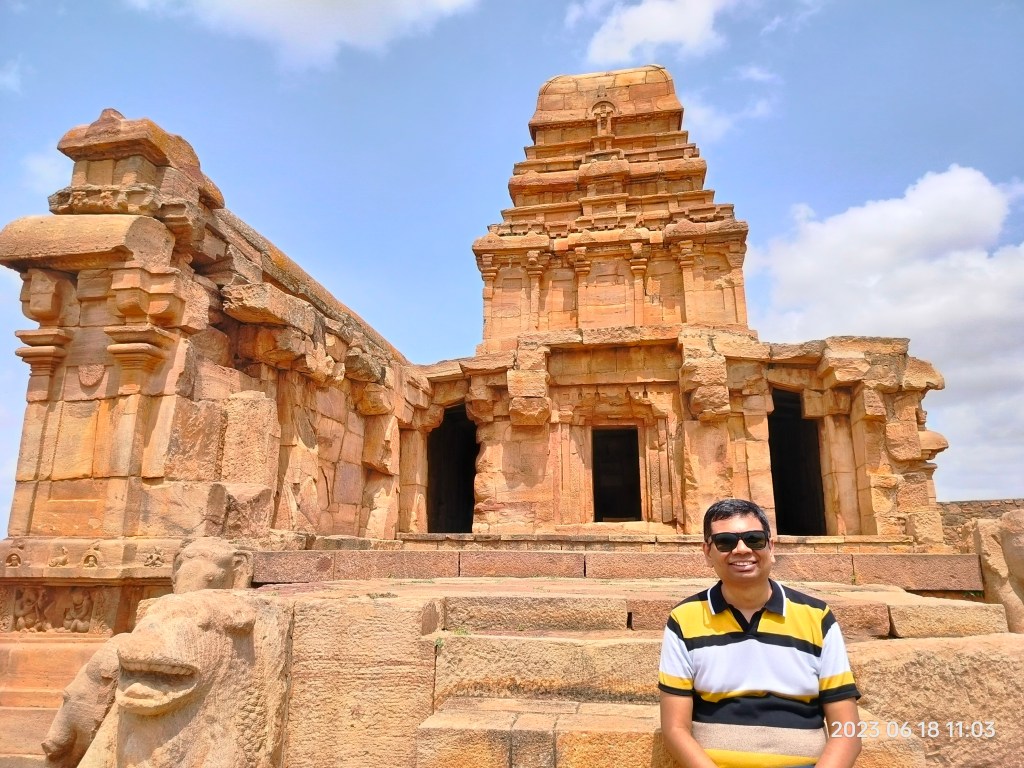
On way down we visited the remains of the old fort. This was at commanding height with good view of the town. Also were two strange looking structured which one assumes to be granaries.
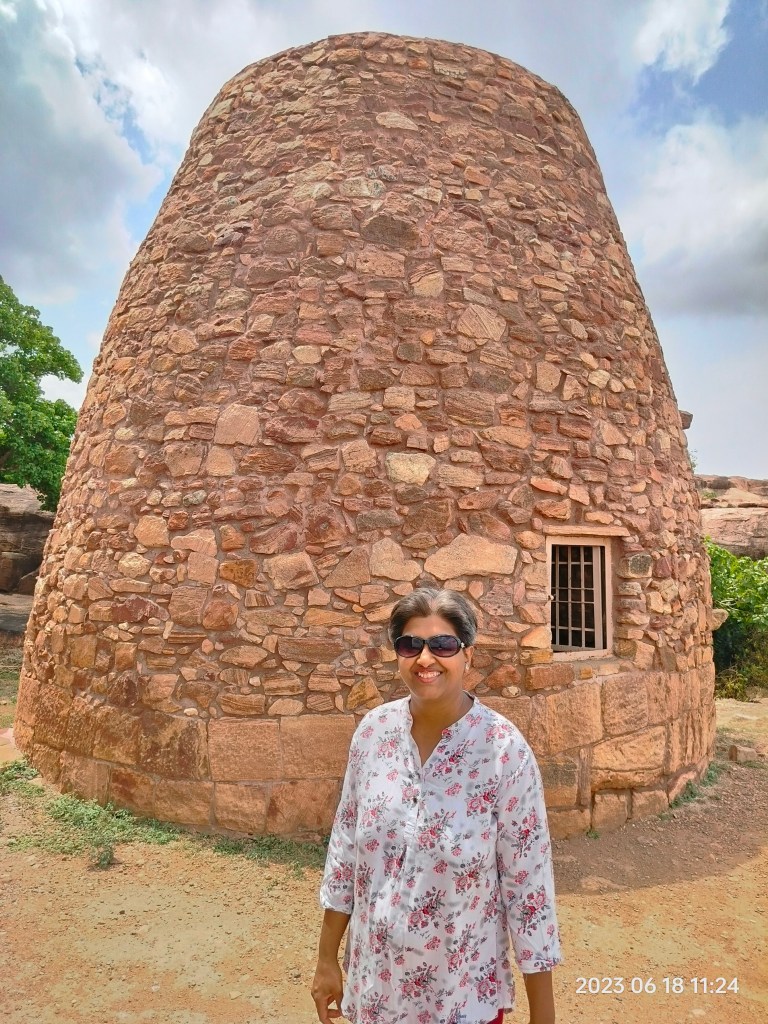
As we descended the fort, I marvelled the technological and architectural skills of ancient Indians. While we admire the bridges and buildings which last 100 years, structures in Badami have withstood vagaries of nature for 1300 years !
While Badami is not yet a popular destination, this town has good road and rail connectivity ,is modestly expensive and Hindi/English is understood extensively. Hopefully, in near future this quaint town will become a new tourist hotspot.
One of my cherished childhood memories is that of a South-India-package tour. For around 10 days, we visited various temples and tourist places in Tamil Nadu and Kerala. Though I have limited memory of that trip, I remember the visit to Vivekananda Rock Memorial in Kanyakumari and the choppy boat ride.
I was keen to visit Kanyakumari given its deep connection with Swami Vivekanand. And presence of Vivekanandpuram was an additional attraction. However, in order to add something new to our itinerary , we decided to visit Varkala in Kerala. Few years ago, Varkala was a little-known beach town which shot into prominence in last decade, primarily due to its popularity with western tourists.
07-Mar-23
We had booked Bangalore-Nagercoil express which departs from SMVT train terminus. This is a new railway station which was recently inaugurated by PM Narendra Modi. Since we were not sure about how long it would take to reach there, we left well in time. We were pleasantly surprised to see the train station, which is built like an airport; with escalators, food-courts and plenty of open spaces. Even ascetically, it is very pleasing. This is “new India” where we are finally getting the infrastructure we deserve !
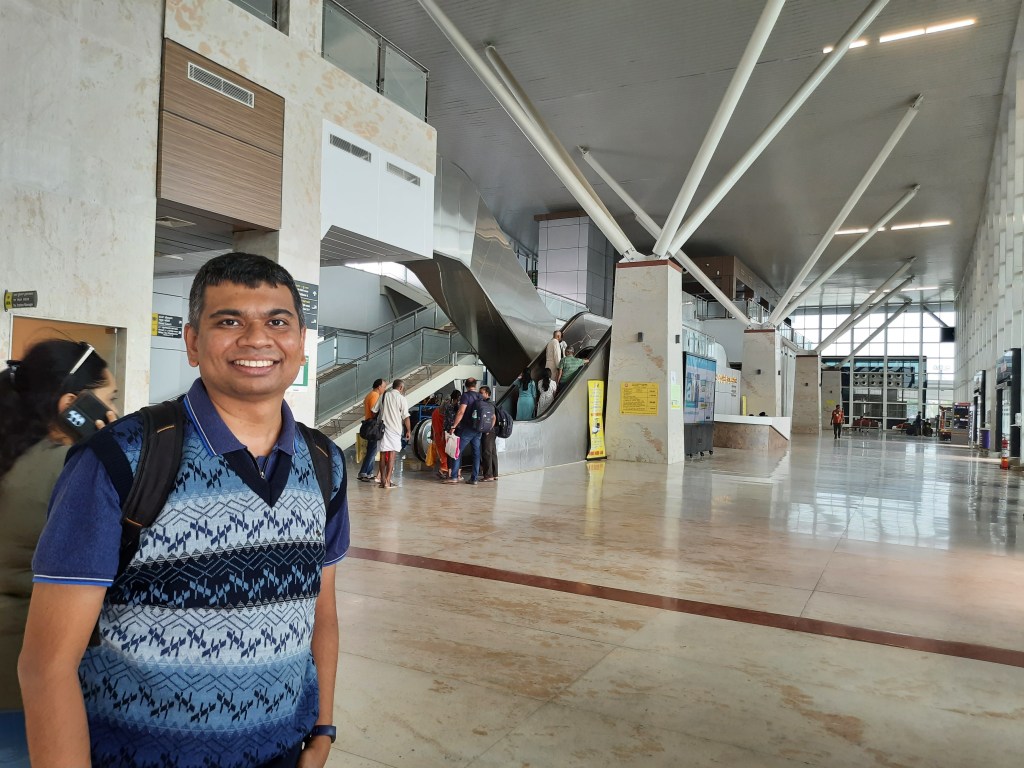
08-Mar-23
After a comfortable journey, we arrived at Nagercoil at around 7:30 AM. Nagercoil is an important city in the district and is around 15 KMS from Kanyakumari town. We hired an auto-rickshaw and reached hotel “Temple Citi” around 8:30 AM.
One of the key learnings from my travels is to visit the key attractions on priority. Given the huge popularity of Vivekanand Rock Memorial, it was obviously first on my list. We took a short break at the hotel and left for the ferry boarding point.
Vivekananda Rock Memorial is the most popular tourist attraction in Kanyakumari. In December 1892, Swami Vivekananda, swam across the sea to reach the rock where he meditated for three days and nights . It is believed that Swamiji was inspired to serve humanity during his meditations here.
The Vivekananda Rock Memorial was fructified through tireless efforts of Eknathji Ranade – a dedicated Sewak of Rashtriya Swayamsevak Sangh (RSS). He played an instrumental role in the constructing of the Vivekananda Rock Memorial by overcoming numerous political and financial challenges.
I had planned my vacation such that we would be in Kanyakumari during middle of the week. On weekends and holidays, this place is overwhelmed by tourists and have read about those who had to wait for 3 hours to visit the Vivekananda Rock Memorial !
We however, had a short wait of about 15 minutes and boarded the ferry for the 10 minutes ride. The waves were very choppy and the boat swerved wildly. A group of north Indian tourists started chanting bhajans of Lord Hanuman and others joined in. The surprising part in Kanyakumari was the number of north Indian tourists we encountered. I had never heard Hindi anywhere else in Tamil Nadu, but in Kanyakumari, not only the tourists but even the local auto-drivers, tourists guides, restaurant staff were conversant in Hindi. This is in sharp contrast to my experience elsewhere in Tamil Nadu where I struggled to communicate as I do not speak Tamil.
Once we reached the Rock Memorial, we were impressed by the grandeur of the structure. Truly a monument befitting Swami Vivekananad. Eknathji Ranade’s super-human efforts will benefit the generations of Indians. We first visited the main mandapam which has the life size statute of Swami Vivekanand and images of Sri Ramakrishna and Holy Mother Sarada Devi. Besides it, is the meditation hall where we meditated for few minutes and headed to the book store.
The unique aspects of the book store is the availability of spiritual books in different Indian languages. I bought a few books in English and Marathi ,especially on the works of Ekhanthji Ranade.
The link to the video of Vivekananda Rock Memorial is given below
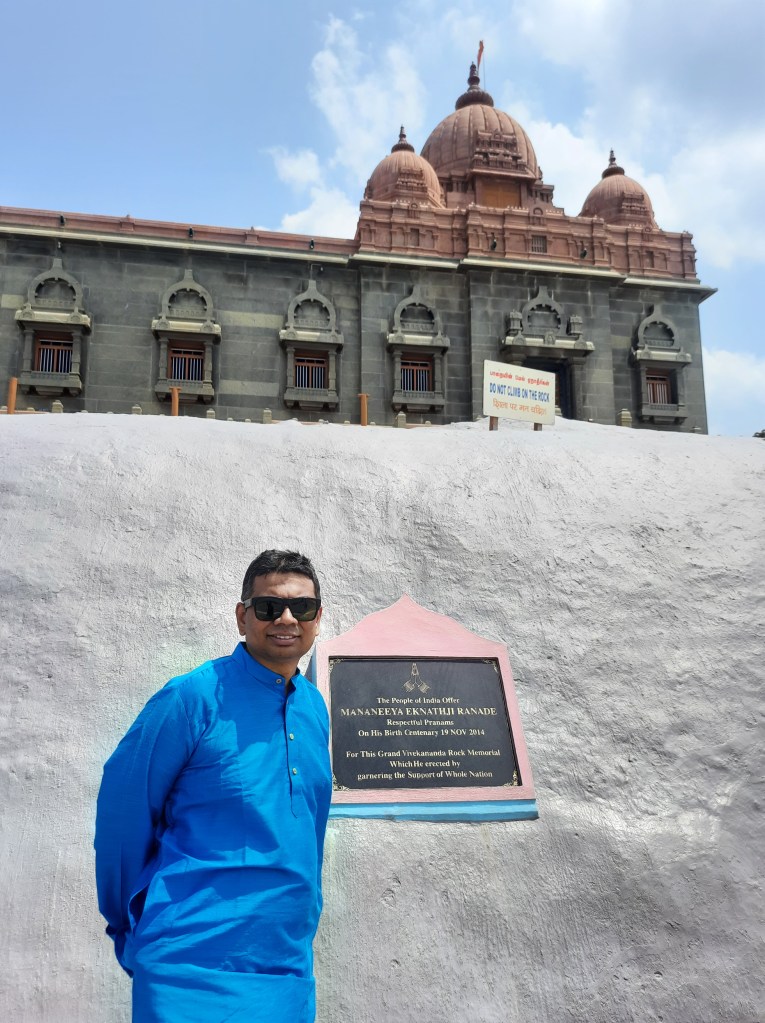
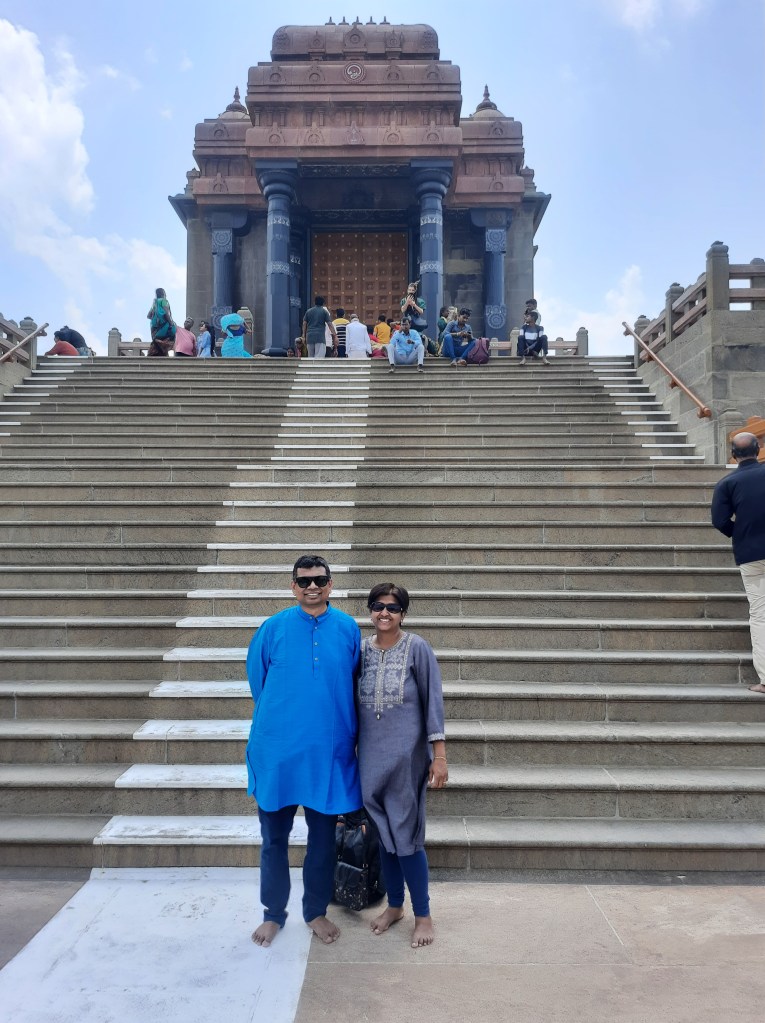
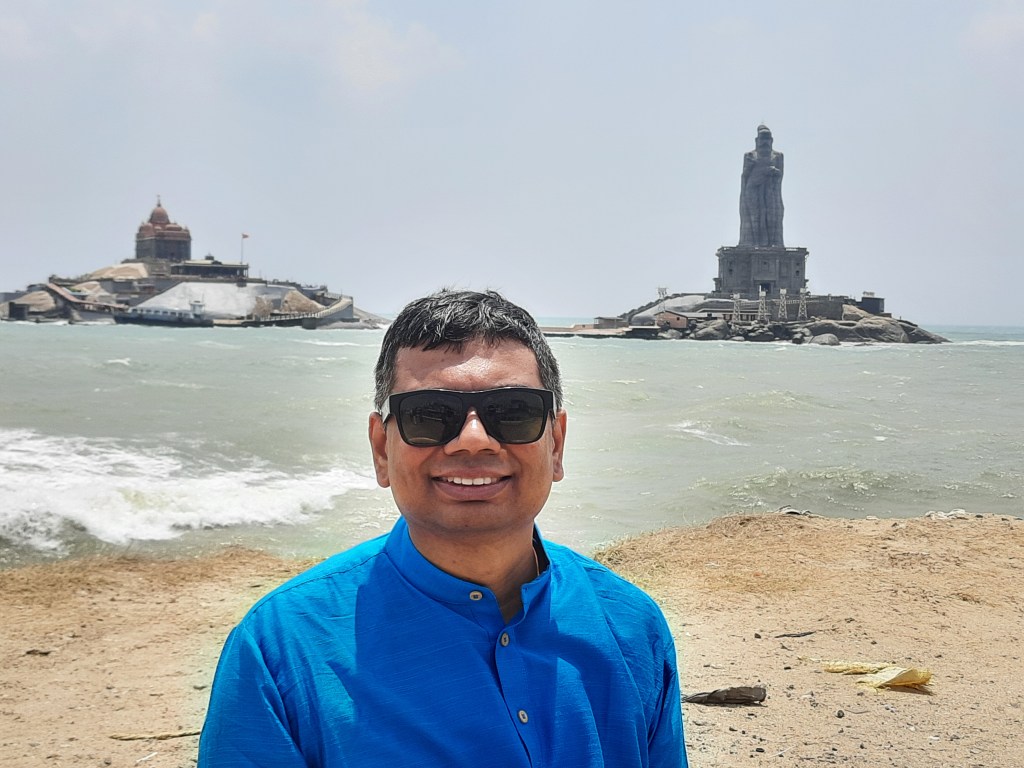
Once back on mainland, we hurried to visit the Bhagavati Kumari Amman Temple (also called Devi Kanya Kumari temple). This goddess is a manifestation of the Hindu goddess Mahadevi in the form of an adolescent girl. According to legend ,her marriage with Shiva was cancelled due to stratagem of Narada who wanted Kanya Kumari to slay demon Banasura. It was preordained that Banasura would be killed only by a virgin, and hence the Kanya Kumari slayed the demon after a fierce fight.
Today the confluence of seas is considered to be holy and devotees bathe in it to absolve their sins.
The link to the video of Triveni Sangam is given below
The temple remains closed from 12 PM to 5 PM and this is true for every temple we visited in Tamil Nadu. In my view, the temple management should re-consider this timing, given the large number of devotees who visit from all over India.
There were very few devotees and we could see the goddess from close. She was dressed on wonderful attire and lighting was mesmerizing . We bowed down to the other gods in the temple and headed back to the hotel.
For lunch, we choose Suchindram Maruti vegetarian restaurant for lunch. The simple Tamil style thali meals suited our taste, and we lunched there next day as well . For dinner we visited North Indian style Delhi Punjabi Dhaba which was acceptable in terms of taste and hygiene.
Viewing sunrise and sunset are the highlights of Kanyakumari. This is unique place where one can view both from nearby spots. In the evening, we firsts visited the “pier”, which is a rocky extension of about 500 meters into the sea. The wind was howling and we could barely hear ourselves speak. In fact, strong wind was a constant during our entire stay there.
The link to the video of Kanyakumari pier is given below
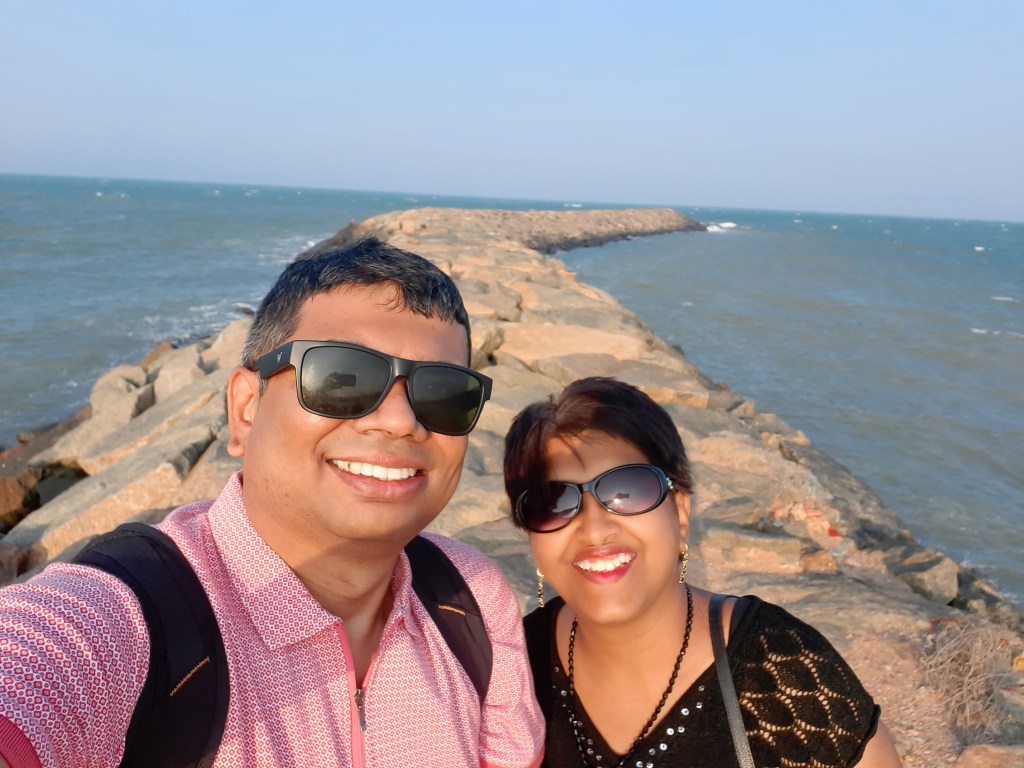
We then hired an auto-rickshaw to visit the Kovalam beach – about 3 KMS from main town (not to be confused with Kovalam beach near Thiruvananthapuram in Kerala). There is good infrastructure to view the sunset from benches, towers etc.
The sea in Kanyakumari is very rough and entering water is not , recommended . In fact , there are policemen on the beaches to dissuade anyone who attempts do so. So we took our seats and viewed the beautiful sunset.
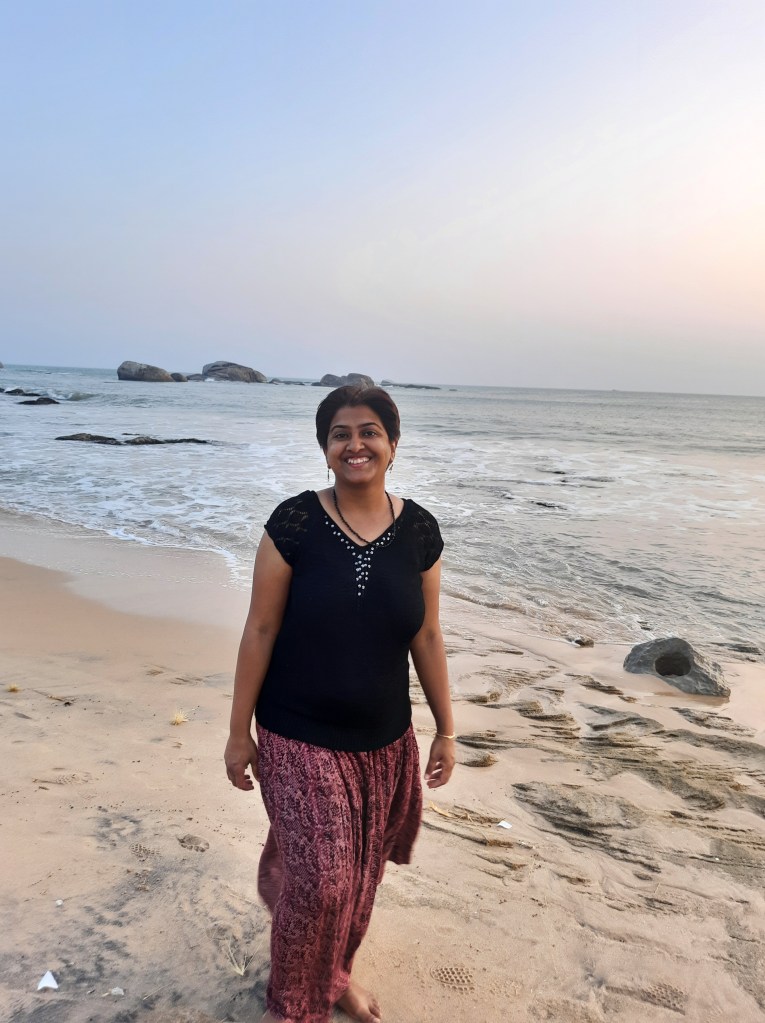
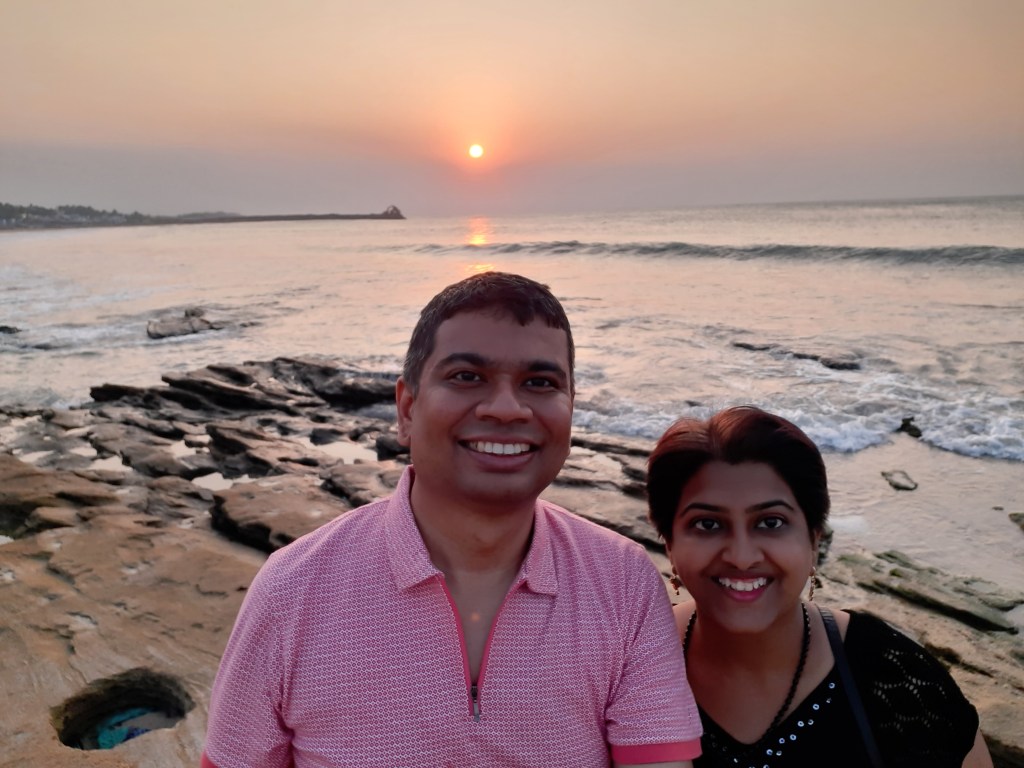
We ended our first day in Kanyakumari with memories of this sunset
09-Mar-2023
Kanyakumari is one of the few places where one can view sunrise as well as sunset. Hence on the second day, we woke up early at 5:30 AM ( not common occurrence in my life !) and headed to the Sunrise viewing point. It was a cloudy morning, hence we could not view the actual sunrise but it was quite a sight to see the sun rays over the sea at such an early hour.
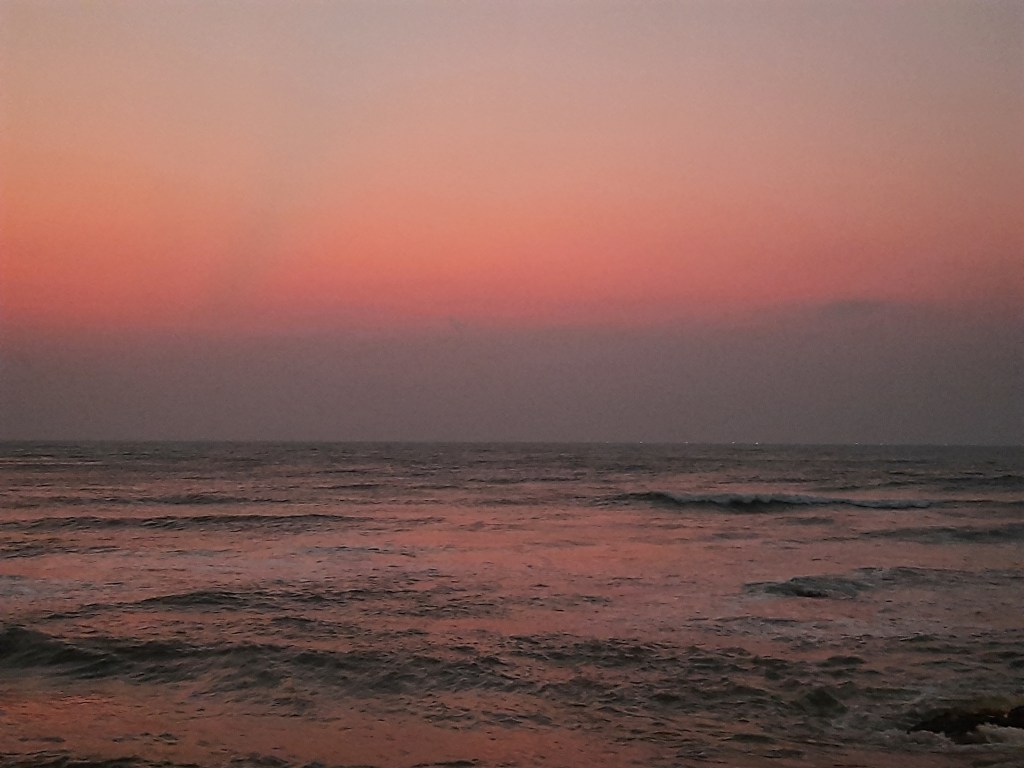
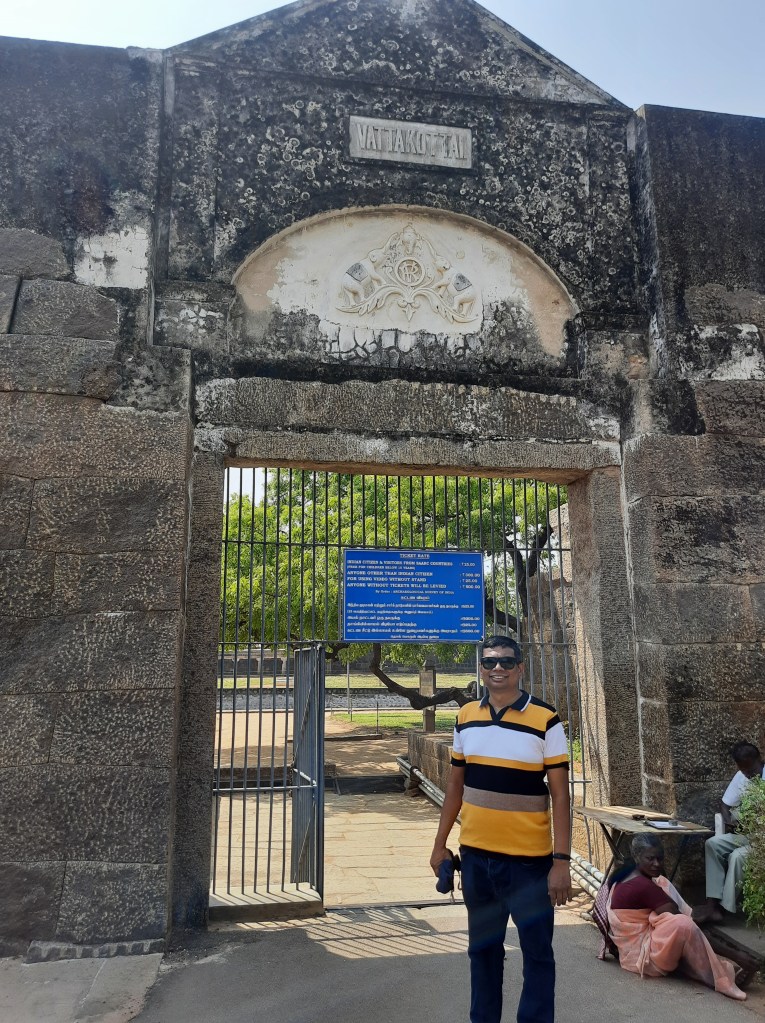
Post our breakfast at the hotel, we decided to visit the lesser known attractions of Kanyakumari. We hired an autorickshaw and headed to Vattakottai fort about 6 KMS from our hotel
Vattakottai fort was built in the 18th century as a coastal defence-fortification by the former Travancore kingdom. It commands a picturesque view of the Bay of Bengal on one side and hills on the other. There is nothing much inside the fort and we took some pictures from vantage points.
The link to the video of Vattakottai fort is given below
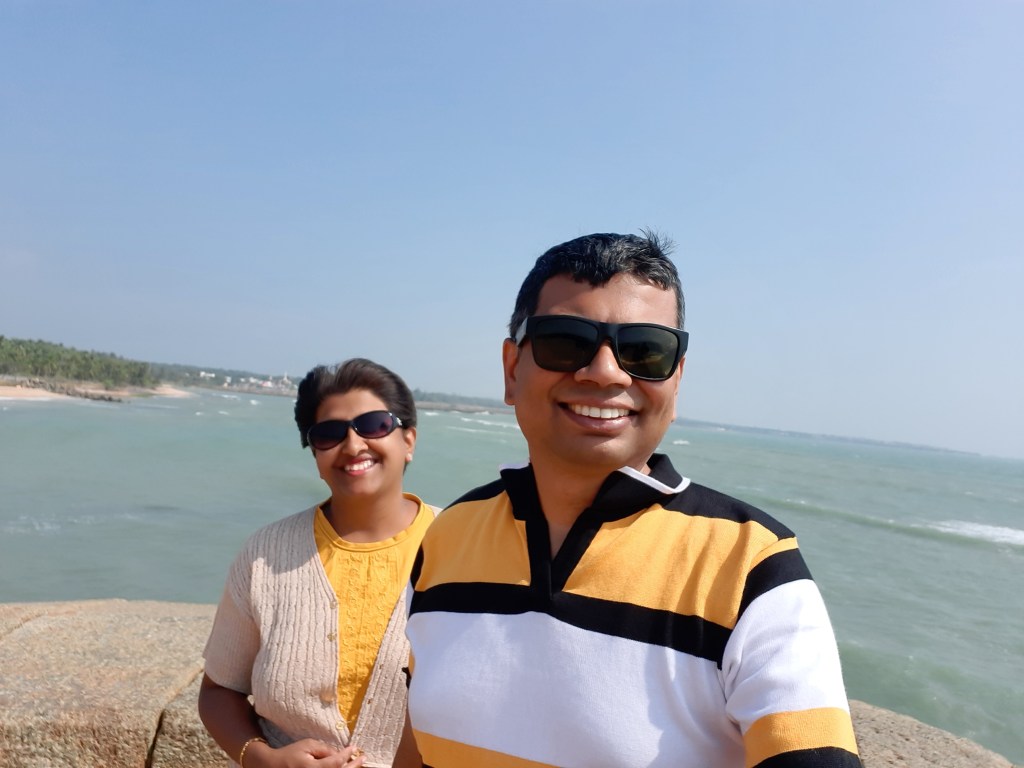
On our way back we saw a sign board “Dattatreya temple”. Lord Dattareya is a well known Hindu god in Maharashtra and I was intrigued to see his temple in Kanyakumari. It is a fairly modern temple and managed entirely by Maharashtrians. Truly, the cultural distances are decreasing and we are becoming “one India”
That evening, we visited the most interesting part of Kanyakumari – ‘hidden twin beach”. As the name suggests, it is not well known and we were the only tourists on its small but beautiful rocky shoreline. It was good experience to view the sun set from this beach
The link to the video of Hidden Beach is given below
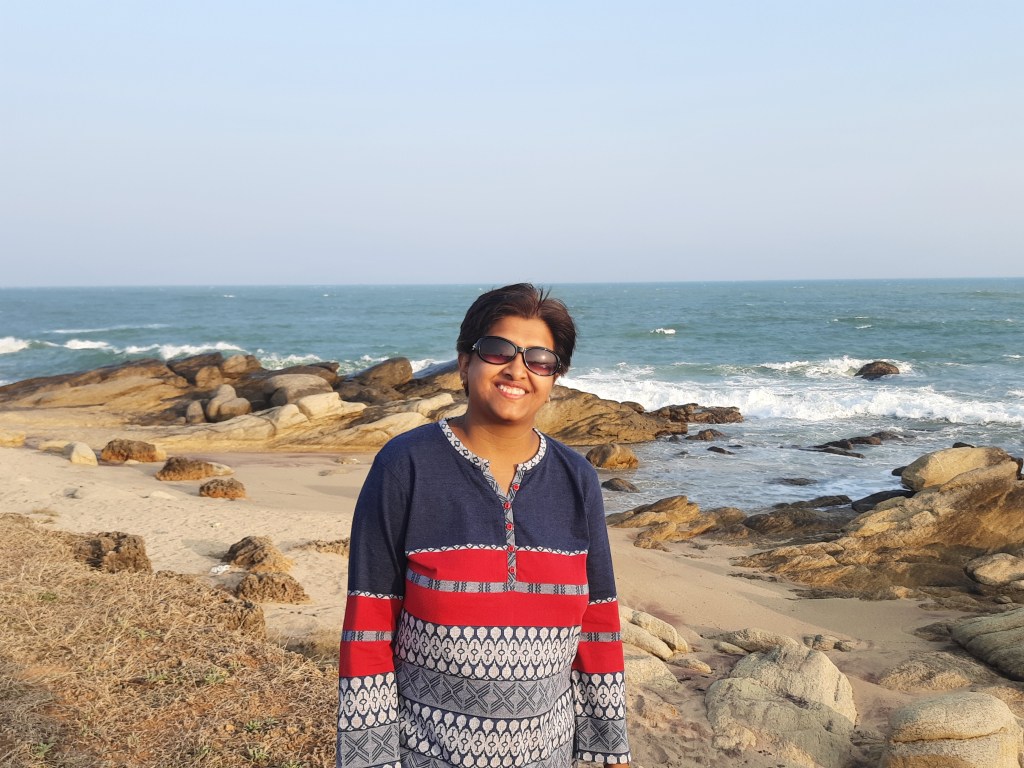
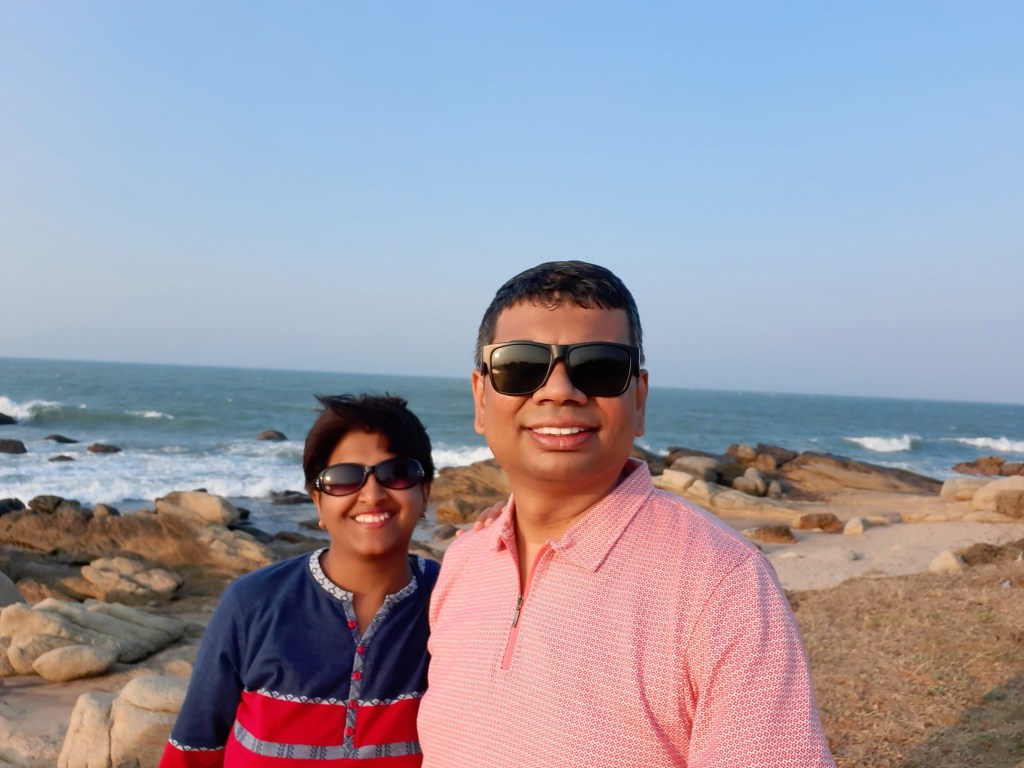
Though Kanyakumari is a very popular tourist destination amongst tourists from all over India, the infrastructure of this town does not appear to have kept pace with the rise in tourists. One can easily imagine the chaos and confusion during the holidays. Its recommended to visit only on weekdays and preferably in non-peak-season.
09-Mar-23
Next morning we checked-out of hotel to board a train to our next destination – Varkala in Kerala. In last few years, Varkala has become one of the most sought-after beach destinations amongst Indian and international tourists. The key attraction is the cliffs adjacent to the Arabian sea, the only place in Kerala with such geographical feature.
The train network in Kerala and Tamil Nadu is pretty good and it is a convenient way to get around. We boarded the Kanyakumari-Pune express at 08:40 AM after having breakfast at the railway station.
After a pleasant journey , we arrived at Varkala railway station and checked into Dahlia Beach resort near the beach. There is no construction allowed on the beach itself and all the hotels are on the cliff which overlooks the beach.
After a quick lunch at local restaurant which served home made food and some rest, we headed towards the cliff. This reminded us of Cola Beach in south Goa, which has similar views from elevation. After clicking a few pictures from the cliff, we walked down around 100 steps to the beach. This is one of the longest and broadest beaches I have ever seen . Though it was fairly crowded we found a quiet spot to view the sunset. Sunsets from beach never fail to mesmerise me !
Post sunset, we walked around the market on the cliff. There are numerous restaurants and shops here and one can spend few hours on this strip.
Link to view of Varkala beach from cliff
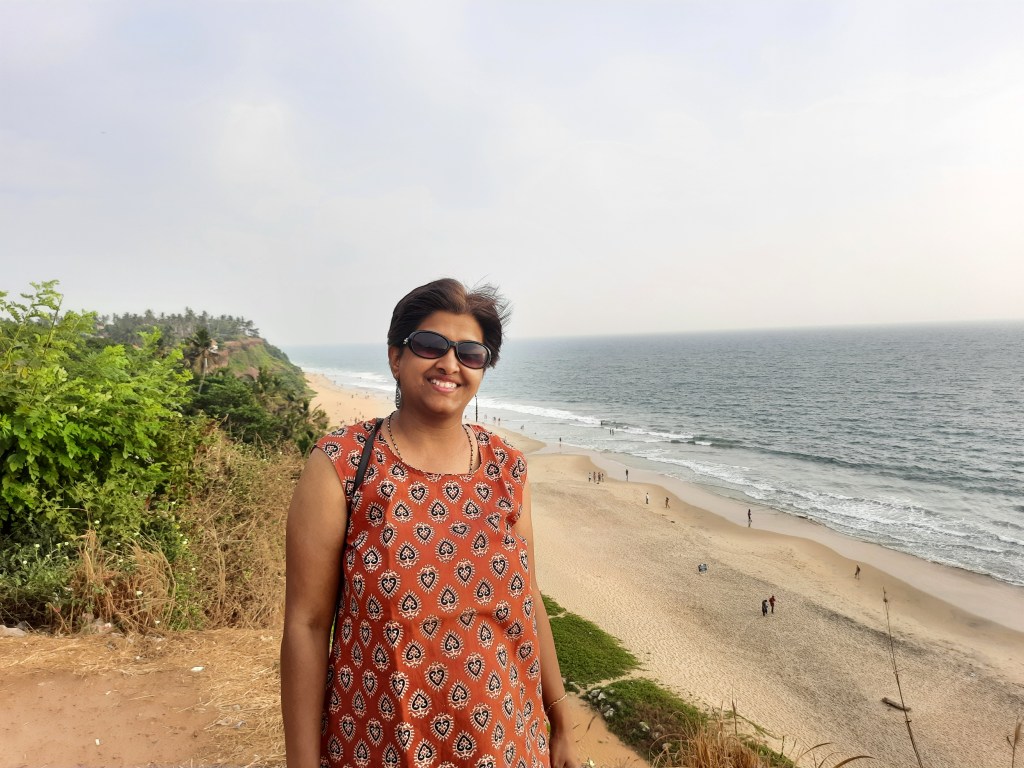
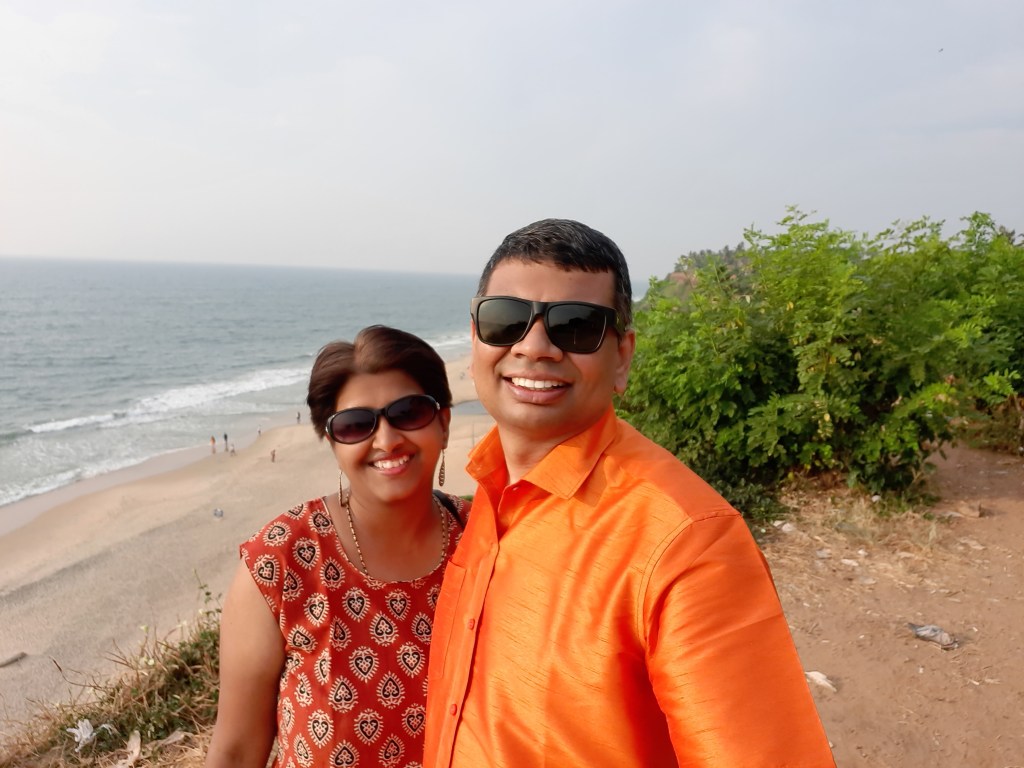
We dined at Little Tibet restaurant, but it was a bit of a search to find anything suitable for vegetarians. Am sure as the number of tourists increase, there will be few high-quality vegetarian restaurants, but till then it is a challenge for those like us.
10-Mar-23
Next morning, we hired a two-wheeler (INR 500 per day) and visited the little know Kappil beach. Adjacent to this beach, is an estuary which flows into the sea. After a scenic ride of about 7 KMS, we reached the beach. The last few meters were not tarred and one must drive on the sand , which can get very tricky !
The views of sea, the coconut trees and the estuary together create a splendid view and spent some time there. The water in estuary was crystal clear and appeared more like lake water
These isolated beaches are excellent for those who want to get away from the crowds and just view the sea in all its splendour
The link to the video of Kappil beach is given below
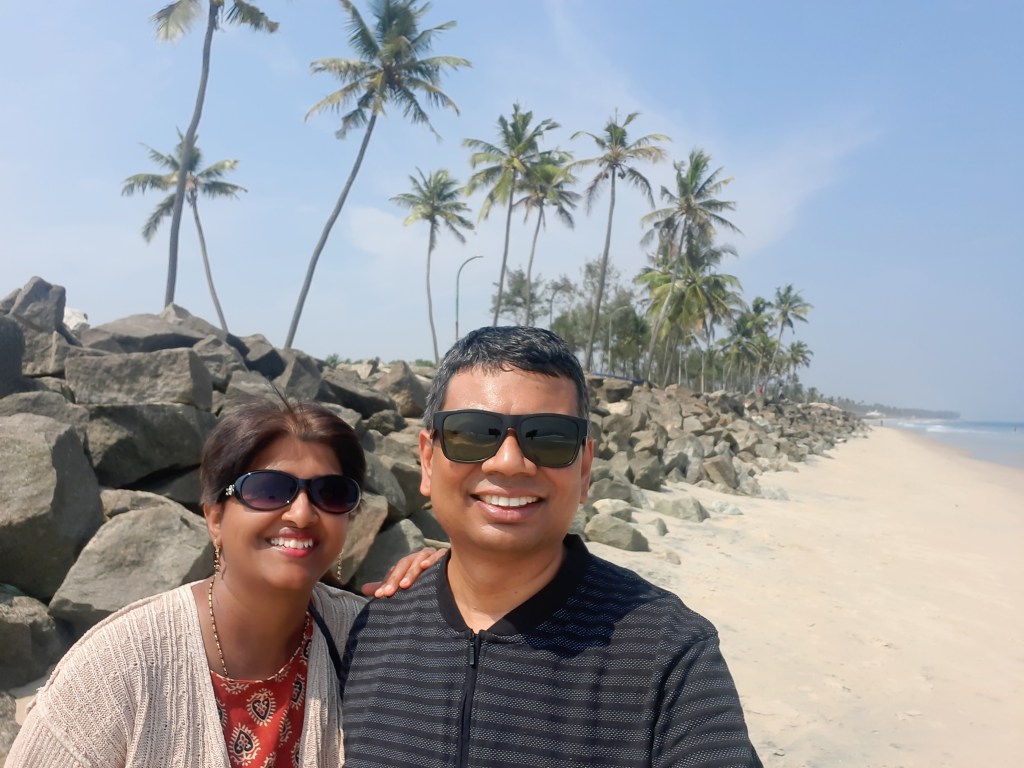
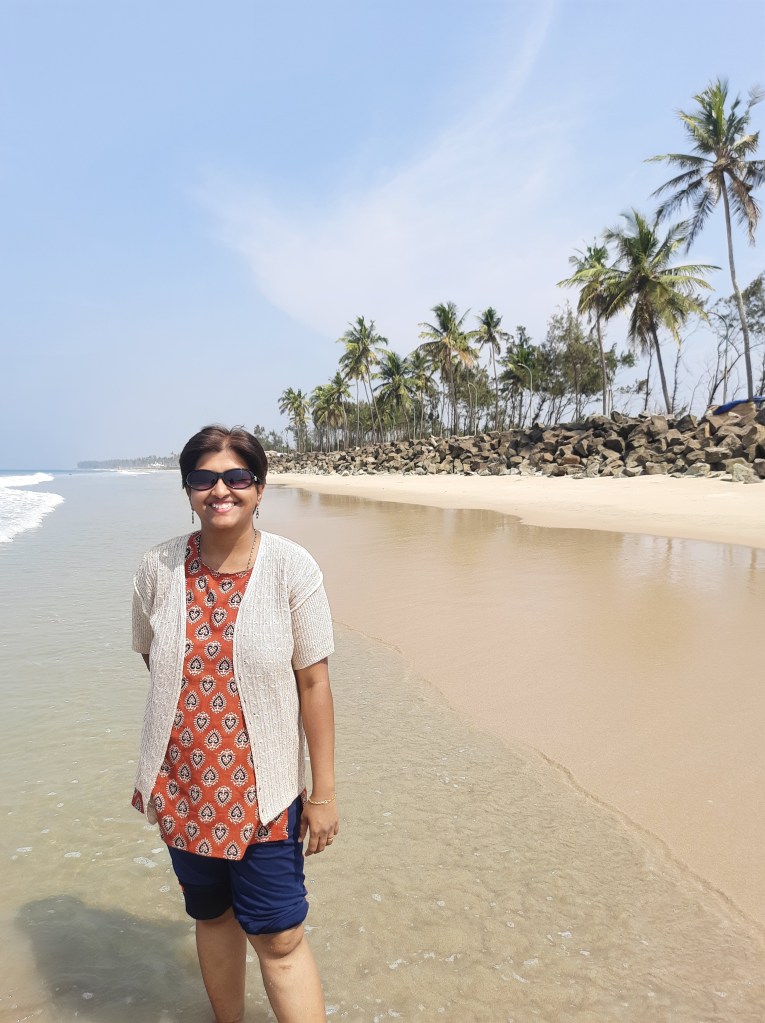
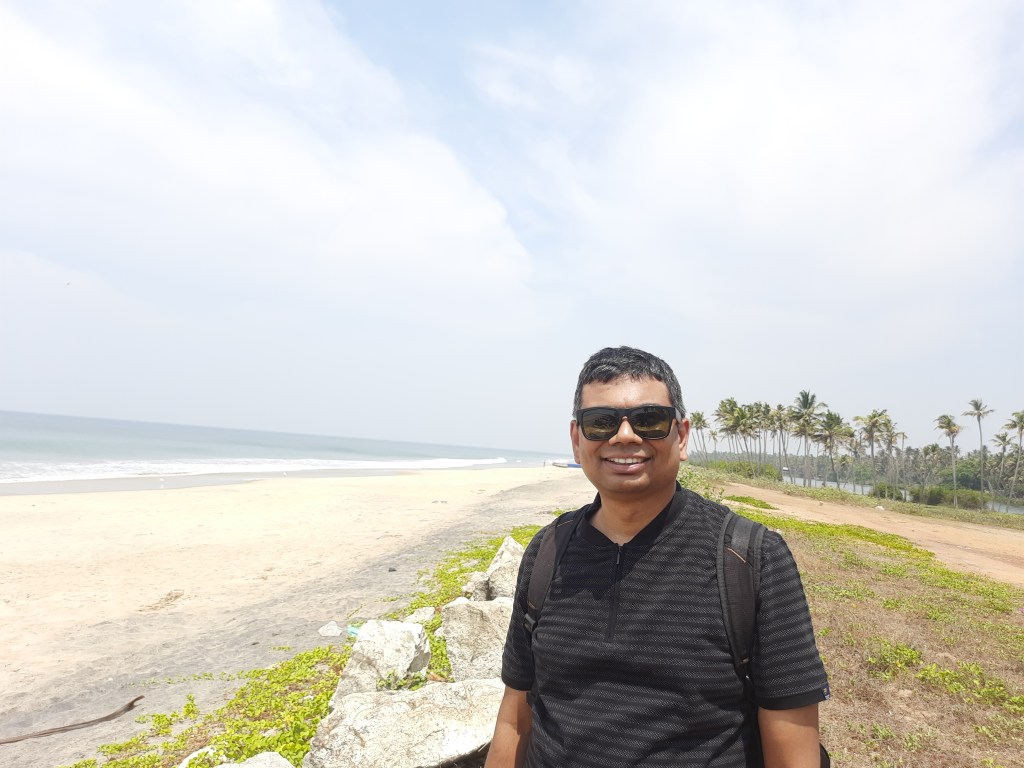
That evening we went for a long walk on the Varkala beach. With water splashing on our feet, we walked for more than 2 KMS, viewing the sunset. I find this to be a therapeutic experience
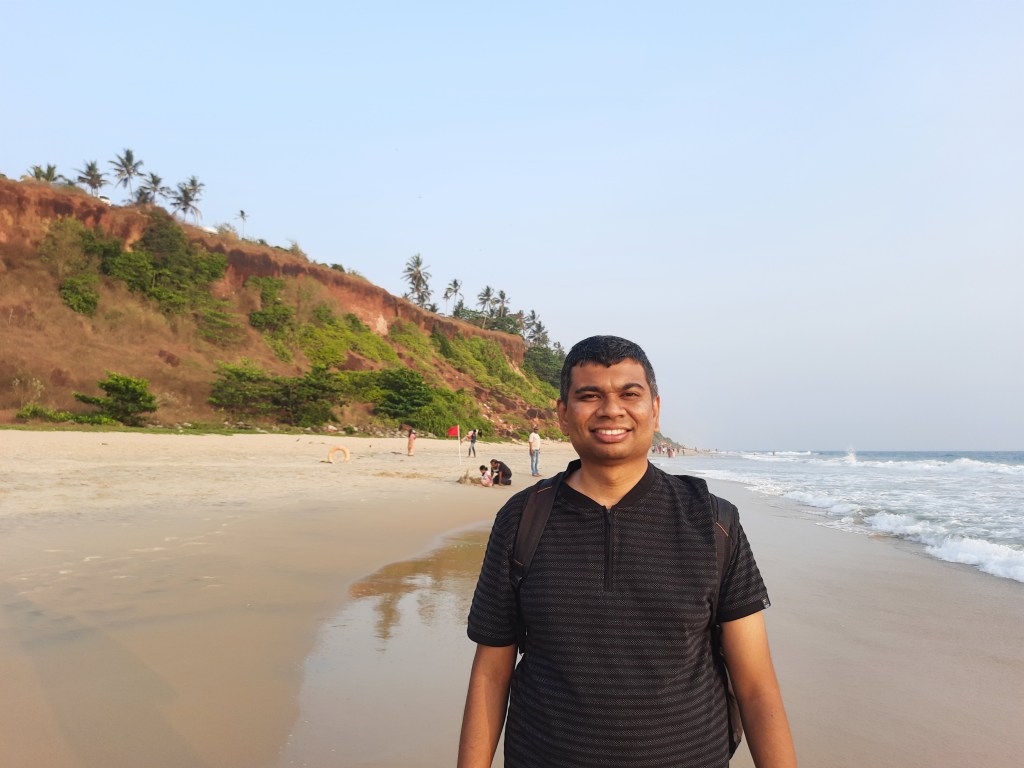
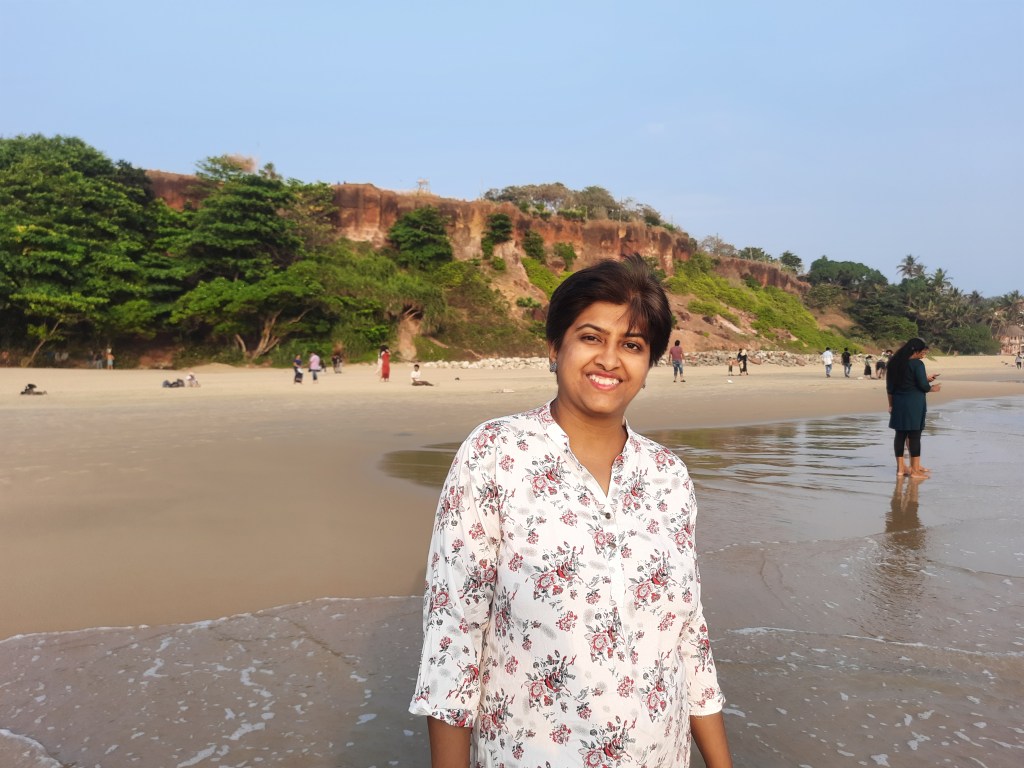
Our next destination post sunset was Janardana Swami Temple which is a 2000+ year-old temple dedicated to Lord Vishnu. It is a fine example of Kerala style architecture with circular sanctum sanctorum and conical dome. This is large and well maintained temple complex with other deities like Shiva, Hanuman, Garuda etc. I spent about 30 minutes here before heading back to Varkala cliff.
The numerous shops lining the cliff provide an opportunity of shopping for clothes, handicrafts, imitation jewellery and souvenirs.
12-Mar-23
Our final day of vacation start bright and sunny. We just walked around the cliff to click a few pictures and departed to railway station. The vendors and auto-drivers in Varkala speak good Hindi and we found the place to be friendly and relaxed. It is easy to understand why it has become so popular.
In this trip, I could not visit the Sivagiri Mutt, where the Sree Narayana Dharma Sangham headquarters are located. It was founded by Sree Narayana Guru to propagate his concept of “One caste One Religion and One God” for man. A place to visit next time in Varkala.
As we boarded our train to Bangalore, I reflected on the different places we had visited in our short vacation; from Vivekananda Memorial, temples, beaches and forts. Truly there is so much to see in our magnificent country !
“Where should be go for winter vacation” – that was a question I was pondering for a while. After shortlisting few options like Pondicherry, Kannur, Kodaikanal etc, I finalized my old favourite- Goa ! This time however, we planned to visit the southern most part of the state, bordering Karnataka. South Goa is not popular as North and I wanted to explore some of the lesser-known beaches in that area.
So on 3-Nov-22, we boarded the Panchaganga express – Bangalore to Karwar at 07:00 PM and planned to take a taxi from Karwar to Goa.
04-Nov-22
On 4-Nov-22, we alighted at the quaint Karwar railway station at 8:00 AM. Surprisingly, the train had arrived 30 minutes earlier ! In all my travels, I had never experienced early-arrival and that too by half an hour. I took this as a good omen and got into the taxi which would take us to Alba rooms in Palolem- South Goa.
The drive on NH 66 (previously NH 17) was very pleasant and we entered Goa in less than half an hour. After few more minutes we arrived at Alba rooms Hotel in Palolem. As usual, we preferred hotel which was right by the beach and more so in Palolem, which is known for its night life.
After resting for a while we hired a two-wheeler for the length of our stay (INR 400 per day) and went around Palolem. Few decades ago, this was a quiet fishing village and it has maintained its old-fashioned charm. There are no glitzing malls and boutique shops here that one sees in North Goa. I found most of commercial establishments are run by locals which is always a good sign.
That evening, we decided to ride down to Galgibaga beach , a distance of about 8 KMS from Palolem. This is one of the lesser-known and cleanest beaches of Goa. It’s a nesting ground for Olive Ridley turtles and hence no commercial activity is allowed here. Hence there are no shops, shacks , restaurants etc on this beach. The sunset from here was mesmerising and after spending some quiet time here, we headed back to Palolem
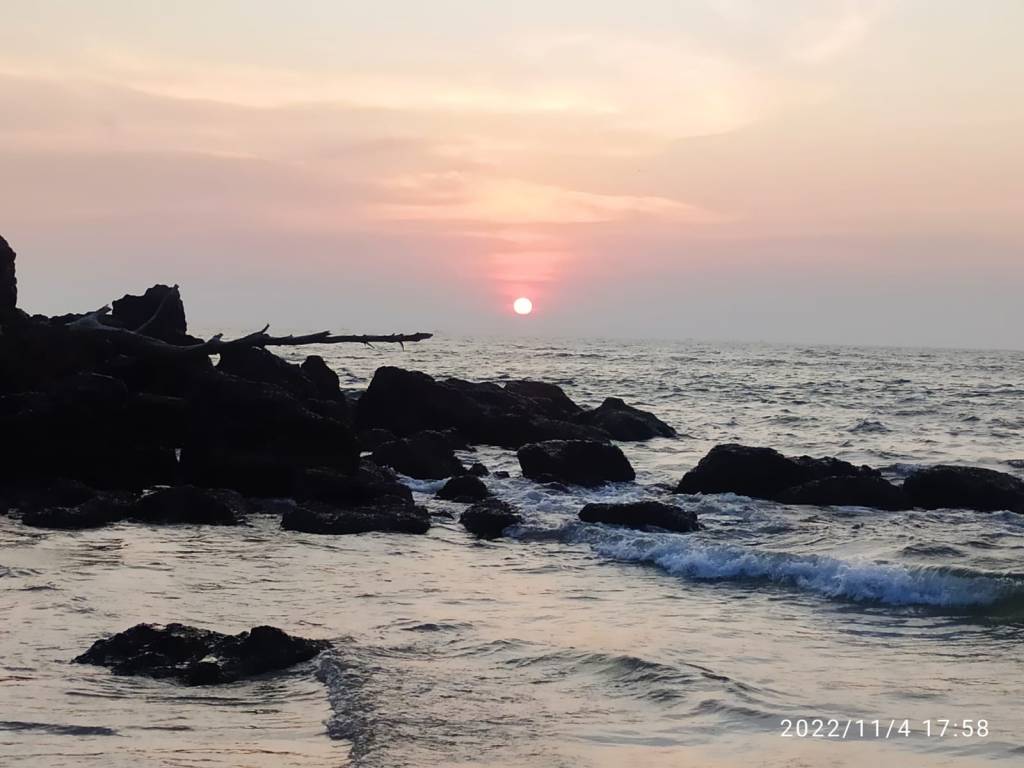
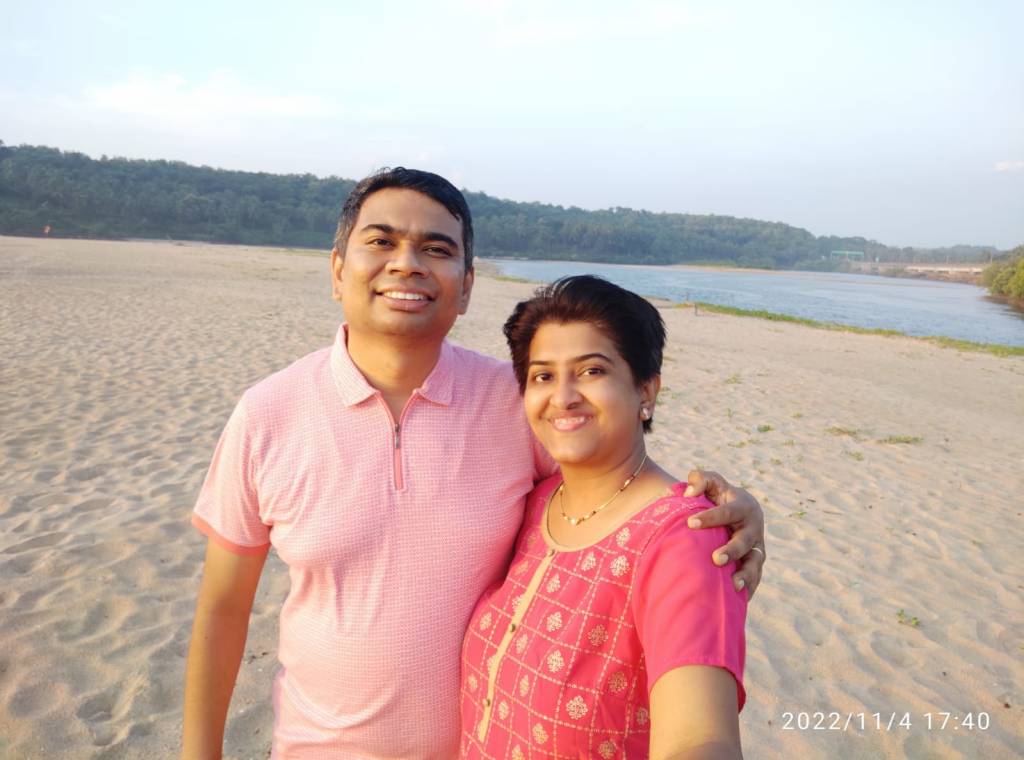
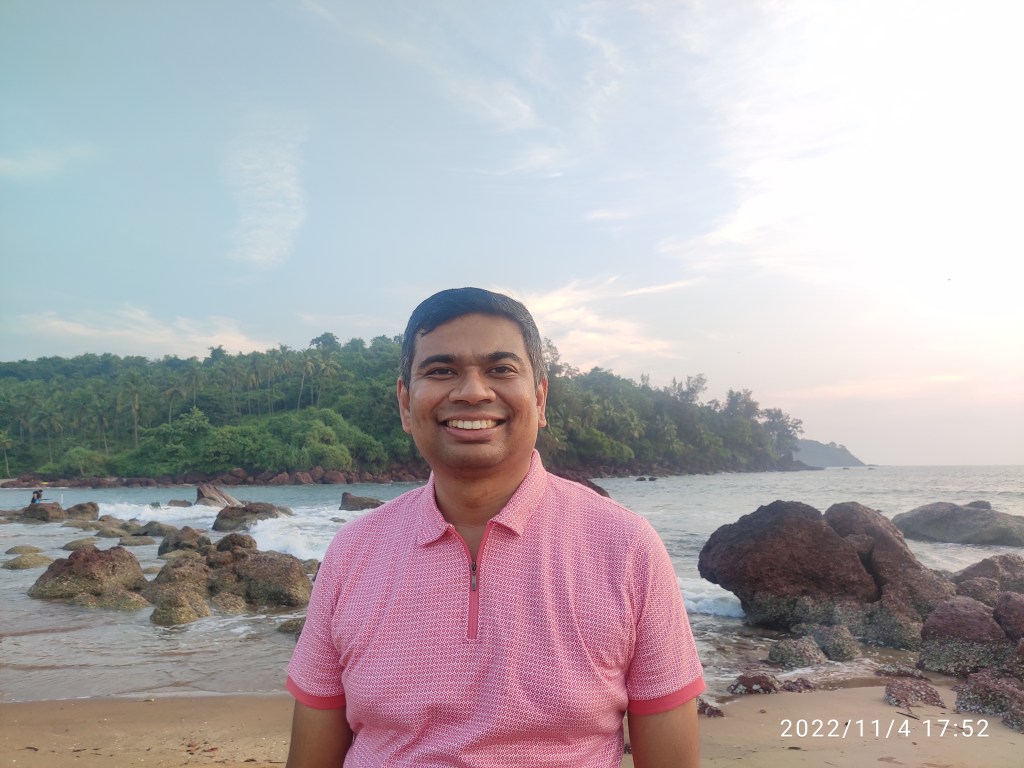
The link to the video of Gaglibaga beach is below
5-Nov-22
Next day we were up early and got ready to visit the most famous attraction of South Goa – Cabo de Rama fort which derives its name from Lord Rama. Legend says that Lord Ram and Sita had stayed here during their years of exile. Over last few centuries, this fort withstood gruesome battles between the Portuguese, Marathas, Muslim invaders, and Hindu kings, and was finally used as a prison by the British till 1955.
The fort is about 27 KMS from Palolem and I enquired about the cost of taxi. The rates were exorbitant and non-negotiable, which is a challenge in entire state of Goa. CM Pramod Sawant had made an announcement that app based taxi will be available soon, but it does not seem to have materialized. Hence, we decided to ride on our two-wheeler which was a good decision. The road was excellent and ride scenic taking us through forests and fields and we arrived at the fort around 10 AM.
The fort is now in ruins, but offers a spectacular view of the beaches below. About 100 or so steps below is the “Pebble beach” which is a small cove-like rocky beach with round pebbles scattered all around. The descent to the beach offers multiple vistas of the sea and one can take few breaks on benches placed by local vendors.
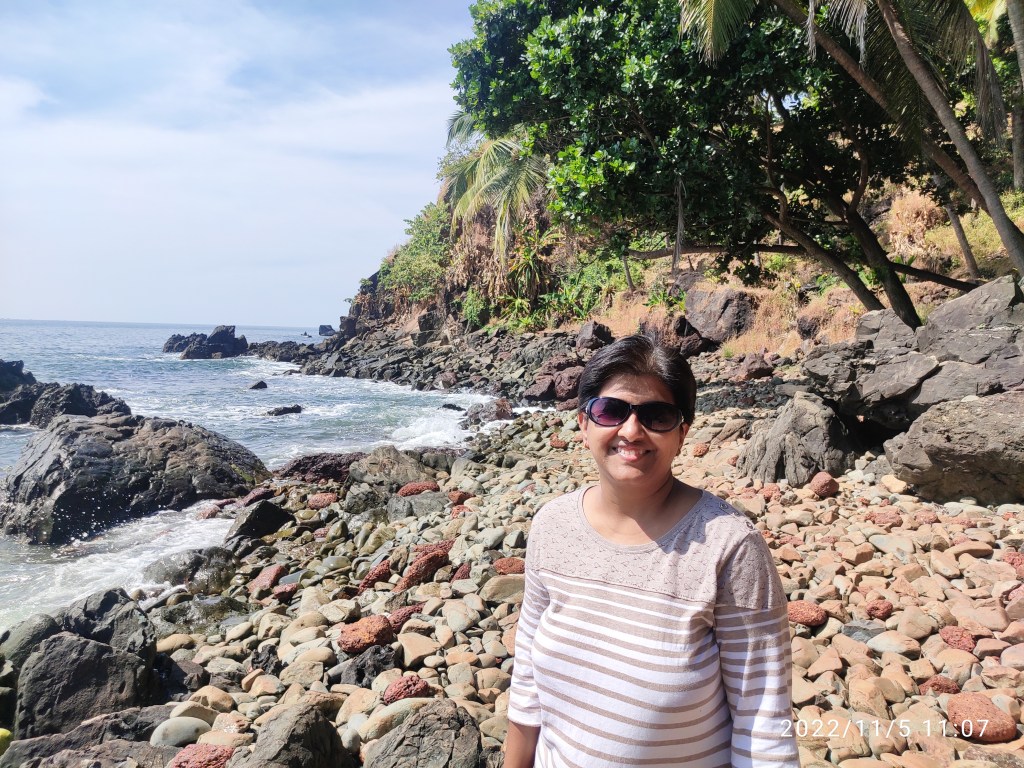
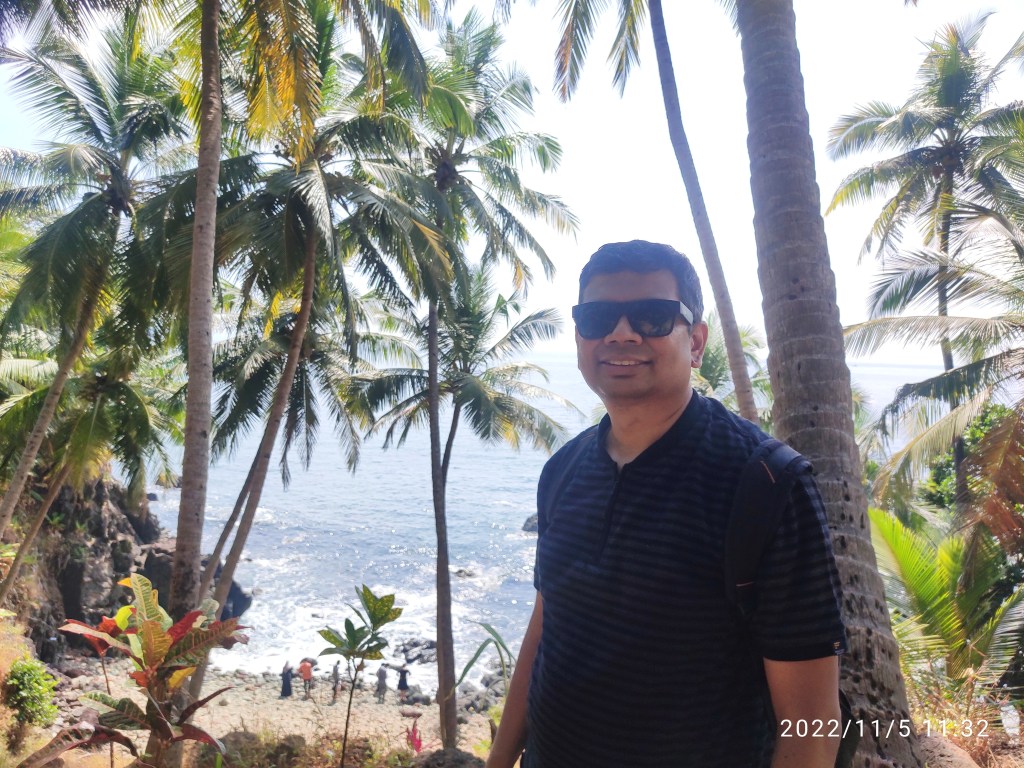
The link to video of Pebbles beach is given below
The sunset from the top of the Cabo de Rama fort is quite popular, however, we prefer to visit sites in daytime as we can spend more time at our leisure
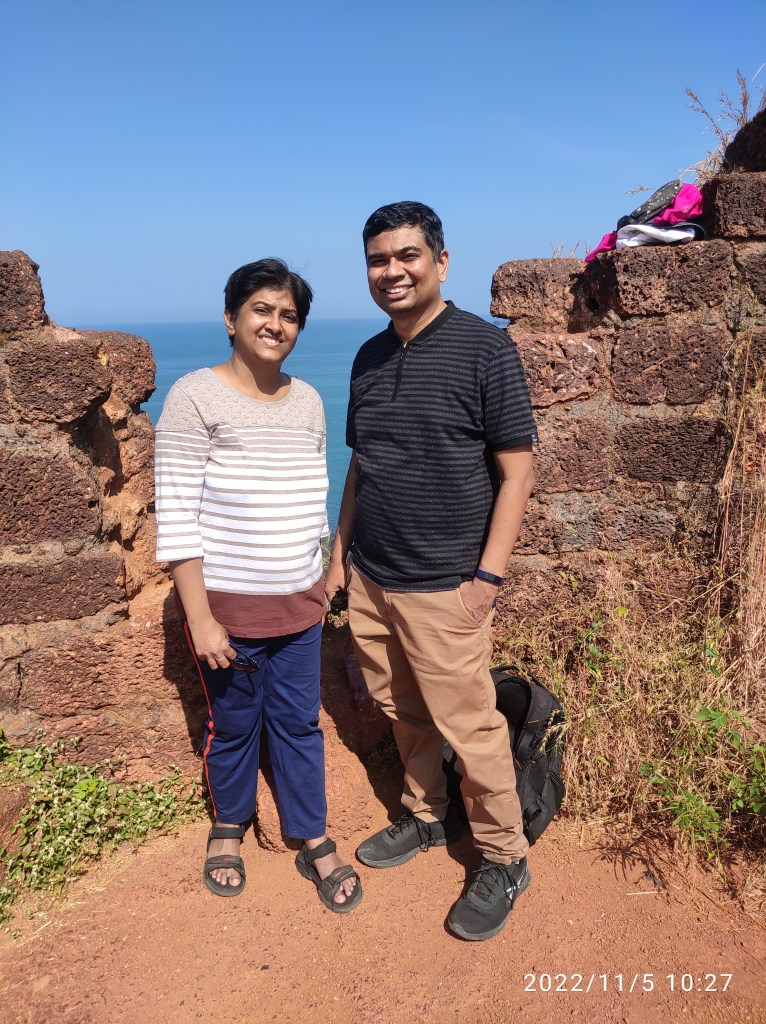
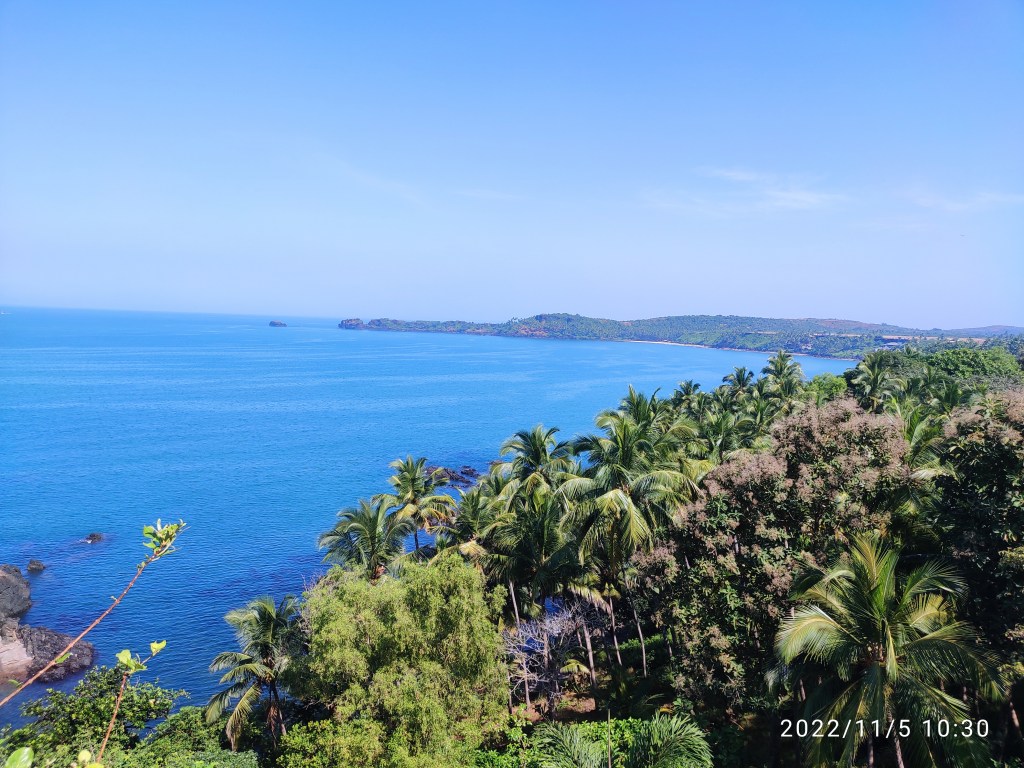
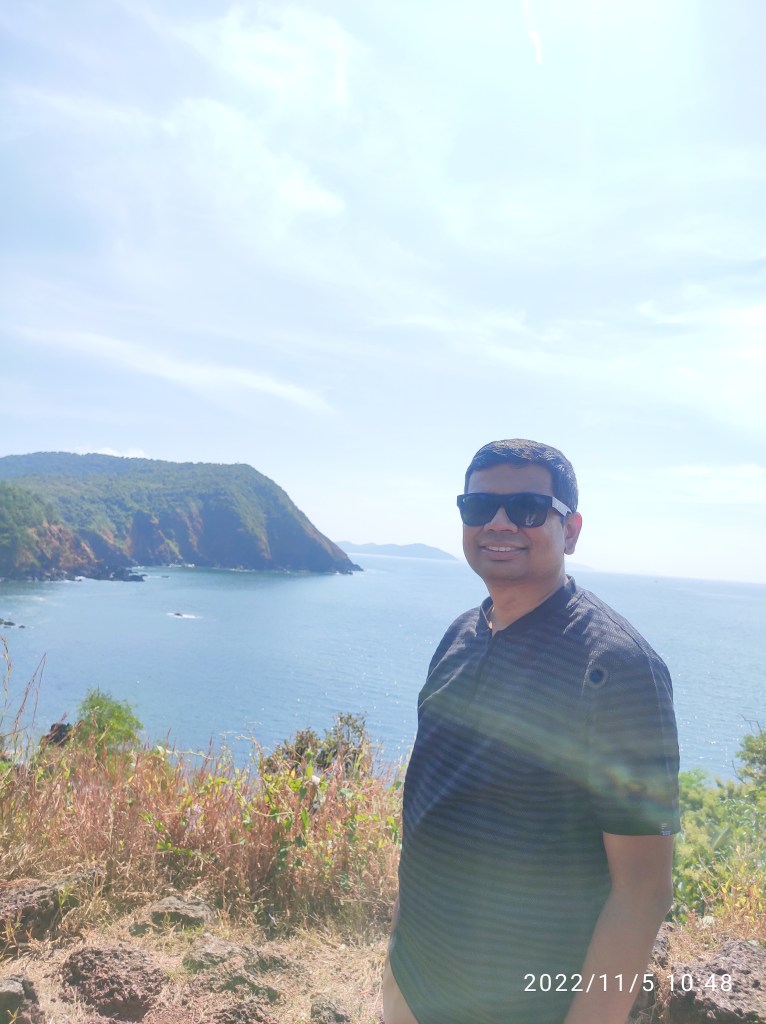
The link to video of Cabo De Rama is given below
That evening , we decided to explore the Paolem beach and take dip in the Arabian sea. It is long beach extending for 2 KMS and I love to walk barefoot with water touching my feet. The sea is not too rough and even those who cannot swim (like us) can take a dip quiet safely.
Another attraction of Palolem beach is the “boat tour”. Fishing boats are converted into tourist boats to visit some of the nearby island and beaches. Neither me nor Meenal found boat ride interesting and we gave it a miss. Also, the price of 1000 INR per person seemed to be quite steep for 90 minutes trip.
There are many restaurants in Palolem and most of them are run by local residents. I was pleasantly surprised to see popularity of the “vegetarian thali”, which caters to growing number of vegetarian tourists. Most of the restaurants appeared to have similar menu and similar pricing. I found Shiv Sai Thali House to be the best in the area and dined there almost every day. Other famous ones like Dropadi and Singh’s family restaurant were good for North Indian food. Overall, the vegetarian food is not remarkable, but quite acceptable in this part of Goa. The breakfast options are many but we found the restaurant Carpe Diem to be the best suited to our taste.
6-Nov-22
Next morning, we headed towards Rajbagh beach. It is about 5 KMS south of Palolem and we reached there in about 20 mins. The last 1 KM or so is through the golf course of Lailt Resort hotel. It is however a public road, and one is not passing through private property of the hotel. The beach is beautiful, clean, and serene with a wonderful view of mountains. Like most south Goa beaches, it is sparsely crowded with very people in sight. There are however number of vendors who sell coconut water, snacks etc. They have placed chairs and recliners on which one can relax and enjoy the view. The vendors maintain polite distance and occasionally offer boat trips, massage etc. A place one can spend hours in quietude and absolute peace.
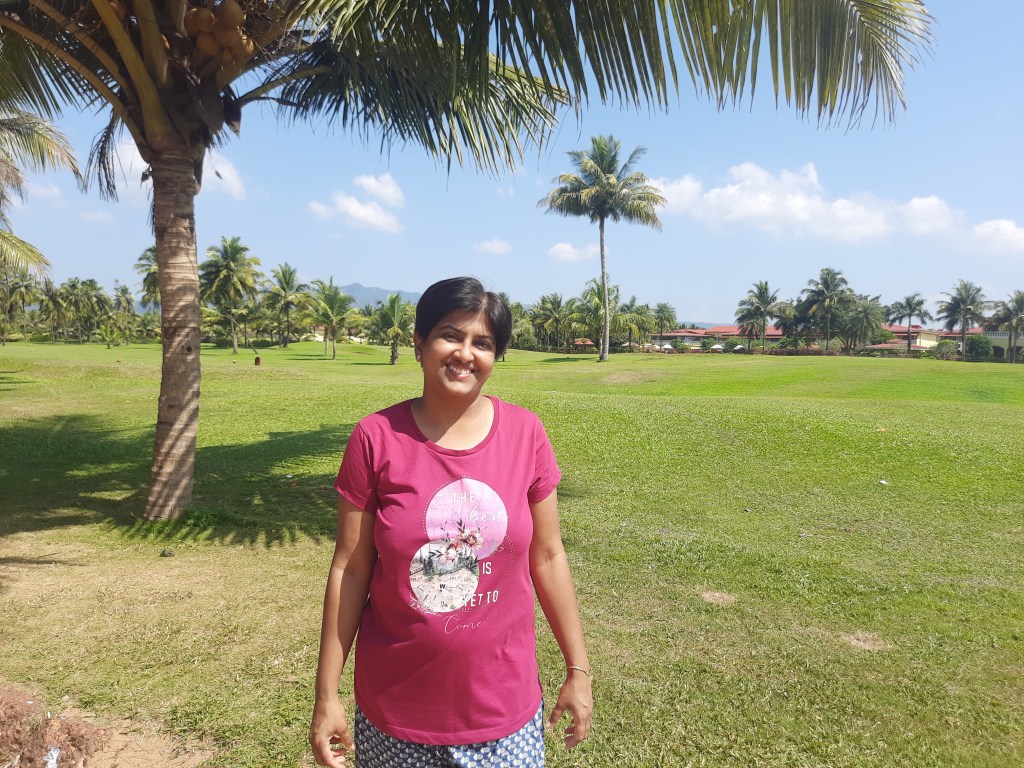
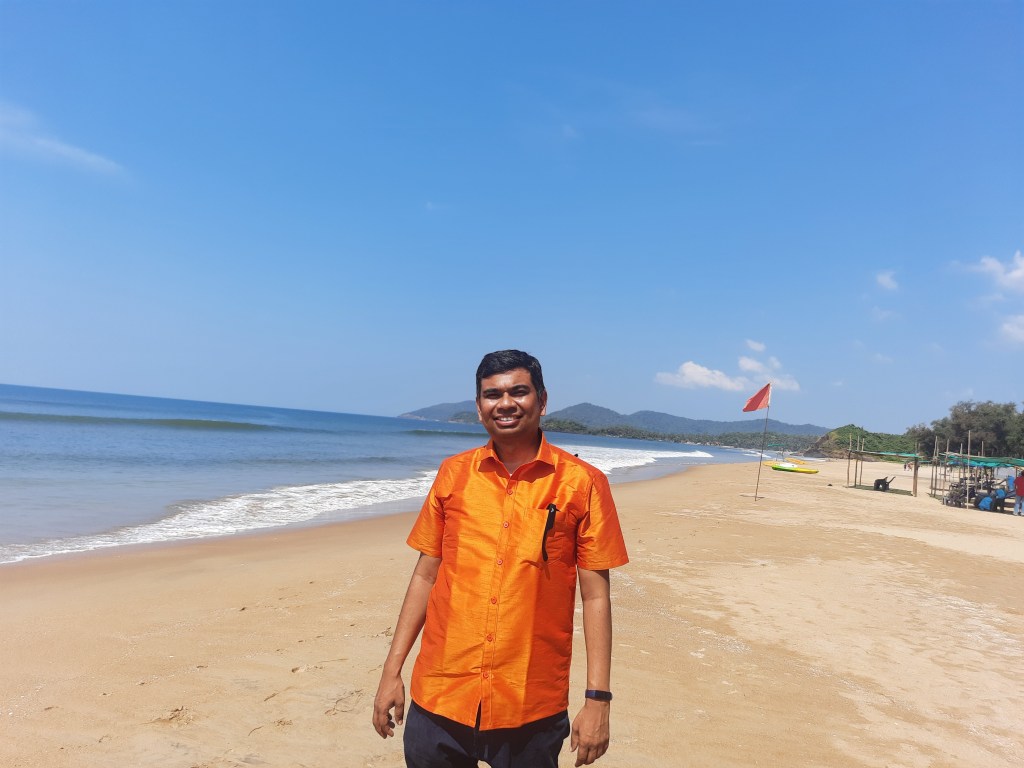
The link to video of Rajbagh beach
At the southern end of the beach, is the river Talpona which merges with the sea. I find it fascinating to watch the serene waters of the river mix with the turbulent sea and more so in Rajbagh. The mountains in the background and fishing boats in the river give an almost magical effect to the place.
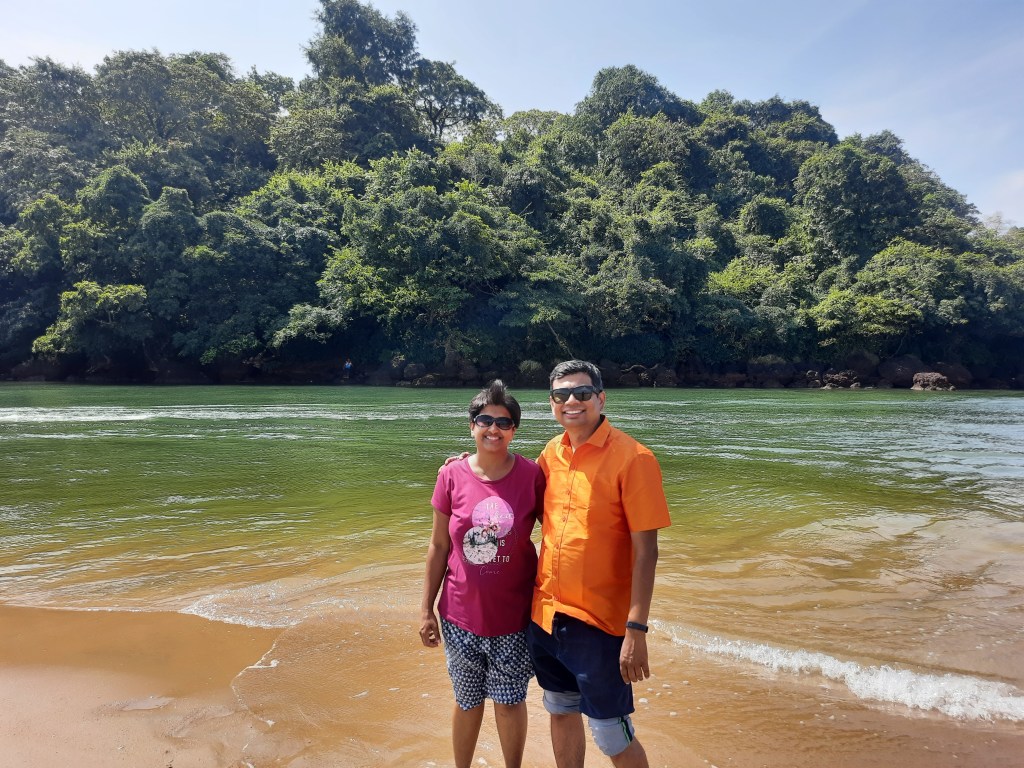
The link to video of Talpona river
That evening we were on our way to Cola beach when our hotel manager dissuaded us from doing so. Due to poor road condition , he advised us to visit that beach only in daytime. Given our misadventure in Hampi, where we went against advice of homestay owner and lost our way in the forest, we agreed to suggestion of hotel manager regarding Cola beach.
To view the sunset, we then went to our favourite beach – Agonda – a distance of 7 KMS north of Palolem. It was a pleasant experience riding two-wheeler in south Goa. The roads are exceptionally good (by Indian standards), the traffic is light and parking easily available.
Though the sunset obstructed due to cloud cover, we had a good time hanging around the beach. Agonda is one of the best beaches in Goa and as a result, the tariffs of the hotels near this beach have gone through the roof ! This is true to some extent about most of hotels and restaurants in Goa. After two years of slack due to Covid, the tourists are back and the business owners are trying to make up for the losses.
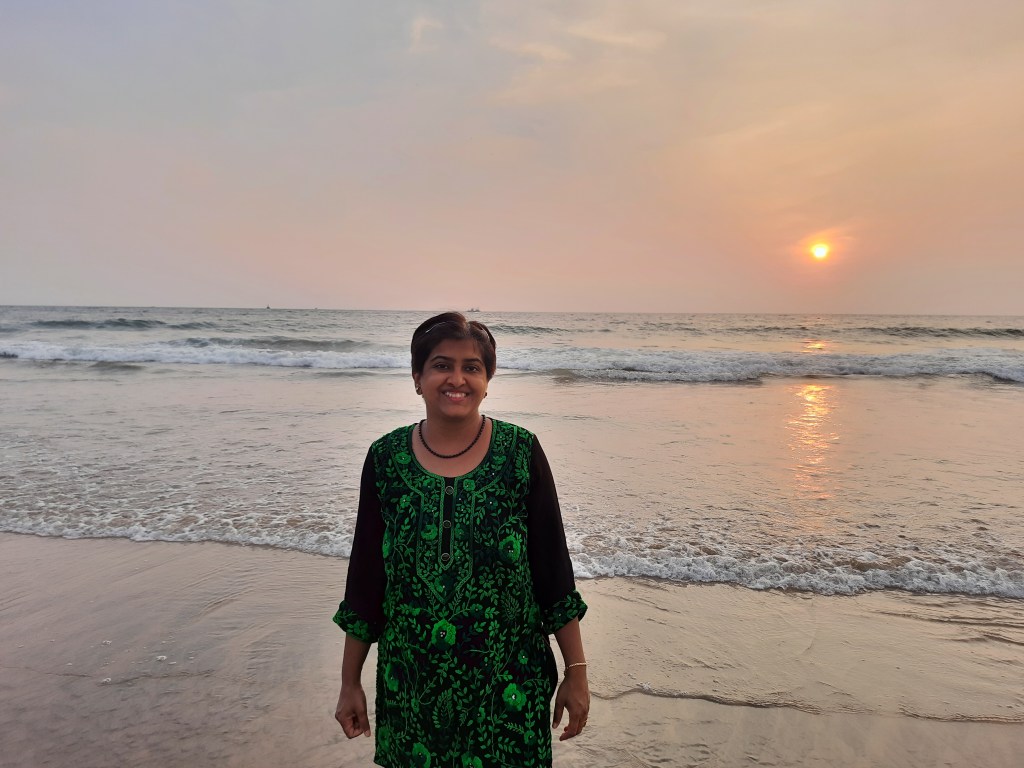
The next morning would turn out to be one of the most memorable one of our vacation. We reached the lesser known Cola beach around 10 AM , the last 2 KMS of the road was in very poor condition. Hence, only a car with good ground clearance or an expert two wheeler rider can reach here. At end of the road is the spectacular view of the sea and the mountains from an elevation.
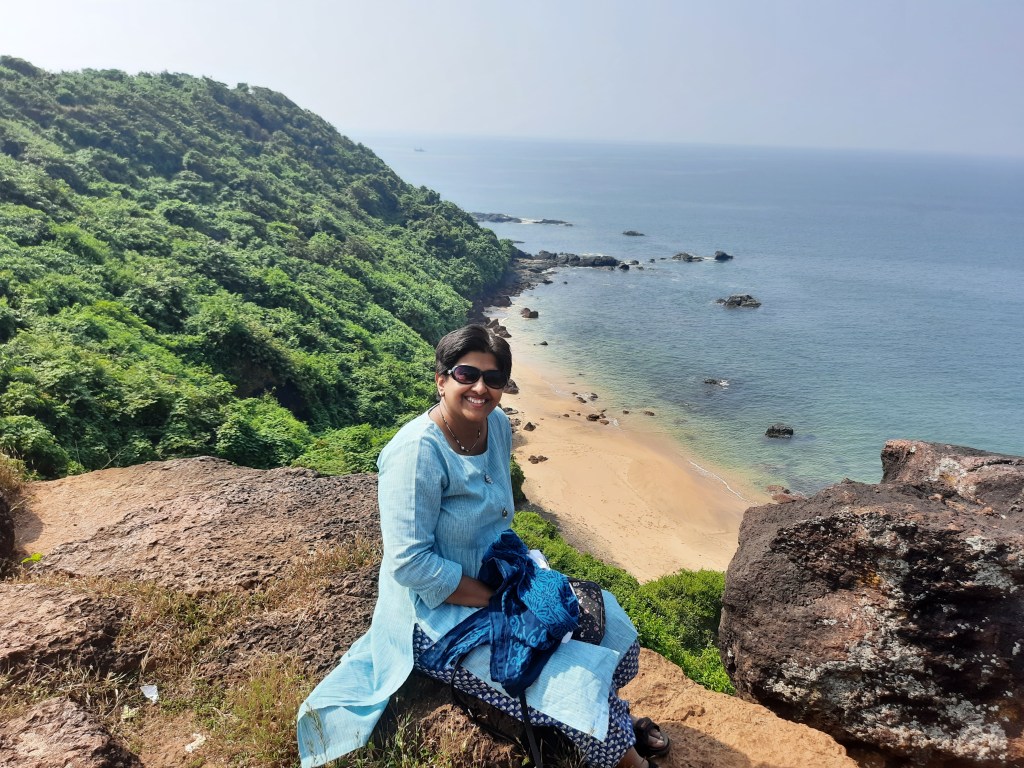
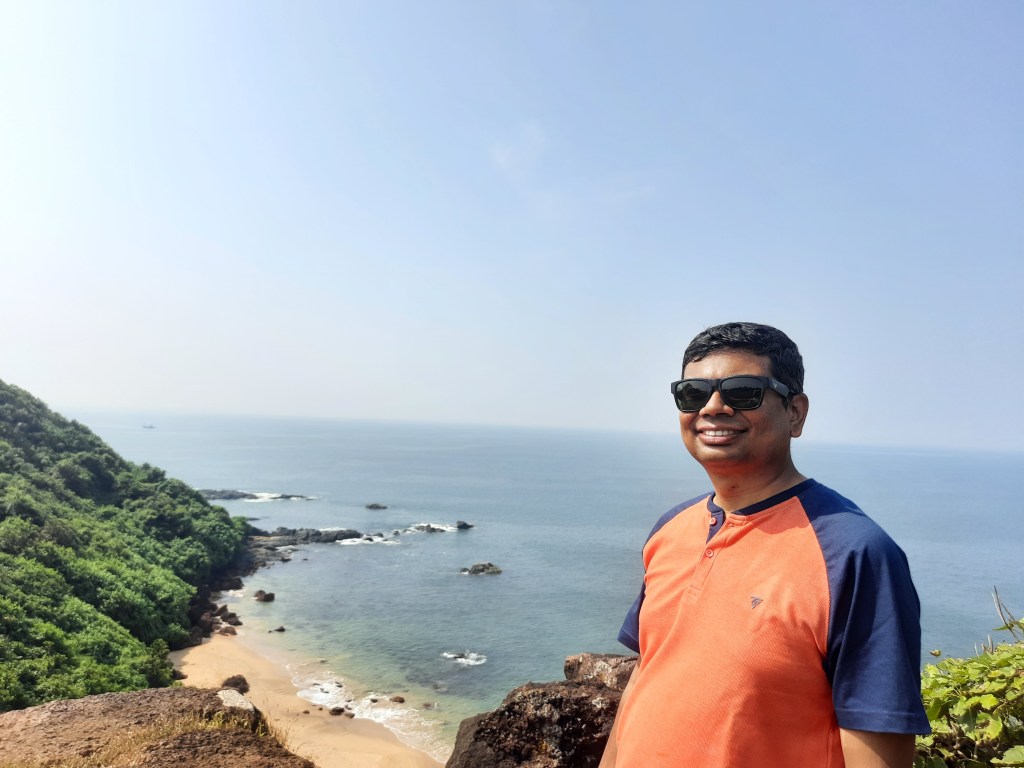
The link to video of Cola beach from evaluation
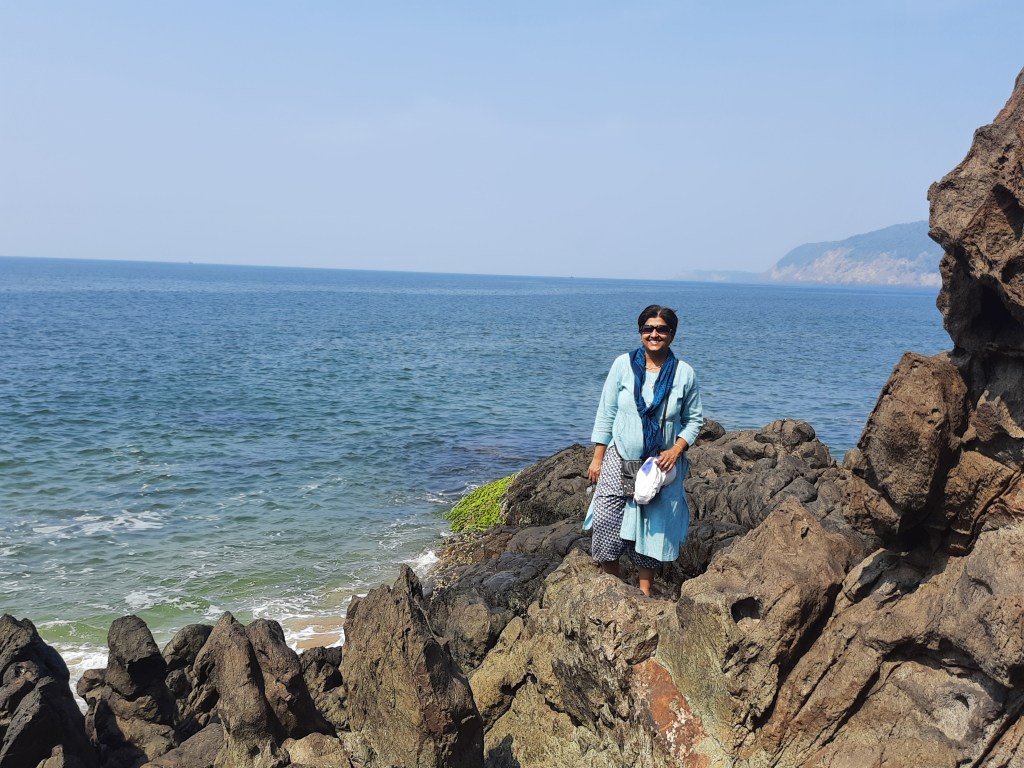
One needs to climb down around 200 steps to reach the Cola beach. There are couple of resorts here, but there are no other commercial establishments around. We decided to become little adventurous and climbed over pile of rocks to get to the southern side of the beach. This is an absolutely deserted place and the pictures below provide an idea of the beach.
The link to video of Cola beach
On the way back, we stopped at a big store to buy cashew nuts and kokam-juice. I love this kokum fruit (also called amsul), which is used as a souring agent in Marathi and Konkani dishes. Kokum-juice added to water is the most refreshing drink in summer.
One remarkable thing about Palolem is that the beach and shops are open well into the night. There are powerful electric lights on the beach that makes walking in the dark possible. There are number of shops on beach road which sell typical stuff like clothes, trinkets, show-pieces which are open till late hours. Goa is famous as a “safe destination” with low crime-rate and we could walk around post-dinner freely.
09-Nov-2022
On the final day of our vacation, we decided to give the beaches a miss and do something different. We headed to Cancona town which looked quite prosperous with malls and showrooms. Little further is the Shri Mallikarjuna temple dedicated to Lord Shiva. The shrine is known to be one of the oldest in Goa and is situated in a valley surrounded by mountains. The Linga of Lord Shiva is believed to be Swayambhu and was uncovered in middle of 16th century. The temple is quite spacious and we spent some time walking around the complex.
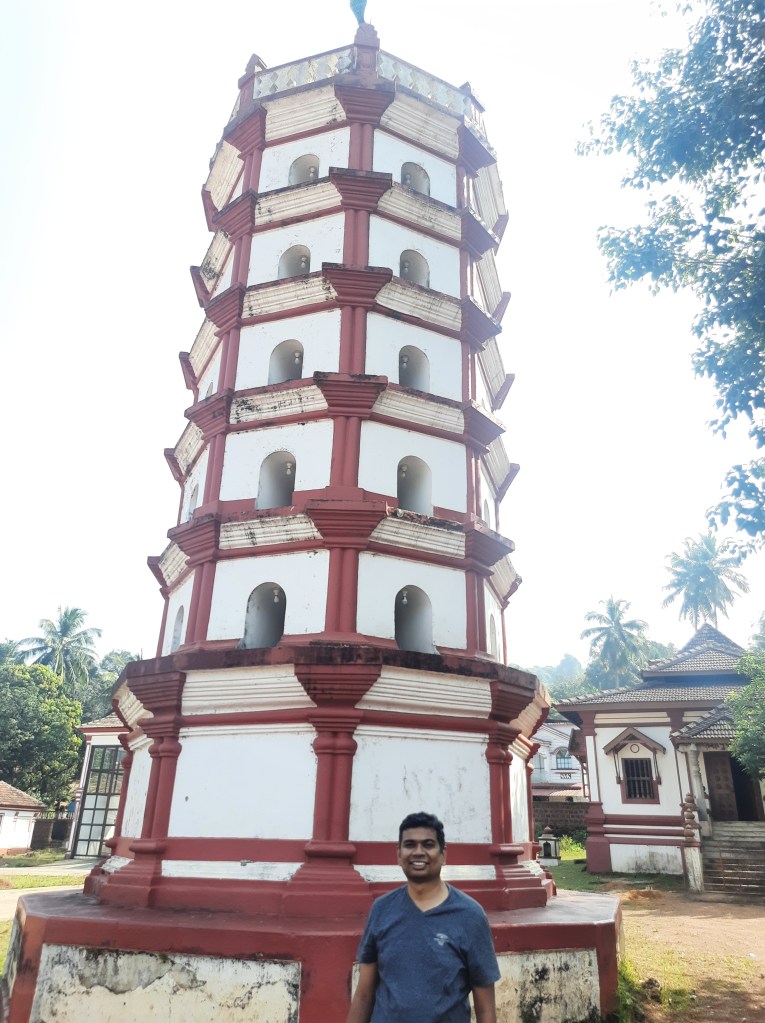
Even after multiple visits to Goa, I am yet to understand the exact status of Marathi language in the state. All the boards in temples and government buildings are in Marathi. Almost all the locals speak Marathi, however, I have never heard it being spoken in public places! Perhaps one needs to visit the non-tourist villages to understand “real” Goa.
The final spot we visited was the lesser known Chapoli dam. Though going up the actual dam is not allowed , one can visit the spot near the backwater for some breath-taking views. Entering this water is not advisable and hence after taking a few pictures, we returned to our hotel.
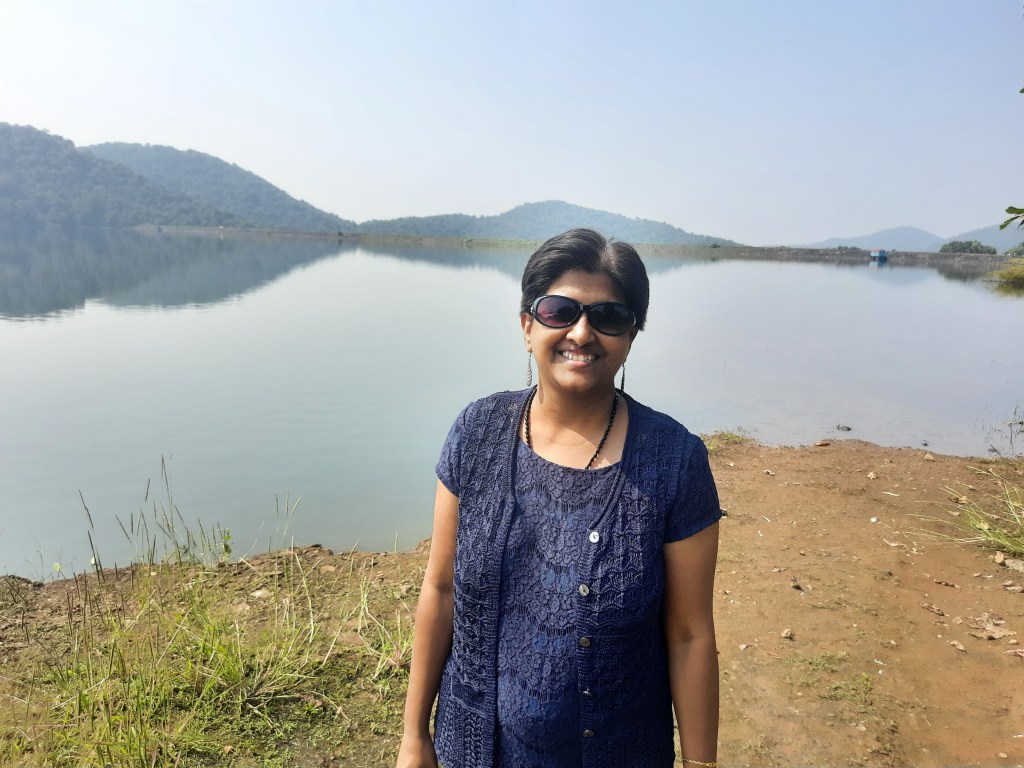
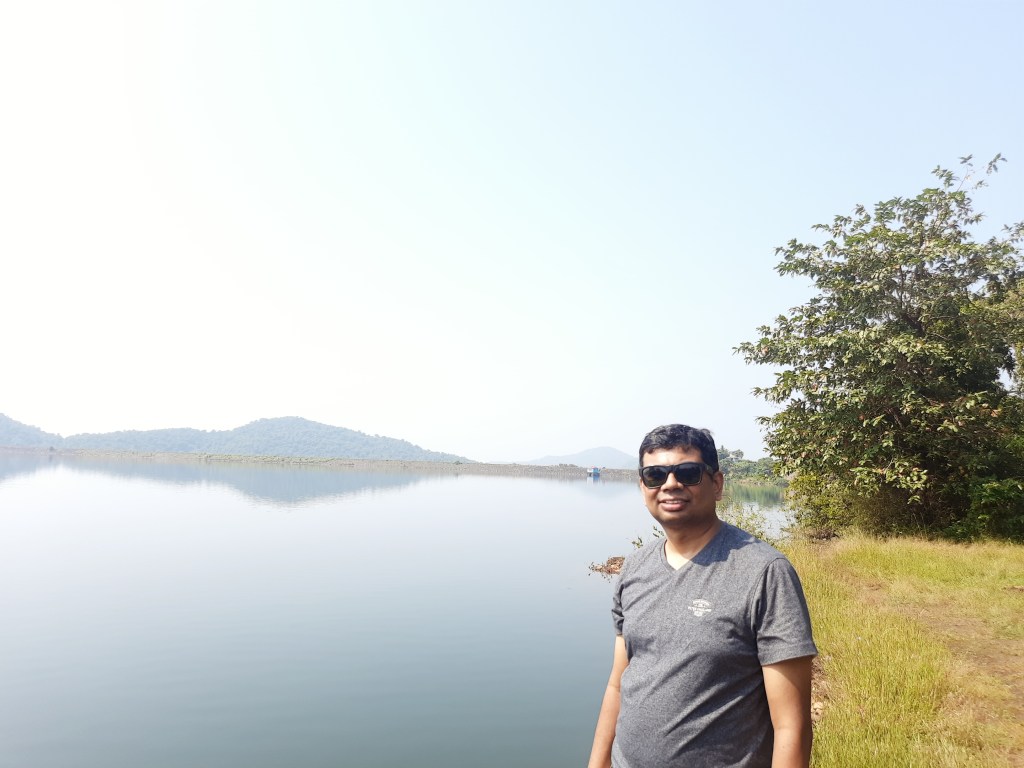
Link to the video of Chapoli dam
At 4 PM that evening, we left Goa to Karwar, where we would board the train to Bangalore. The best part of our trip was the warm-hearted locals we had met in Palolem. Everyone was friendly, helpful, co-operative and the overall trust factor appeared to be very high. It is very stress free to spend vacation in such a welcoming place.
This vacation in 2022 was our sixth trip to Goa. I had promised myself in 2021 that I will visit new places and not repeat the same vacation destination. However, the allure of Goa is so strong that one wants to visit this state again and again.
Madurai – one of the most famous sites for religious tourism in Southern India. The Meenakshi-Sundareshwarar Temple (also called Meenakshi Amman Temple) is popular throughout India and devotees aspire to visit this place once in their lifetime.
Another famous temple in Tamil Nadu is the Sri Ranganathaswamy temple at Srirangam. I came to know about Srirangam while reading about life Sri Ramanujacharya , the great saint who propounded the Vishisht-advaita (qualified non-dualism) philosophy. Ramanujacharya lived in Srirangam for considerable period of time and was in-charge of Sri Ranganathaswamy temple.
I decided to combine my visit to these two holy towns – Madurai and Srirangam . Thanjavur, the town famous for its arts – painting ,classical music and craftsmanship is close to Srirangam. Hence I planned my itinerary to cover these three places.
An advantage of living in Bangalore is that there are direct trains to almost every major city in India. An overnight train to Madurai and another from Thanjavur to Bangalore suited me perfectly.
We departed from Bangalore on 28-Jun-22 by Mysore- Tuticorin express. At Bangalore railway station ,I was impressed by overall cleanliness . The “Swaach Bharat Abhiyan” undertaken by government are showing excellent results indeed!
At 7:30 AM next morning, 29-Jun-22, we alighted at Madurai Railway station.
Madurai is an ancient city mentioned in Sangam texts from 4 century CE. It was the magnificent capital city and the seat of the Pandyan empire which extended to large parts of modern Tamil Nadu. Today it is a bustling place, third largest city of the state and hub of industries like textiles and engineering.
After checking into our hotel – Mani’s Residency, we had breakfast at the New Sabareesh Hotel – a vegetarian restaurant which is in operation since 1963. Interesting to note that Madurai has numerous heritage vegetarian restaurants, especially in area around the main temple.
Next, we visited the most important attraction of Madurai – the Meenakshi Amman temple. This temple is at the centre of Madurai and finds mention in the Tamil Sangam literature, from 6th-century-CE texts.
The temple was originally built by Pandayan emperor Sadayavarman Kulasekaran , and major additions were made by many other Pandayan kings over the centuries . In 1311 infamous eunuch Muslim general, Malik Kafur devasted and looted the temple, destroying it completely. It was re-built in all it’s glory by the rulers of Vijayanagar empire in 15th century.
Mobile phones and other electronic gadgets are not allowed inside Meenakshi temple. Devotees are expected to place them in a locker near the shoe stand. There are in fact other restrictions related to leather belts and wallets which were not strictly enforced.
The temple complex is so huge, that it has four entrances! We clicked couple of pictures before entering the premises.
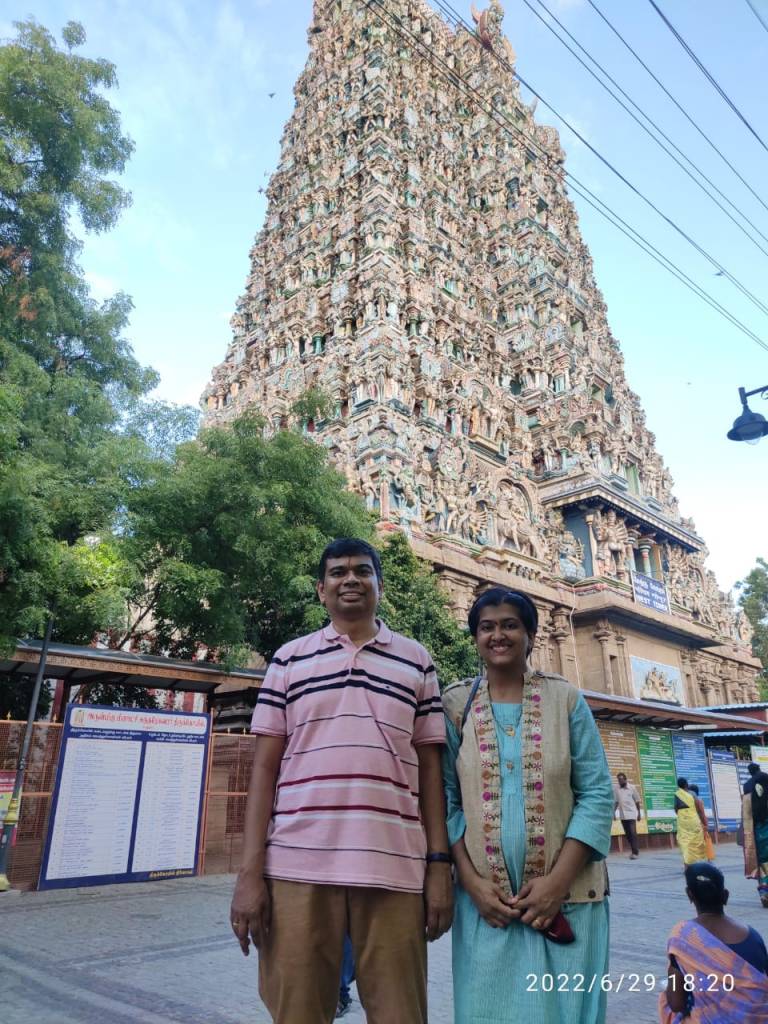
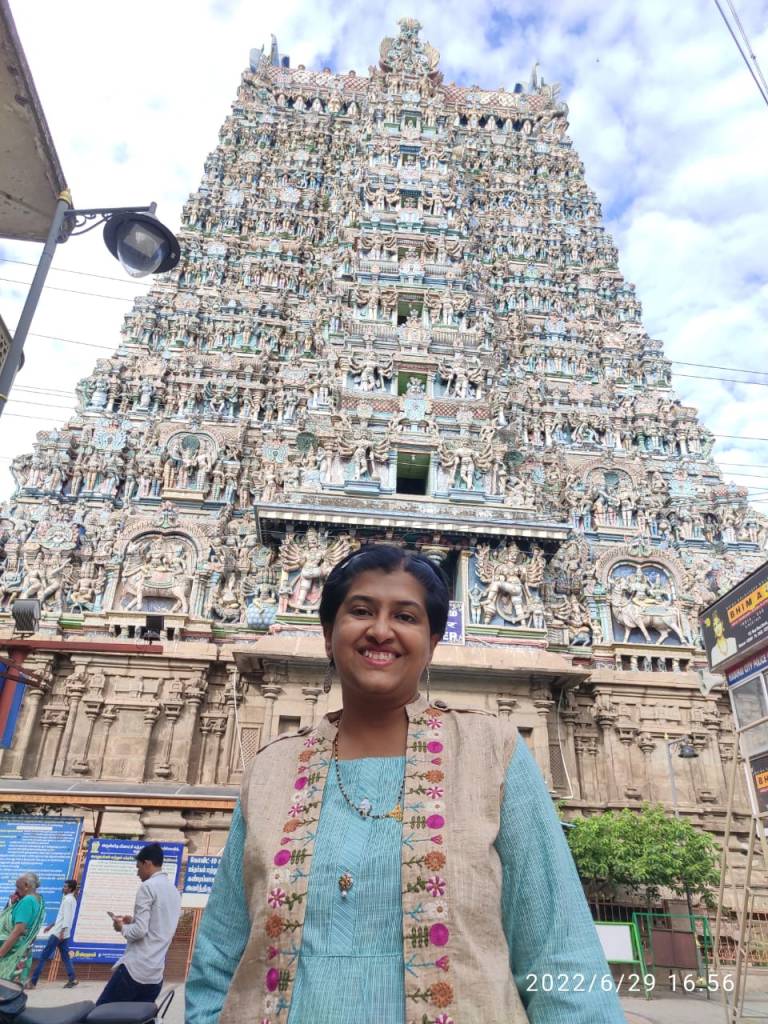
Since our focus was the take darshan of Meenakshi and Lord Shiva , we reached the South gate of the temple. Meenakshi temple has two separate shrines for the goddess Meenakshi and Sundaresvara (Lord Shiva) respectively . After taking special ticket of INR 100 each, we stood in the “Special darshan” queue. Many of my friends from northern India find it inappropriate that those buying tickets are given priority in darshan queue. I find it perfectly acceptable though. It gives an option to those who have limited time for the visit.
The darshan of both Meenakshi Devi and Lord Shiva took around 30 minutes and was memorable. Post the darshan, we admired the huge idols in the temple complex. The ones I found fascinating were those of Lord Ganesha, Nataraja and Bhadhara Kali. Each of these idols is more than eight feet in height and has exquisite expressions. There are shrines dedicated to Mahalakshmi, Saraswati, Dakashinamurthy and other deities in which regular worship is performed.
We had hired a guide to give us information on the temple and show landmarks which we would have missed otherwise. It is recommended to hire a guide as there are no clear sign boards in the temple premises.
The Thousand-Pillared Hall is a remarkable structure in the temple complex. Built during the reign of Vijayanagar empire, it was originally a dancing hall. Each pillar in the hall has a carved sculpture – of Karthikeya, Ganesha, Shiva or yali (mythological beast with body of lion and head of an elephant). The giant statue of Nataraja at the centre of the hall is simply mesmerising, it is lighted brilliantly which makes it appear very life-like.
There is a Temple Art Museum in the hall where icons, photographs, drawings, and other exhibits of the temple are displayed. However, the information about these artefacts is displayed only in Tamil, hence I could not get understand the context.
Since there are no mobile phones or cameras allowed, I could not capture the magnificence of the temple in pictures. In my view, the temple management should reconsider this mobile phone ban and freely allow its usage.
After the visit to the Meenakshi temple , I visited the nearby Koodal Azhagar Temple. This is a medieval temple dedicated to the Lord Vishnu. The temple is originally built by the Pandyas, with later additions by the Vijayanagara empire and Madurai Nayaks kings
A video about the Koodal Azhagar temple is given in the below link.
Madurai is known for its iconic restaurants. Over the years, these restaurants have upgraded themselves – installed AC , renovated their look-and-feel. However, have kept their authenticity of taste intact.
For lunch we visited Sri Ram Mess and Murugan Idly shop for evening snacks. The food was pretty good and met our primary expectations during travel- the service should be quick and the food should be heathy. The special ghee-podi idly from Murugan Idly Shop was really scrumptious
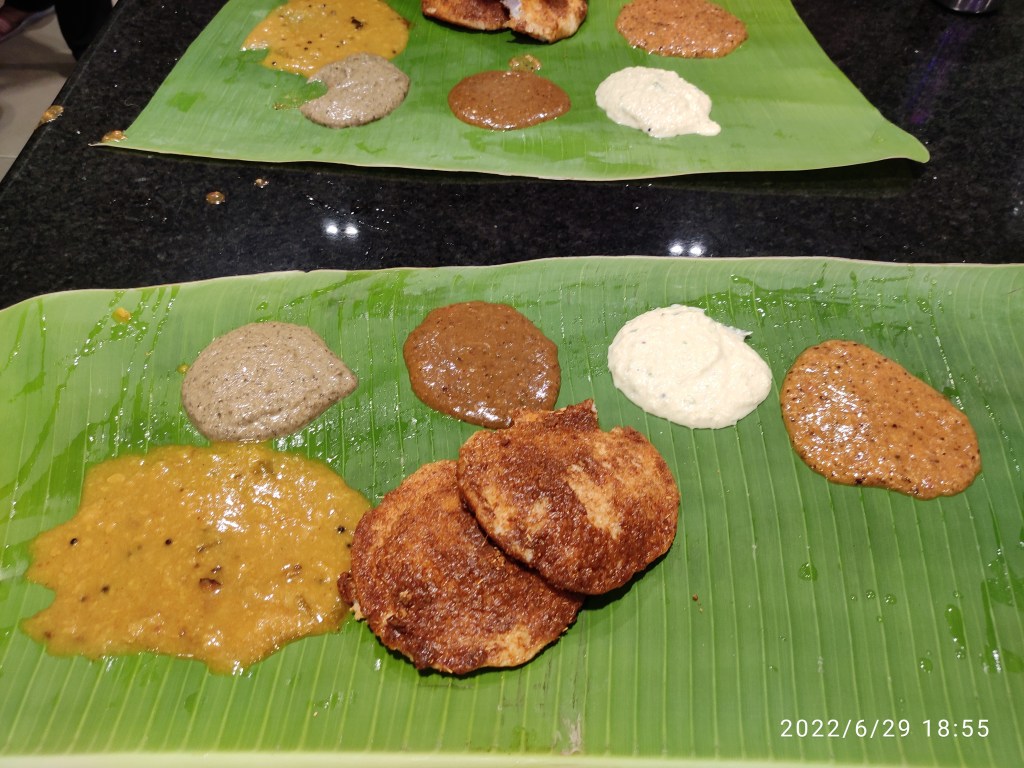
Next morning, I visited another landmark of Madurai – Thirumalai Nayakkar Palace, about 2 KMS from Meenakshi Temple.
It is a 17th-century palace erected in 1636 AD by King Tirumala Nayaka, a king of Madurai’s Nayakkar dynasty who ruled from 1623 to 1659. This palace is a fusion of Italian and Indian styles. It is known for its majestic pillars, with height of about 82 feet and width of almost 19 feet. Today only the Main Hall and the Dance Hall remain of the palace, but the remains are impressive.
There is also a small museum inside the hall which has artefacts like paintings, sculptures and stone inscriptions.
The link to the Dance Hall of the Nayakkar Palace is given below
The link to the stone inscriptions in the Nayakkar Palace is given below
The heat in Madurai was oppressive as one would expect in months of June and July. The famous drink “Jigarthanda” to the rescue ! Made with milk, sugar and almonds it has been popular in Madurai since decades.
We departed from Madurai boarding a train that took us to Srirangam. The rail and road connectivity in Tamil Nadu is excellent and those who prefer taking trains/buses can do so easily.
Srirangam is an island town-part of Tiruchirappalli Metropolitan Area. It is bounded by the Kaveri river on one side and its distributary Kollidam on the other. It is home to Sri Ranganathaswamy Temple, a major pilgrimage destination and the largest temple complex in India. It is also famous because Sri Ramanuja, one of the great philosophers of Hinduism, lived here during 11th century AD.
Sri Ramanuja is known for his commentaries on the Brahma Sutras ,Bhagavad Gita and as a proponent of Vishisht Advaita (qualified non-dualism).
We checked in at Srirangam Yatrininas – a hotel run by the management of Sri Ranganathaswamy Temple. I was impressed by the room size, the cleanliness and the professional behaviour of the staff. The major downside is that the functioning restaurant in its premises was temporarily closed. Since there are no nearby restaurants, it was a hassle to travel 2 kms for every meal.
At around 5 PM we visited the Sri Ranganathaswamy Temple and hired a guide to understand the significance of the temple. In our visit that lasted around two hours, we covered the following
The link to video from the Rooftop view point is given below
Some of the pictures from Srirangam Temple are below
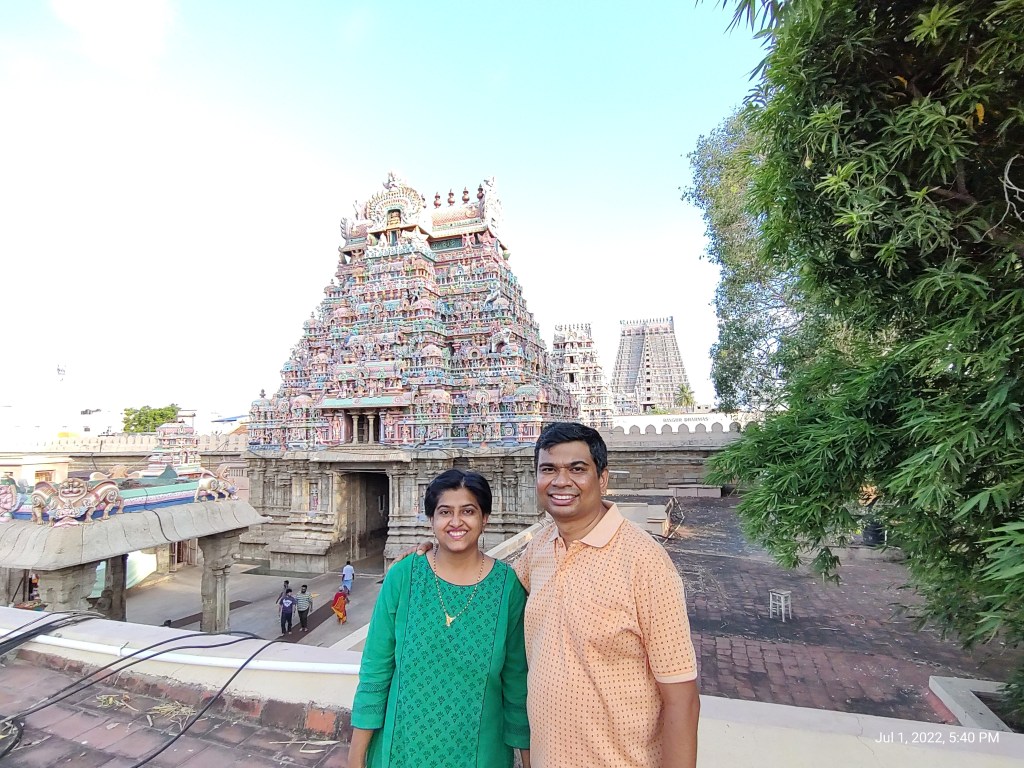
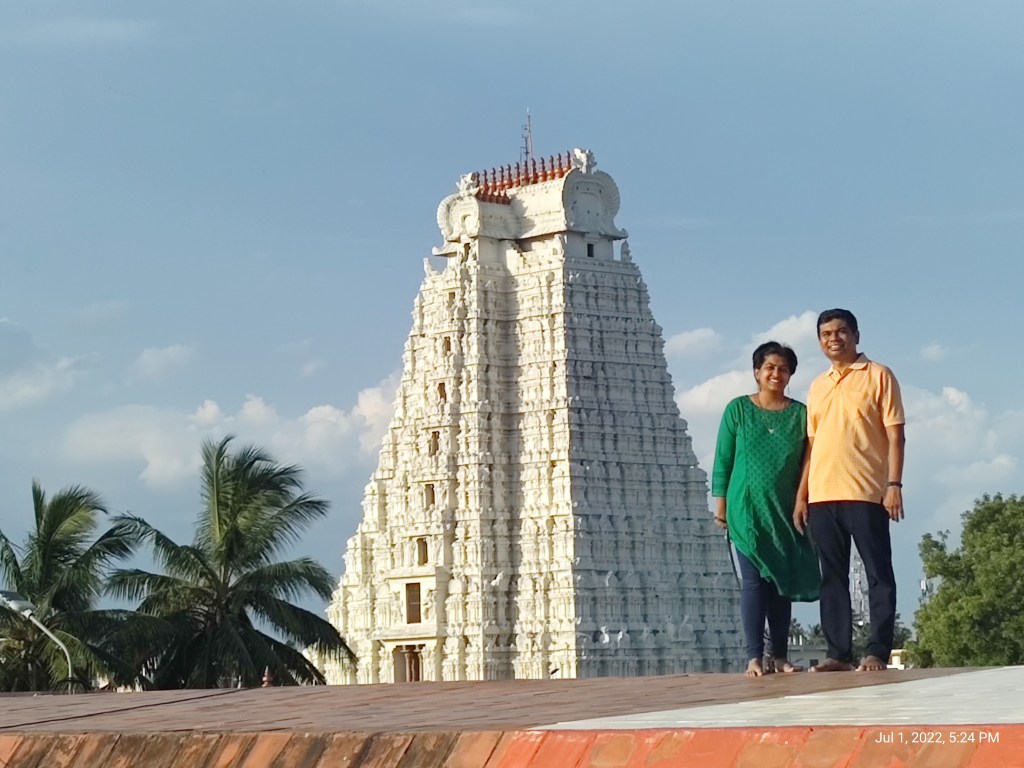
The link to video of Ranga Vilasa is given below
Pictures from Ranga Vilas are given below
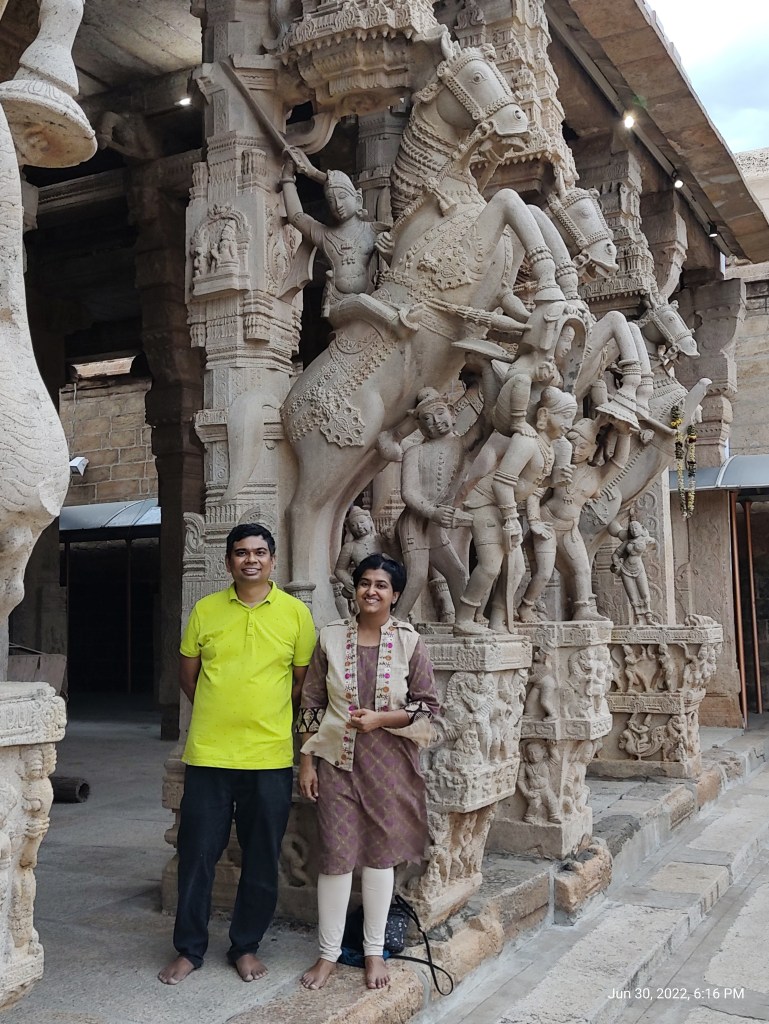
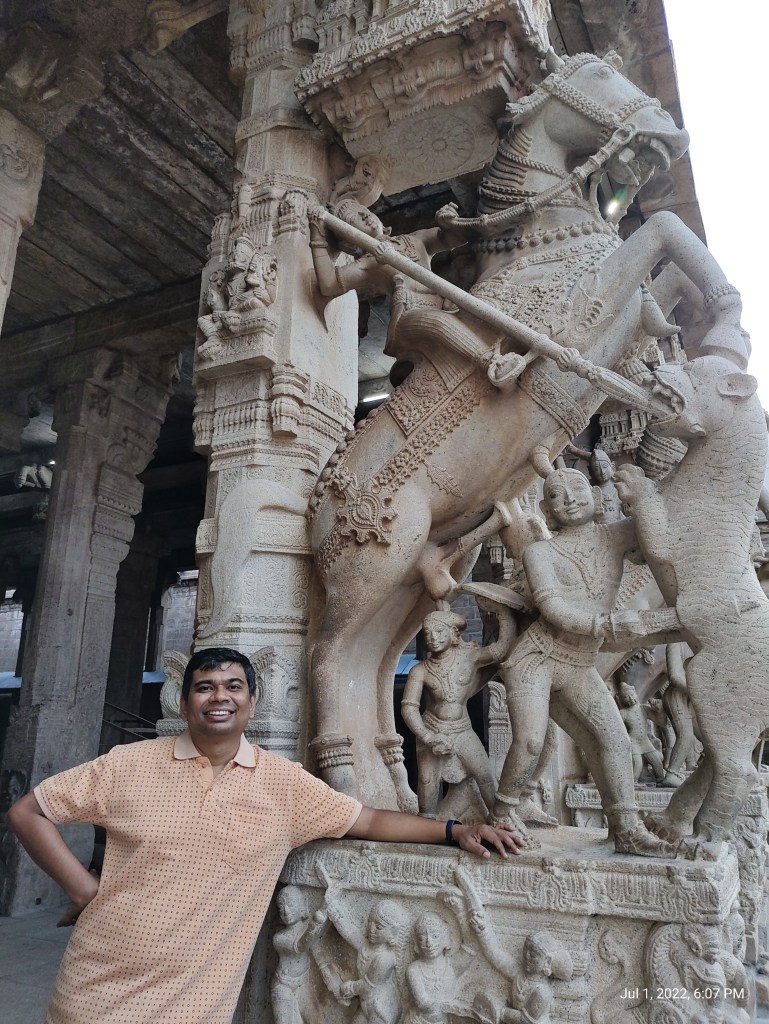
This is undoubtedly one of the most magnificent temples in world in terms of grandeur, architecture and religious significance.
However ,our darshan experience was not so pleasant and though we had purchased special darshan tickets, we had to wait for 45 minutes to take darshan of Lord Ranganathswamy, jostling with other devotees. In my view, the temple management can do better job of managing the crowd and ensuring devotees have hassle-free experience.
Next morning, we visited the famous Rock Fort temple in Trichy ,a distance of about 5 KMS from Srirangam. The Rockfort is a fortress which stands atop a 273-foot-high rock and provides a magnificent vista of the city.
The temple complex has three shrines, two of which are dedicated to Lord Ganesha, one at the foot and the other at the top. And the Lord Shiva Temple which is half way up the hill. The surprising part is that one ascends to the top from inside the hill and thus escaping from the sweltering sun ! The Lord Shiva temple which is inside the hill (halfway up) is magnificent with pillars and paintings. We took some rest and admired the architecture of the temple
The link to video of Rockfort temple is given below
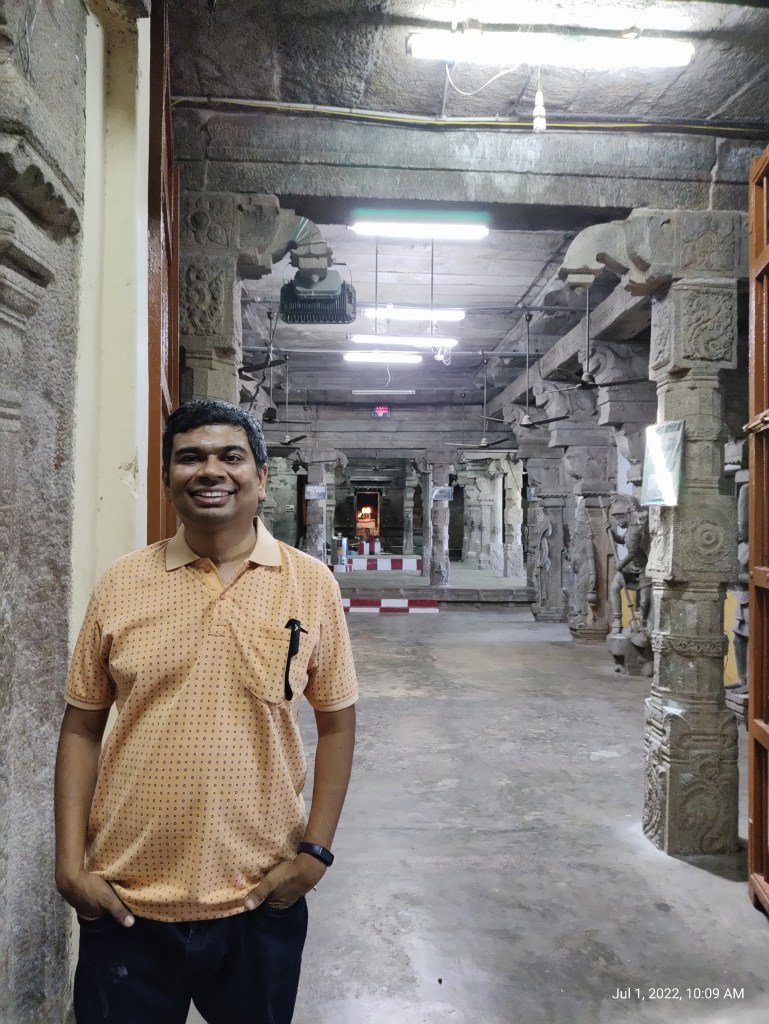
As we approached the summit, we could see the Kaveri river and the gopuras of the Srirangam temple. Excellent vantage point and perfect place to enjoy the cool breeze.
The link to video of Rockfort temple view is given below
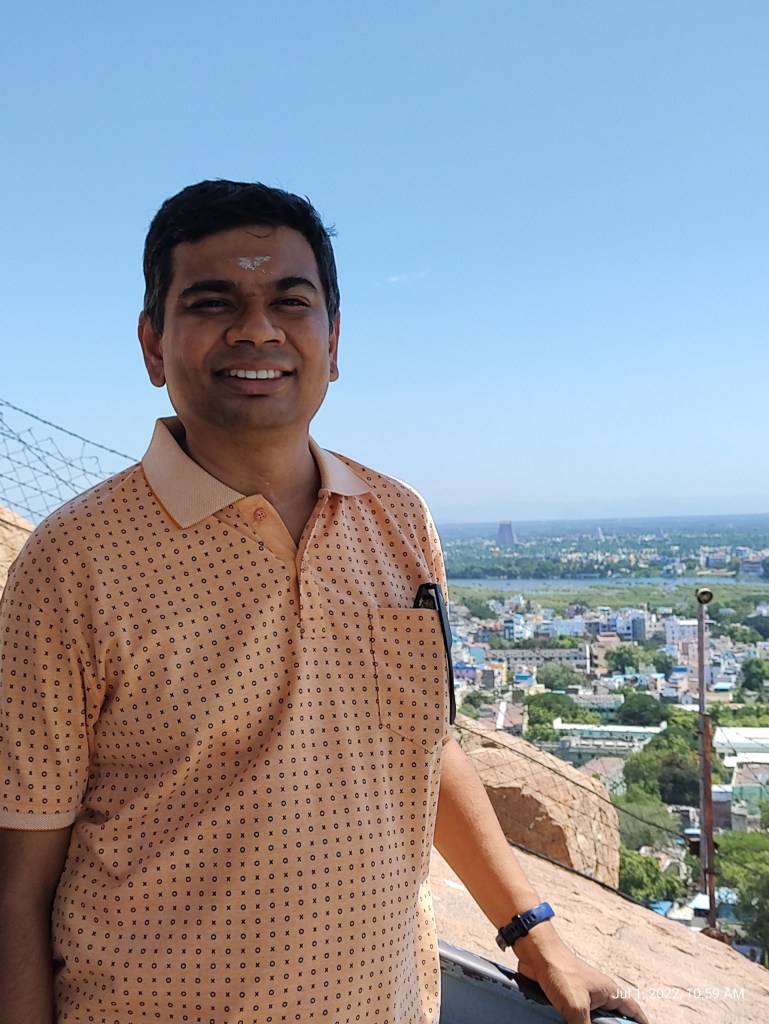
The Ranganathswamy temple is surrounded by numerous small family run restaurants which serve limited menu. Initially, I was hesitant due to external appearance of these places, but acquiesced due to lack of choices. However, two restaurants in particular – Gopal Iyengar Homely Mess and Mani’s café were quite impressive is terms of taste and service. The wholesomeness of the food was a welcome change from standard restaurant cuisine and we enjoyed all our meals there.
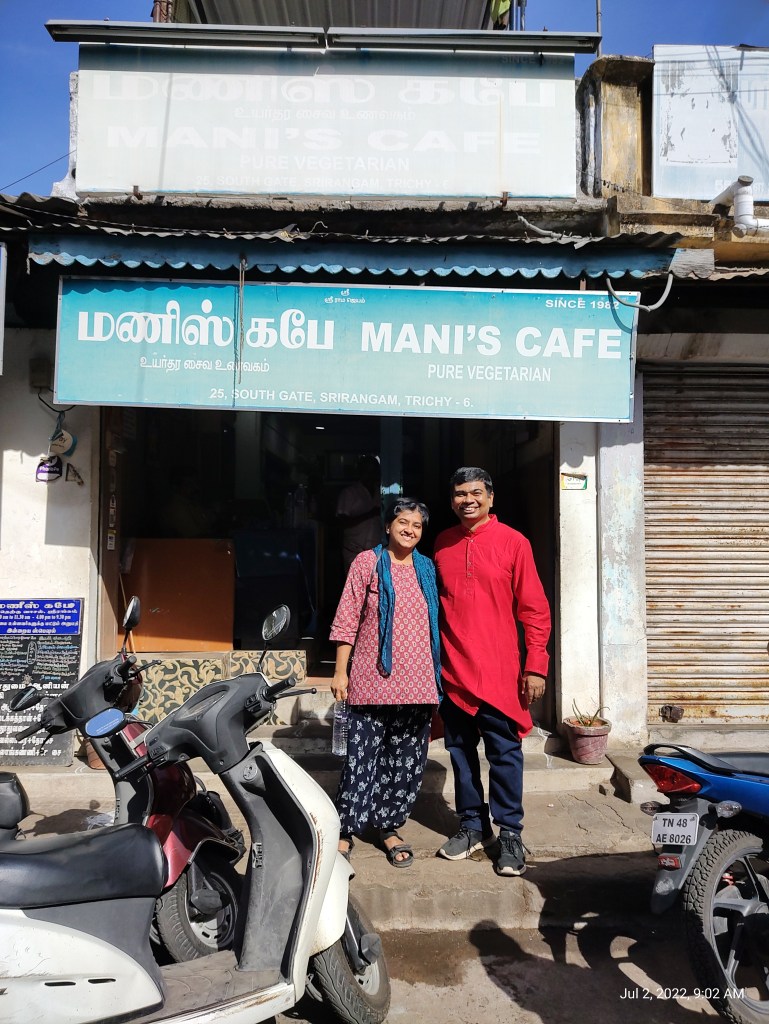
While the Sri Ranganathaswamy Temple is dedicated to Lord Vishnu , Jambukeswarar Temple is the famous Shiva temple of Srirangam. Another masterpiece of Dravidian architecture from the Cholan period.
The link to video of Jambukeswarar Temple is given below
Though we had positive experiences everywhere it is to be noted that Tamil Nadu is an unilingual state. Almost no one we interacted with could understand even a smattering of Hindi or English. Therefore our communication was restricted to few words which did lead to occasional confusion. Even restaurant menus are in Tamil !
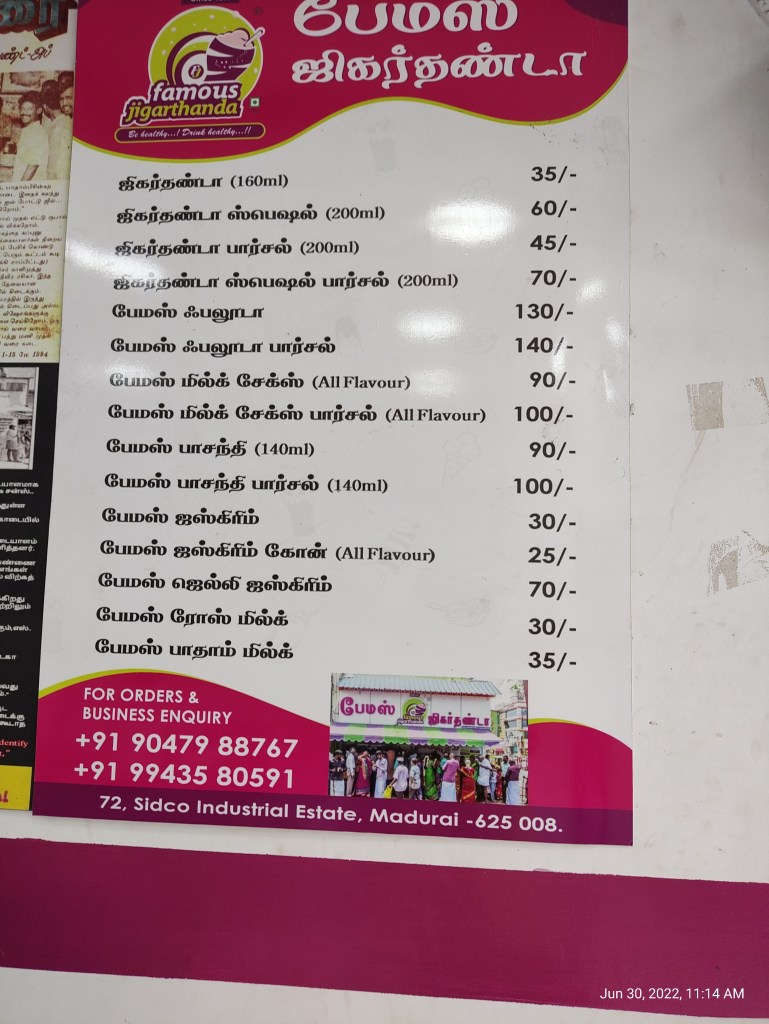
For the next stage of our travel , we had hired a taxi. After checking out from the Srirangam Yatrinivas, we headed towards Thanjavur about 60 kms east of Srirangam.
On the way stopped to view the Kallanai Dam, one of the wonders of the ancient world. Build around 150 AD, it is water diversion structure that diverts the waters of Kaveri across the delta region for irrigation via canals. Built entirely with stones, it is astonishing that this dam is still in use after 2000 years !
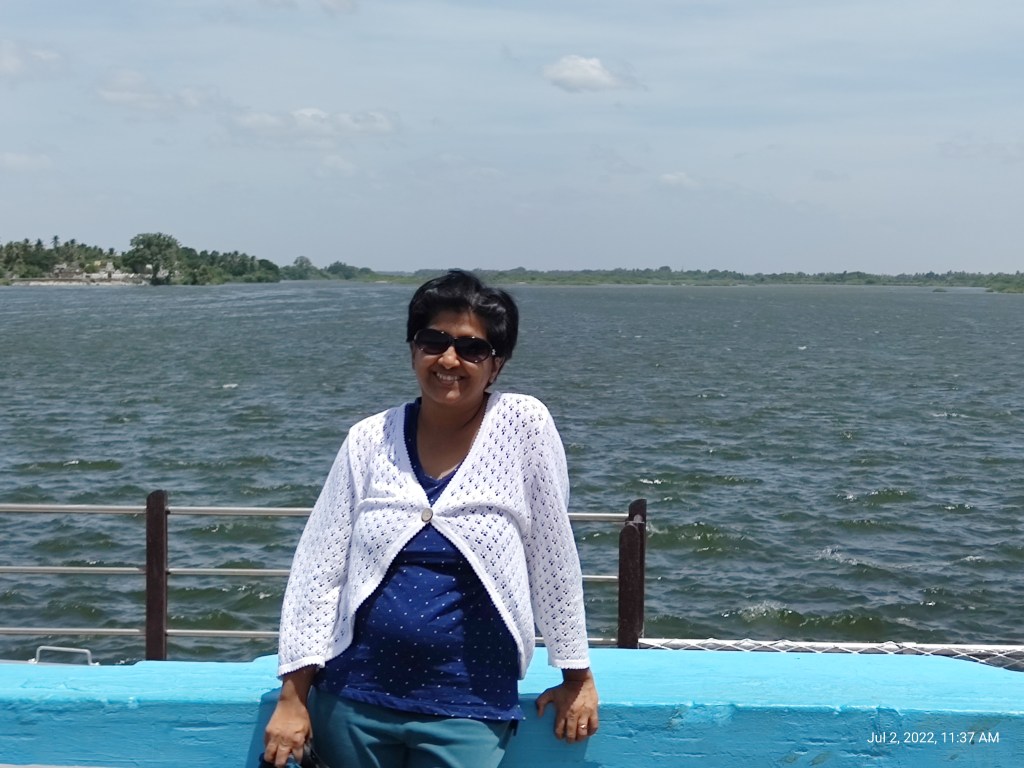
Cruising along the excellent highway Number 83, we reached Thanjavur is less than an hour . We checked into Hotel Victoriya which is about 2 KMS from the famous Brihadeshwara temple.
For lunch we visited Chellammals Manpaanai Samayal – a famous vegetarian restaurant serving clay pot cooked food. They serve authentic healthy dishes which are slow cooked in clay pots. The taste was quite unique and definitely worth a visit.
Later in the day we visited Brihadeshwara temple – built in the 11th century by the Chola king Raja Raja Chola I and dedicated to Lord Shiva. The temple complex was brightly lit with classical musical program performance. Devotees and tourists thronged the temple giving it a festive atmosphere
The unique aspect of this temple is the numerous inscriptions on the temple walls. These inscriptions are primarily in Tamil and Sanskrit scripts and provide details of the kings who funded the temple. It is amazing that these written records have remained legible for more than 1000 years !
The link to video of Brihadeshwara Temple is given below
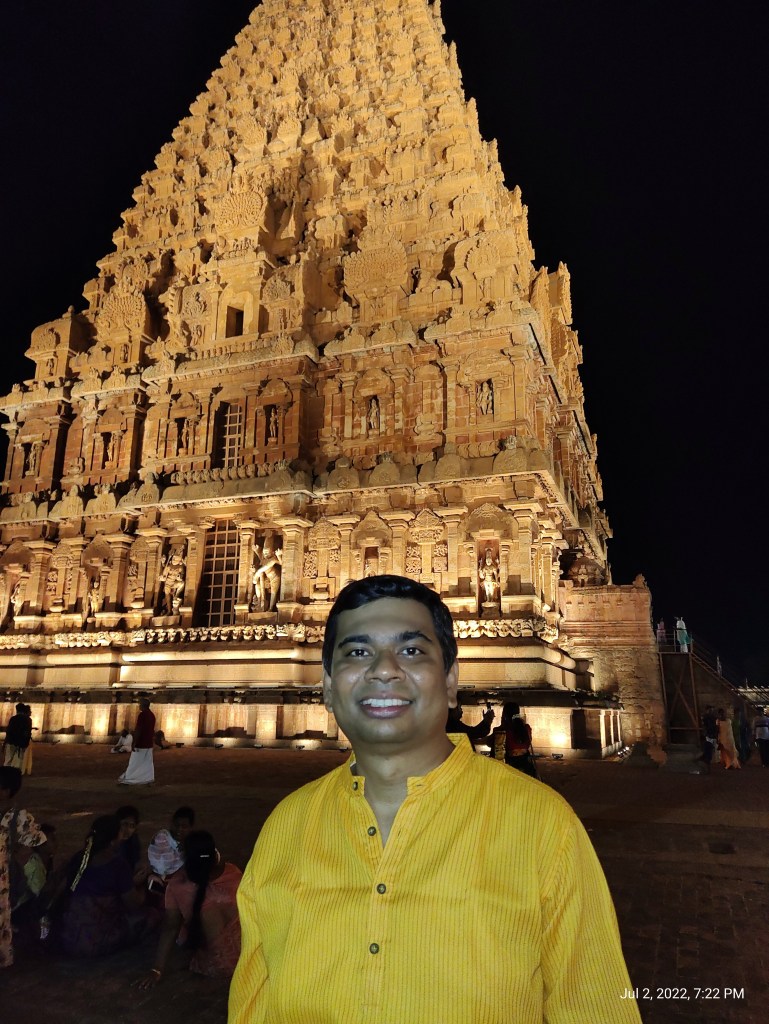
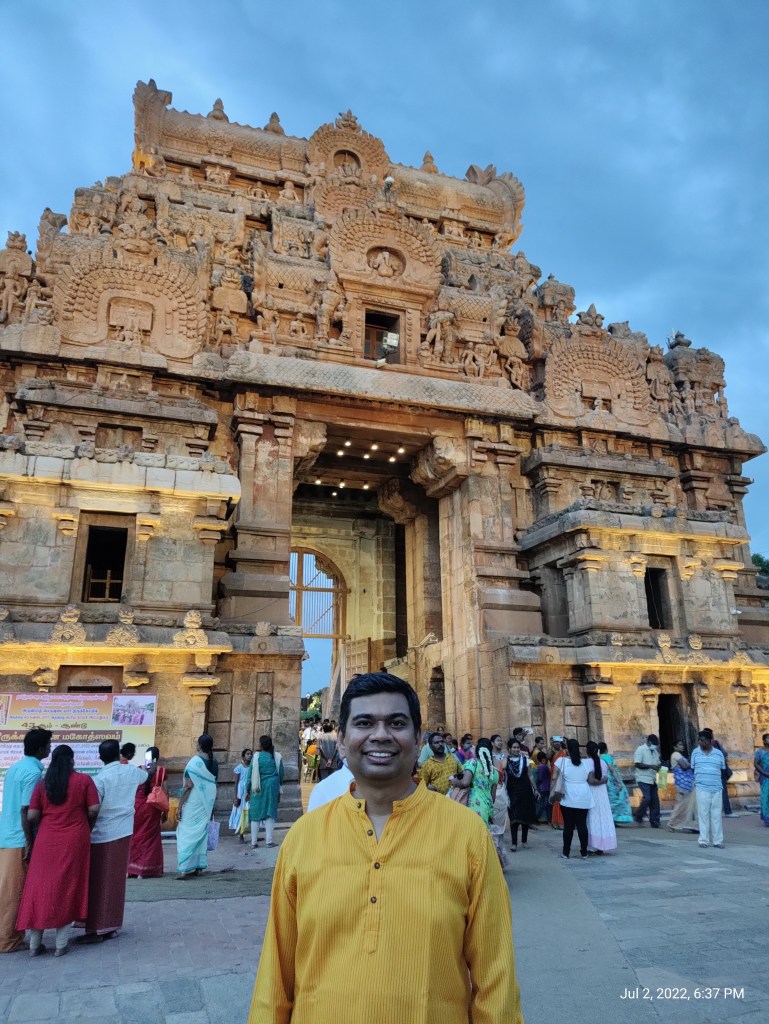
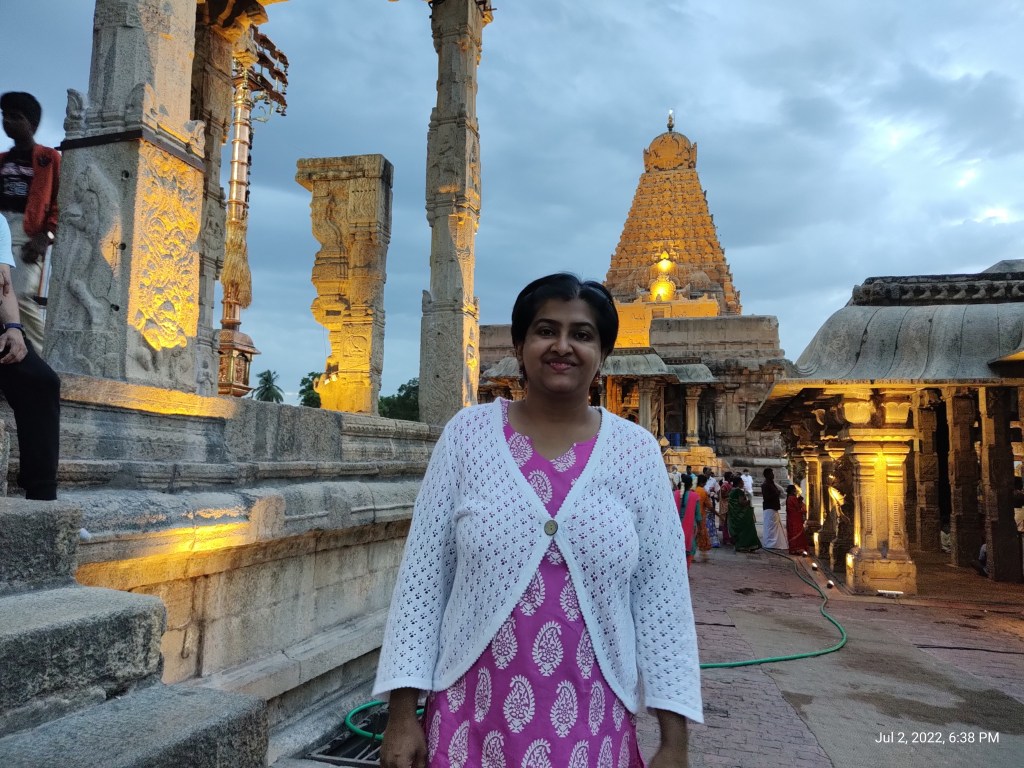
The main deity of this temple in Lord Shiva and there are numerous other shrines dedicated to Murugan, Parvati and Ganesha. Though the main shrine was built during the reign of Chola dynasty, additions and renovations were carried out by Nayyakars and Marathas over next millennium
Next morning, I paid another visit to the Brihadeshwara temple. This was a different experience than the previous evening : morning visit was more of piety and devotion.
The connections between the Marathas and the Thanjavur goes back to the time of Chhatrapati Shivaji Maharaj. Vyankoji, half-brother of Shivaji Maharaj, was the first king of Thanjavur. For next 150 years the Marathas ruled the region till it was annexed by British in 1855
After paying my respects to Ganesha and other deities I made way to Thanjavur Maratha Palace Complex.
The link to video of Brihadeshwara Temple is given below
There are multiple museums and halls in the Palace complex. The one I found interesting was the one with bronze and stone sculptures.
As my journey came to an end, I was filled with admiration for the great dynasties that ruled Tamil Nadu for centuries. The temples are testimony to the grandeur and the sophistication of the society.
The reason that medieval temples have survived in Tamil Nadu is due the valour of Vijayanagar empire who comprehensively defeated the tyrannical Madurai sultanate in 1300s. The Vijayanagar empire, the Nayyakars, the Pandyans and many others waged long and bloody battles against the invaders and were finally successful in protecting this glorious land. Today the descendants of these brave warriors form a significant percentage of Madras Regiment – one of the oldest and most decorated regiment of Indian Army.
As I travelled back to Bangalore, I reflected on the sheer number of temples in Tamil Nadu. By one account, there are more than 100,000 functioning temples in the region. Visiting even the main shrines is journey of a lifetime.
Gokarna – a well-known name amongst two unlikely groups of people – the religious minded and the frequent travellers. Till about two decades ago, Gokarna was a very pious destination for devout Hindus referred to as Dakshin Kashi (Kashi of the South), but today it is modern beach destination – popular amongst young Indians and foreigners alike.
Gokarna (literally means cow’s ear) lies between two rivers -Gangavali and Agnashini . It is on the Arabian sea about 100 kms south of Goa. As one would expect, it has spectacular beaches and numerous restaurants with beach facing view.
In addition to Gokarna, I decided to add Murdeshwar to my itinerary. It’s a small town famous for its 120 feet Shiva idol and temple with towering gopura.
The benefit of moving to Bangalore from Mysore is that there is excellent connectivity to various tourist destinations. Since I prefer taking trains instead of driving, an overnight train suits me perfectly . It’s convenient and saves a great deal of time.
We boarded the Bangalore -Karwar Panchaganga express at 06:40 PM on 23-Mar-22 from Bangalore railway station. This train is suitable for those wanting to visit south Goa as Karwar is just 15 kms from Goa border. The crowds at the railway station were similar to the pre-covid days which was heartening, a sign things are now back to normal.
Next morning, we woke up to the beautiful scenery of Western Ghats. The train was speeding through dense forests and crossing mighty rivers and it was sight to behold ! At around 7:30 AM we alighted at the quaint little station of Gokarna Road.
A 10 kms journey in an autorikshaw brought us to our resort – Namaste Samudra, right on the Gokarna beach. I always prefer resorts on the beach as it makes access to the sea very convenient.
After breakfast , we went to the sea and had a refreshing dip. Surprisingly, it was neither too hot nor sunny and we were able to walk on the beach quite easily.
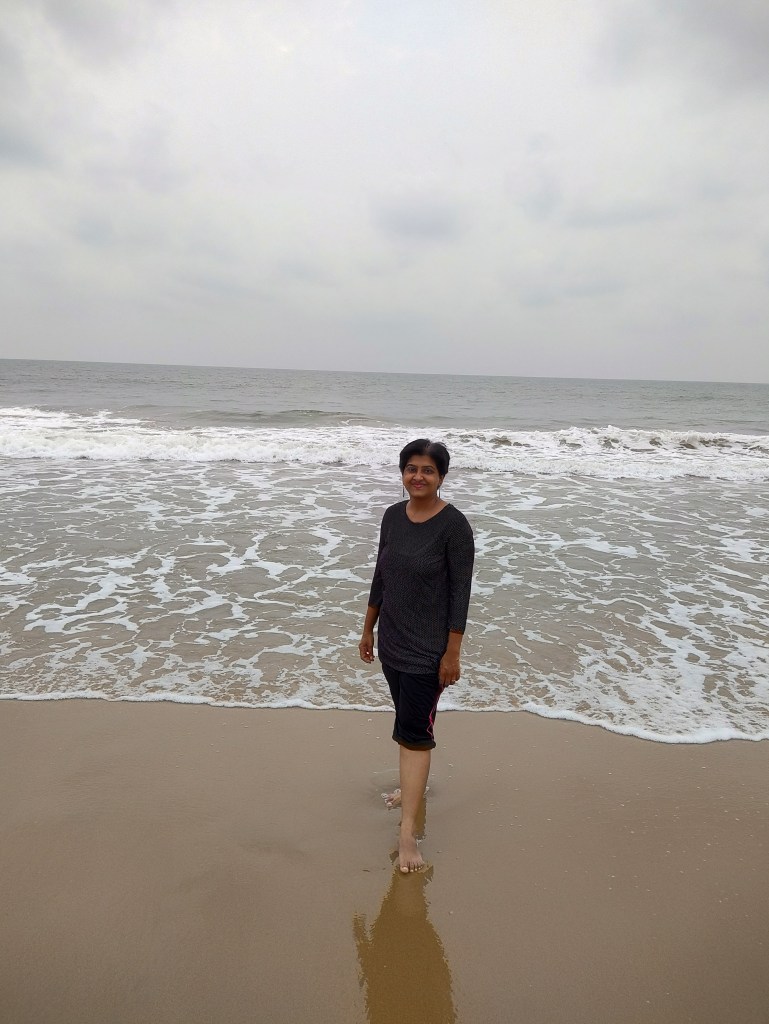
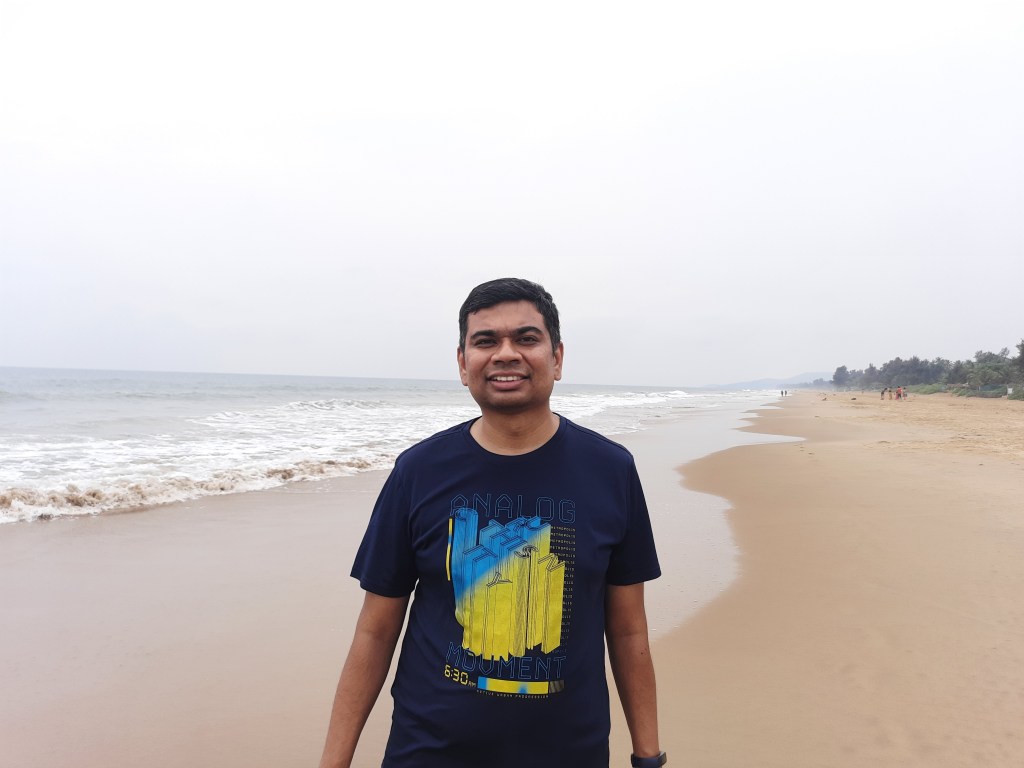
Like in Goa, we can hire two wheelers for short term in Gokarna . We hired an Activa for INR 400 per day and set out to the famous temple of Gokarna – Mahabaleshwar temple. The legend of the temple is as follows.
As per legend, Ravana was given Atmalinga by Lord Shiva and instructed that it would stay permanently where it is first placed on land. But Ganesha came in the form of a boy and planted it in Gokarna while Ravana was performing rituals. Once placed, Ravana could not remove it from the ground- and hence he gave the name “ Mahabaleshwar” to the Atmalinga.
The temple is just adjacent to the beach and was surprisingly crowded for a Thursday . One reason is because the temple is one of the seven sacred Muktikshetras (“places of salvation”) in Karnataka. It is a place where many Hindus perform obsequies (death rites) for their departed. We sought the blessings of the Lord Shiva (the main deity) and visited other adjacent temples of Goddess Parvati and Maha Ganapathi . These temples are not very architecturally grand and the visiting these temples did not take long time.
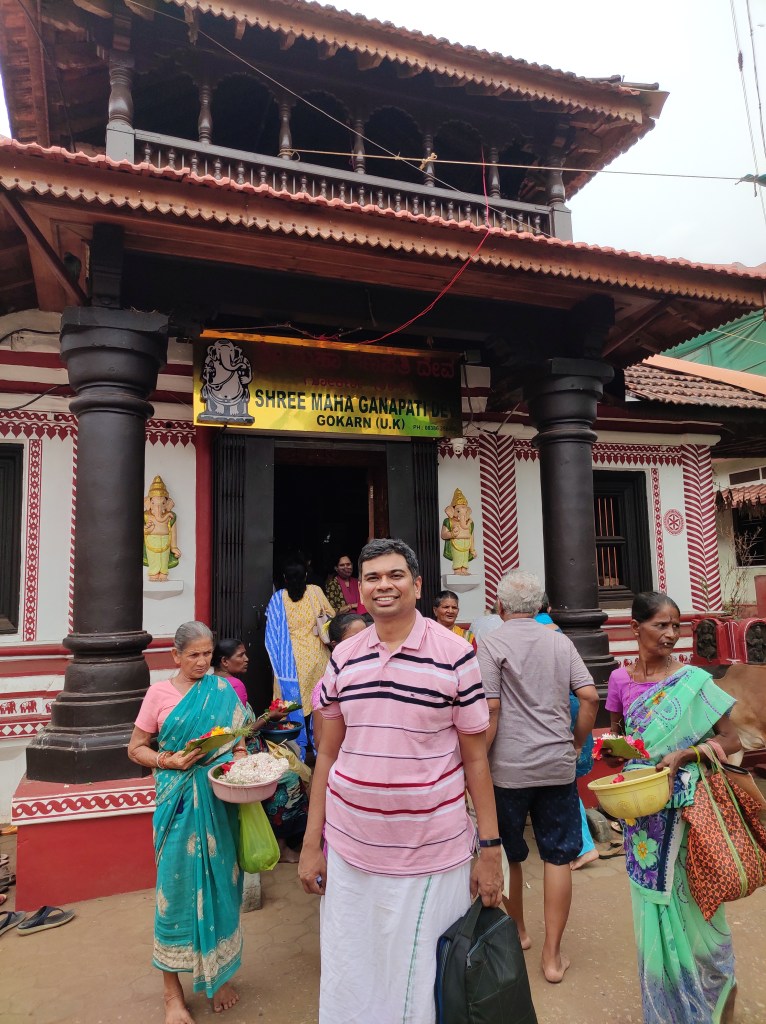
We was however unimpressed with the aggressive way in which vendors and priests sought money from devotees. A simple teerth by random priests in temple corridor was followed by demand for money. One understands that temples like other institutions require money for upkeep and the priests need make a living. But the monetary aspect needs to be made more systematic with proper receipts and queue system.
Post the visit, we went for a walk around the “Car street” – where the procession of the temple chariot takes place during religious festivals. I was surprised to see numerous Marathi nameplates like Joglekar , Mule, Sane etc- perhaps some little known history of migration ! There are number of vegetarian restaurants on this road and we preferred the Pai Hotel for next two days for our lunch.
That evening, we went for a long walk on the main Gokarna beach. The best part of long beach is that one can walk in solitude for long stretches which is quite an enjoyable experience.
Next morning , 25-Mar-22 we had no particular plan and spent the morning taking a dip in the sea water. For lunch we decided to visit the famous Mantra café, few minutes ride from the main temple. Mantra café is adjacent to Zostel – a backpacker hostel in Gokarna. Perched on the cliff overlooking Gokarna Main Beach, it provides a wonderful view of the Arabian sea. It appeared to be a popular destination for young travellers and I was by far the oldest diner there!
View from the Mantra Café is seen in following video
That evening we decided to visit the famous Kudle beach – which is extremely popular amongst the trekkers, water sport enthusiasts , yoga learners and night campers. This beach is smaller than the main Gokarna beach but has livelier atmosphere. After spending some time here, we went back to the main beach to view the sunset.
The link to the video of the sunset is given below
The final dinner at Gokarna was a memorable one. At the Ill Mio beach facing restaurant, we had a good time amongst colourful lights and watching the waves crash on the beach.
Next morning , 26-Mar-22 we had leave Gokarna and proceed to Murdeshwar – a distance of about 80 kms. We hired a taxi and started at 10:15 AM on the National Highway 66, made famous by film Dil Chahta Hai . It is indeed a picturesque drive through lush greenery and imposing mountains in foreground .
Just before Kumta, we stopped at the Mirajan fort , one of the lesser known attractions in the area. It’s an ancient fort with most of its parts in ruins.
The link to the video of the Mirjan fort in given below
Around 12:30 PM, we arrived at town of Murdeshwar and the influence of R N Shetty was immediately evident. Late R N Shetty was an entrepreneur and philanthropist from Murdeshwar, who executed number of important construction project like highways, hydel power projects and five star hotels during his lifetime.
RNS modernized the temple town of Murudeshwara and transformed it into a tourist attraction. The building of temple Rajgopura (tallest in the world) and the statute of Lord Shiva were funded by RNS.
Around 5 PM we entered the temple and were impressed by the maintenance and professional management. The main deity is Lord Shiva and there are numerous small temples surrounding it. This temple is located just adjacent to the Arabian sea and provides wonderful vista of the beach.
The main attraction of Murdeshwar, the giant statue of Shiva is in the same temple complex. It is the second tallest statue of Shiva in the world , only after the Kailashnath Mahadev statue in Nepal. One can get very close to this statue and admire the artistic finesse of the sculptor. Right behind it is the sunset point from where we viewed the sun set into the sea.
The link to video of the temple is given here
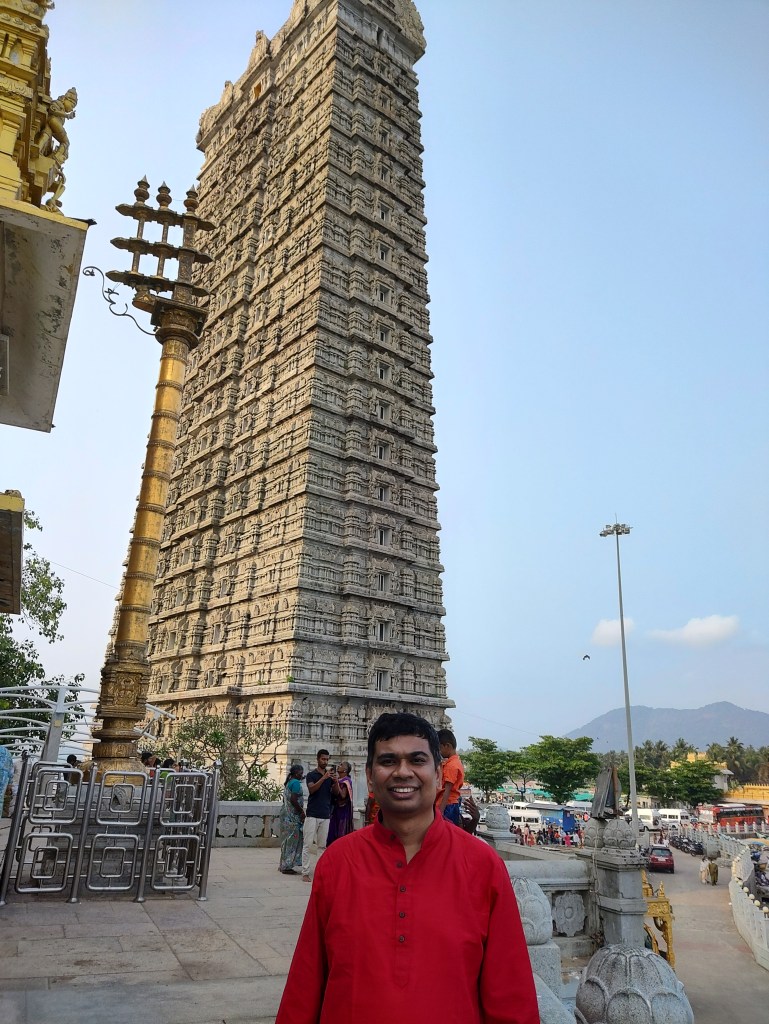
As the suns set, the lights at the Gopura and the Shiva idol were lit up creating a mesmerizing view. Its highly recommended that those visiting Murdeshwar spend an evening here and view the lighting.
We ended our day with dinner at Kamat Yatrinivas . True to its brand, the service was efficient and food pretty good.
Next day 27-Mar-22 was our last day in Murdeshwar. Waking up before 06:30 AM I went to temple to avoid the weekend rush. The premises was deserted and I could see all the shrines and views at leisurely pace. I was intrigued to see an entrance to the Bhukailasa caves and I went in. There are wonderful statuettes and life size images depicting various stories from Puranas. The legend of Gokarna is a special attraction here.
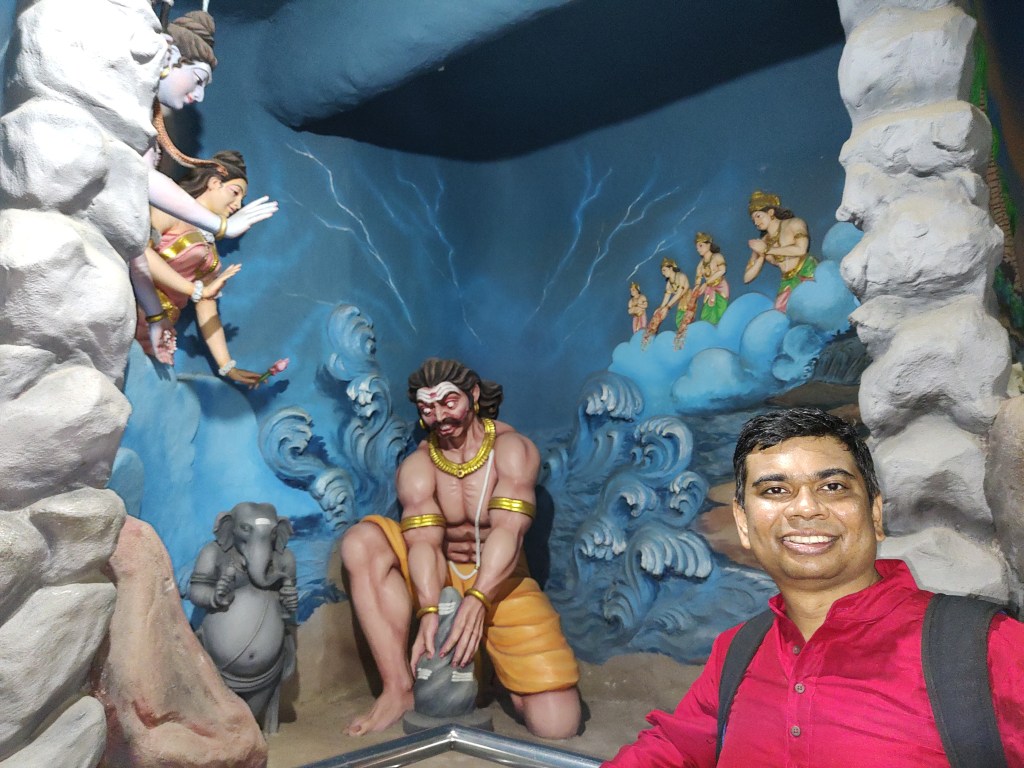
There is a lift near the entrance to the temple that takes one to the highest floor of the gopura. When we reached the top, we were slightly disappointed to see that the view was restricted from windows. It was not a panoramic view which I was expecting, however I did capture some interesting videos through the windows
The link to video is given here
There are numerous water sports available at the Murdeshwar beach and I mustered my courage to take a speed boat ride. It’s a high adrenaline rush activity and I held on to the seat while boat twisted and turned wildly in choppy sea. I was glad when the speedboat reached the shore!
As we made our way to railway station to catch train back home, I was reflecting on the number of lives that R N Shetty had touched through is philanthropy, especially in field of education. And his contribution to building of what is truly “temples of modern India”
“ Like living beings, empires too go through cycles of life-death-and-rebirth “
Vijaynagar kingdom was at its zenith in the middle of 16th century. International travelers extolled its grandeur and compared it to Rome. Undoubtedly, one of the most magnificent cities of the era.
And then disaster stuck. The five Muslim kingdoms (called Bahamani) united and defeated the Vijayanagar army in battle of Talikota in 1565. What followed was looting and destruction on unimaginable scale. For six months the plunder continued and the city was left in ruins.
After the horrific destruction, two commoners approached a wise sage lamenting the loss. It is then the sage commented that empires too go through the same cycles which the humans do.
Ever since I had read this story, I had wanted to visit Hampi, the town which was once the capital of Vijaynagar empire. Many of my friends also had recommend me that place.
At beginning of 2020 , I had decided to visit all the culturally significant destinations in Karnataka. But we all know how 2020 turned out to be.
In August of 2021, I finalized my plans for Hampi visit. Though initially, I thought three days would be enough, but given the vagaries of the rain, I decided to add an extra day to my itinerary.
During my last few travels, one of my take-away has been to stay close as possible to the key attractions and ensure adequate time to re-visit places of interest. The fact that I stayed in city of Puri for four nights enabled me to take darshan of Lord Jagganath multiple times and each experience was unique.
So I booked my train tickets for 08-Sep-21 from Bangalore to Hampi for duration of 3 nights and 4 days. Rocky Guest House ( just 300 meters from Virupaksha temple) seemed like an ideal choice. The reviews on Tripadvisor do provide a useful data which helps one make decisions. Hence I make it a point to write objective reviews of the hotels I have stayed in as a guide to future travelers.
We boarded the Hampi express at Bangalore railway station on 08-Sep-21. For many years, we used to alight from the same train during our weekend Bangalore visits from Mysore. Ironically, we were boarding the same train now from Bangalore.
After a comfortable journey, we arrived at Hospete Railway station at 7 am on 09-Sep-21. Hampi is around 12 kms from Hospete and we hired an auto-rickshaw to take us to our homestay – Rocky Guest House. The weather seemed pleasant and the extreme heat (for which Hampi is known for) was not be a problem for us.
There are few preparations which are recommended for those travelling to Hampi.
a) There are no ATMs in Hampi, hence carry plenty of cash- also ensure you have currency notes in lower denominations of 100s and 50s.
b) If you are driving down in your own car, can stay in the hotels in Kamalapur area about 4 KMS from Hampi. Those travelling by bus/train can stay in Hampi town like we did.
c) Do carry medicines and other essentials– there are very few shops in Hampi and no supermarkets.
After a quick breakfast, I headed to the world famous Vijaya Vittala temple. Meenal decided to rest for few hours after the train journey . After a drive of 10 KMS in auto-rickshaw I arrived at the Vittala temple. The roads were surprisingly in excellent condition thanks to recent visit by Vice President M. Venkaiah Naidu.
After a walk of about 1 KM from the parking lot, I arrived at the entrance of the Vittala temple. There are battery operated vehicles for ferrying the passengers which are a better option. On entering the temple, I was dazzled with an extravagant architectural showpieces . The sprawling compound of this temple houses pavilions, halls and many other smaller temples.
The highlight of Vittala temple is its impressive pillared halls and the stone chariot.
The stone chariot in fact a shrine built in the form of a temple chariot. An image of Garuda (the eagle god) is enshrined within its sanctum. The image of this chariot now adorns the modern INR 50 currency note.
The other highlight of the Vittala temple is the Maha-Mantapa with its richly carved giant monolithic pillars. The outermost of the pillars are popularly called the musical pillars which emit musical tones when tapped. Though its prohibited from tapping these, one can tap similar ones in the adjacent mantapa . I was impressed with the variety of the sounds that emit from these pillars.
The walls of the mantapas are adorned with the sculptures that depict Krishna Leela, Ramayan and story of Bhakta Prahlad. These sculptures are bigger than those I have seen in other temples.
The video link to the Vijaya Vittala temple is given here : https://youtu.be/N6OAOCONgLw
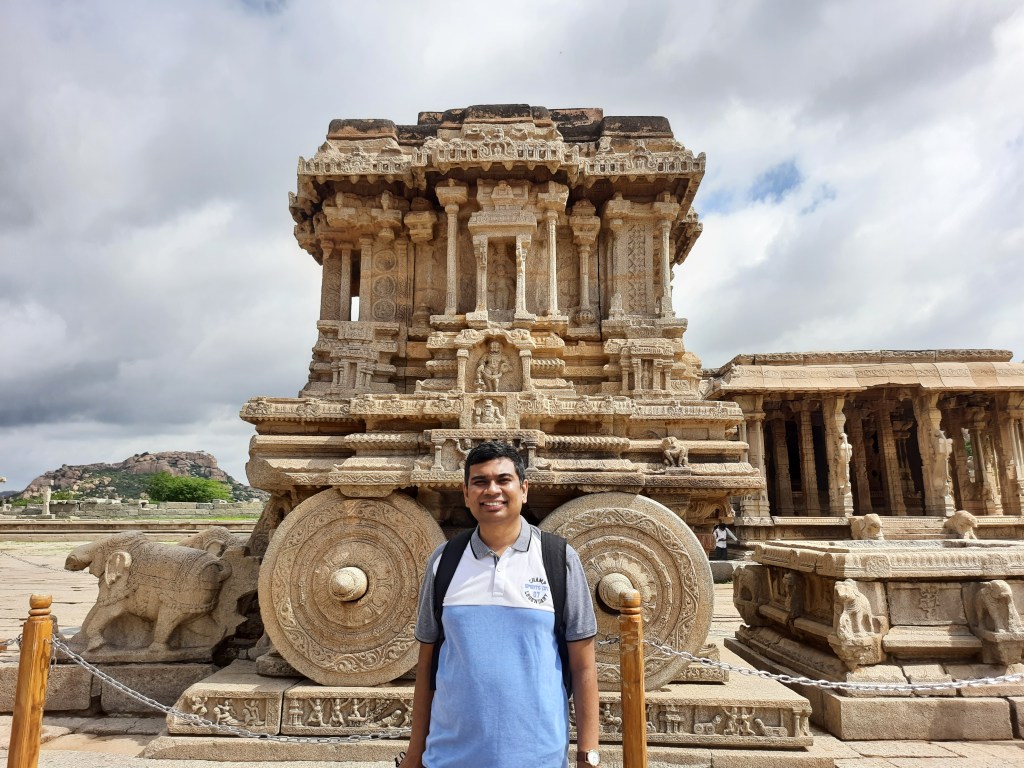
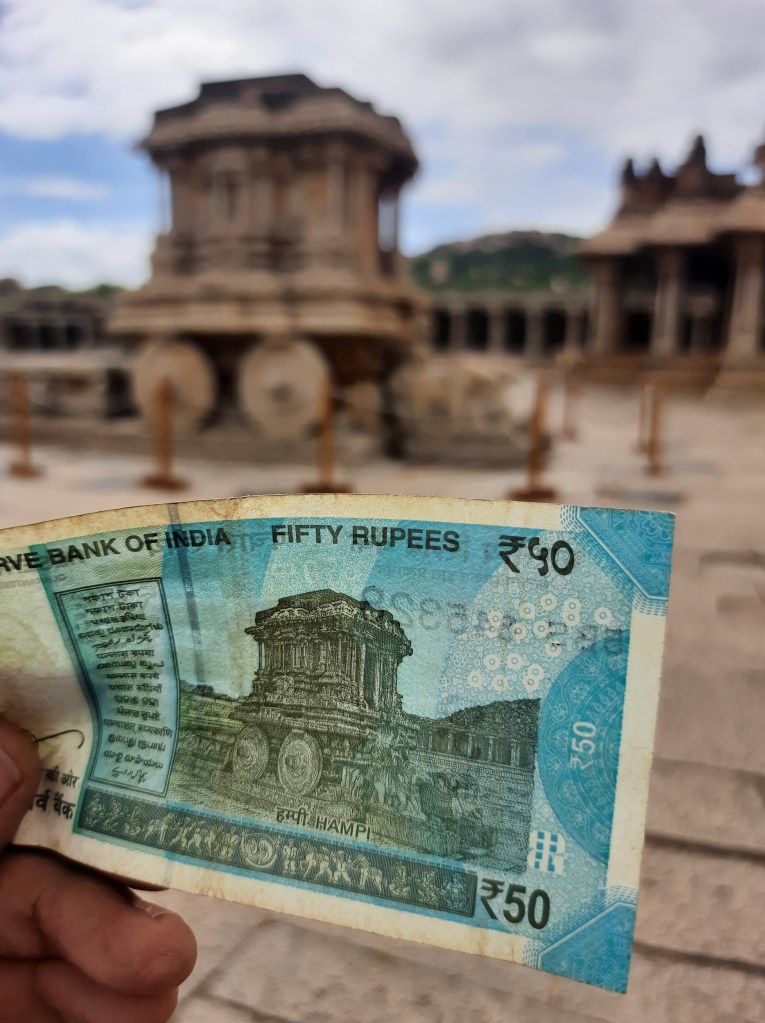
After the Vittala temple visit, I walked down to the river front which is few meters behind the temple. The Tungabhadra river flowed majestically and it was a sight to behold ! On the other side of the river one could see the Anjanadri hill, birth place of Lord Hanuman.
I arrived at the guesthouse and then we had lunch at the popular Mango Tree restaurant, next to our guesthouse. We liked everything about this place from the moment we stepped in. The ambiance, service, taste and variety of the dishes. In fact, we had almost all our meals in the same restaurant over next four days.
Later that evening, we entered the Virupaksha Temple , the temple dedicated to Lord Shiva, known here as Virupaksha/Pampapathi, as the consort of the local goddess Pampadevi. This is a huge complex built during 7th century AD though most of the additions were made during the Vijayanagar period.
The gopura of the temple is an imposing structure, towering 50 meters in height .In addition to the shrine of Lord Shiva, there are ones dedicated to Devi Bhuvaneswari and Vidyaranya Muni, the spiritual founder of Vijayanagar. The striking feature of this temple are paintings on the ceiling. These are very colorful and have remained so for hundreds of years ! These paintings depict the well-known stories epics and puranas. Another extraordinary feature is the wall on which the inverted shadow of the main tower falls upon. Quite an engineering marvel ! There is temple elephant who is popular with the devotees.
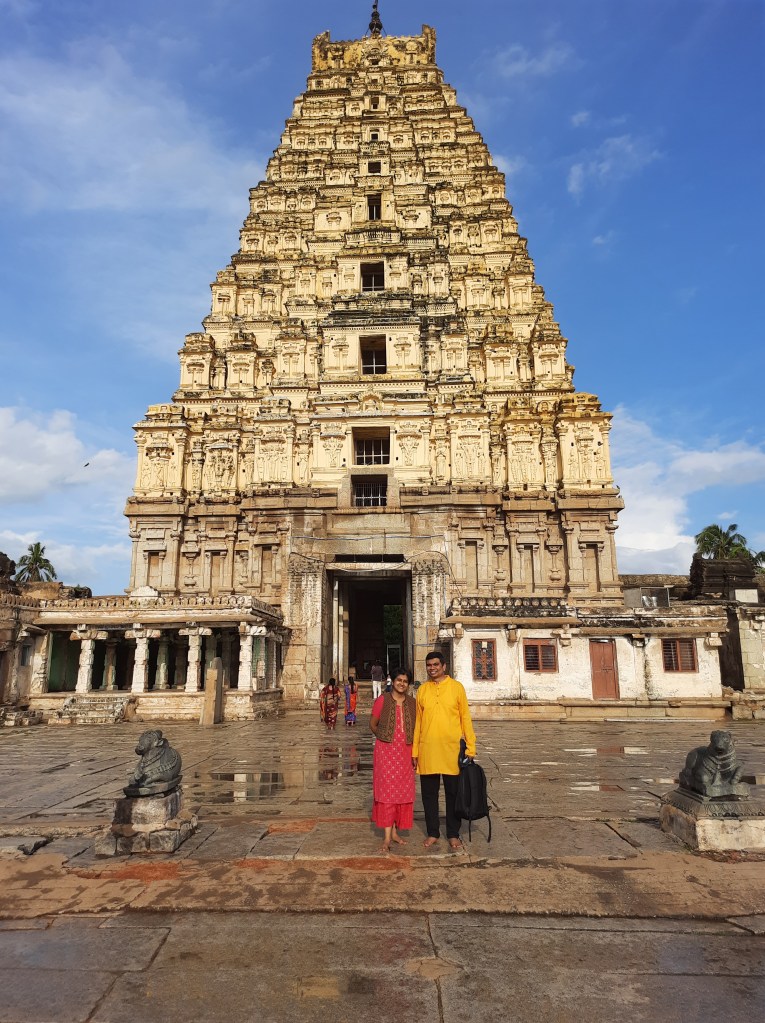
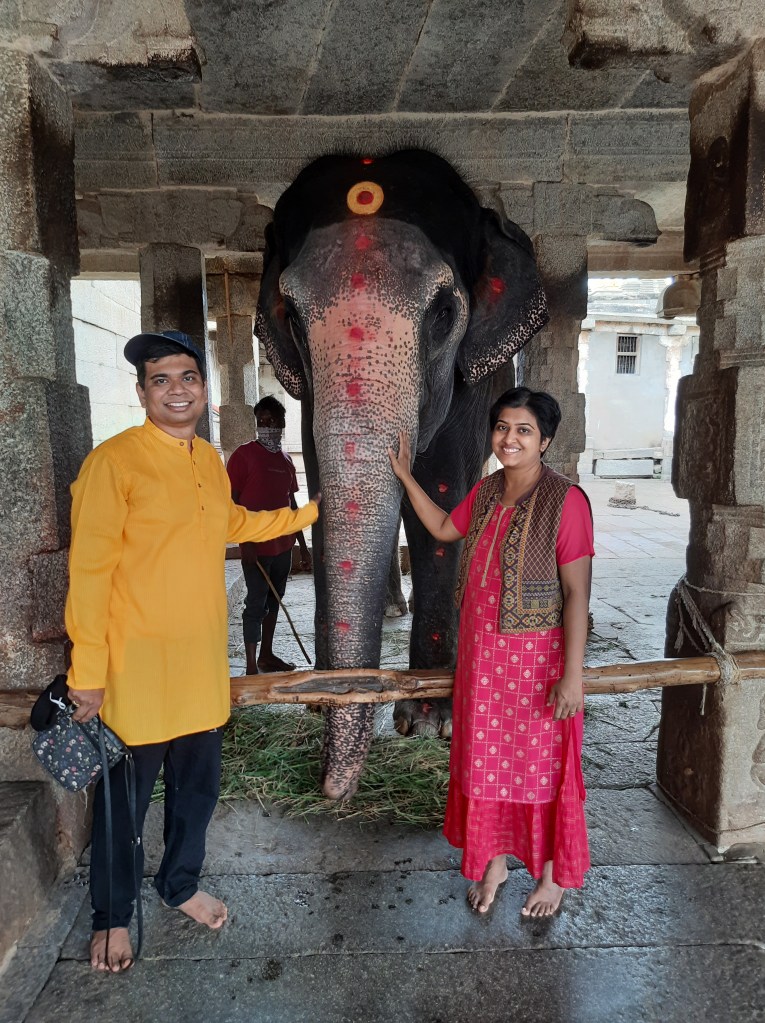
Around 5 PM we started walking up the Hemakuta Hill Complex adjacent to the Virupaksha temple. The Hemakuta group of temples is a cluster of ancient temples situated on the Hemakuta hill in Hampi. There are numerous boulders on this hill at different angles which give the impression that they might roll down any minute ! The sunset point on this hill is quite popular and the vista from here is spectacular.
The video link to the Hemakuta Hill is given here : https://youtu.be/VCBFVVysj9A
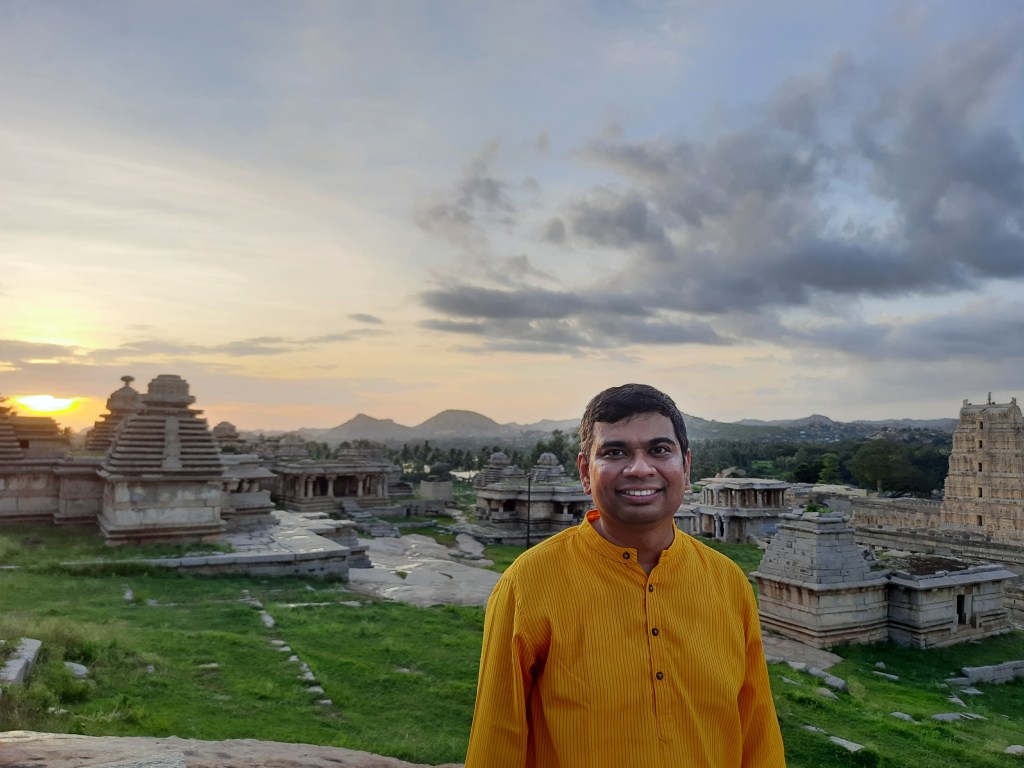
10-Sep-2021
This was an important day of our trip in which we had hired an auto-rickshaw for a full day for INR 1000. The plan was to view all the important attractions throughout the day. Auto-rickshaws are the best way to commute in Hampi, since all the attractions are in 10 KMS radius. The hotel /homestay employees will easily procure an auto-rickshaw at any given time.
We started with another visit to Vijaya Vittala temple and this time without the guide. The vastness of the complex was re-experienced and we took some photographs at leisure. We checked the engravings which clearly show Arabs, Italians and Mongols visiting in Hampi during 16th century.
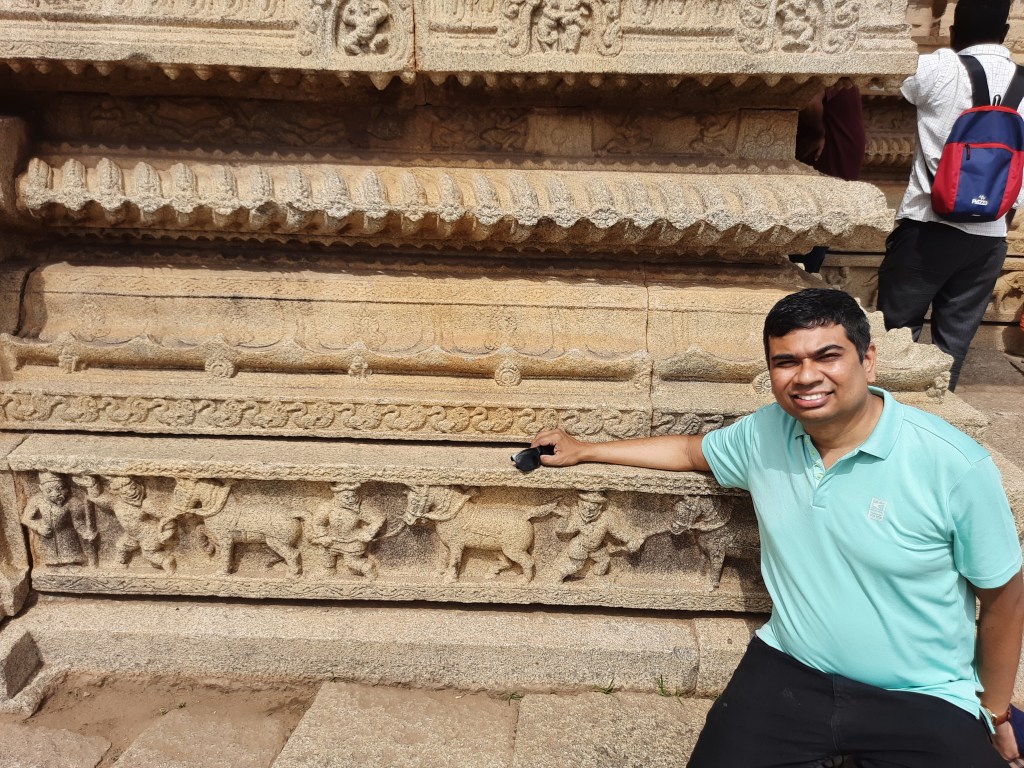
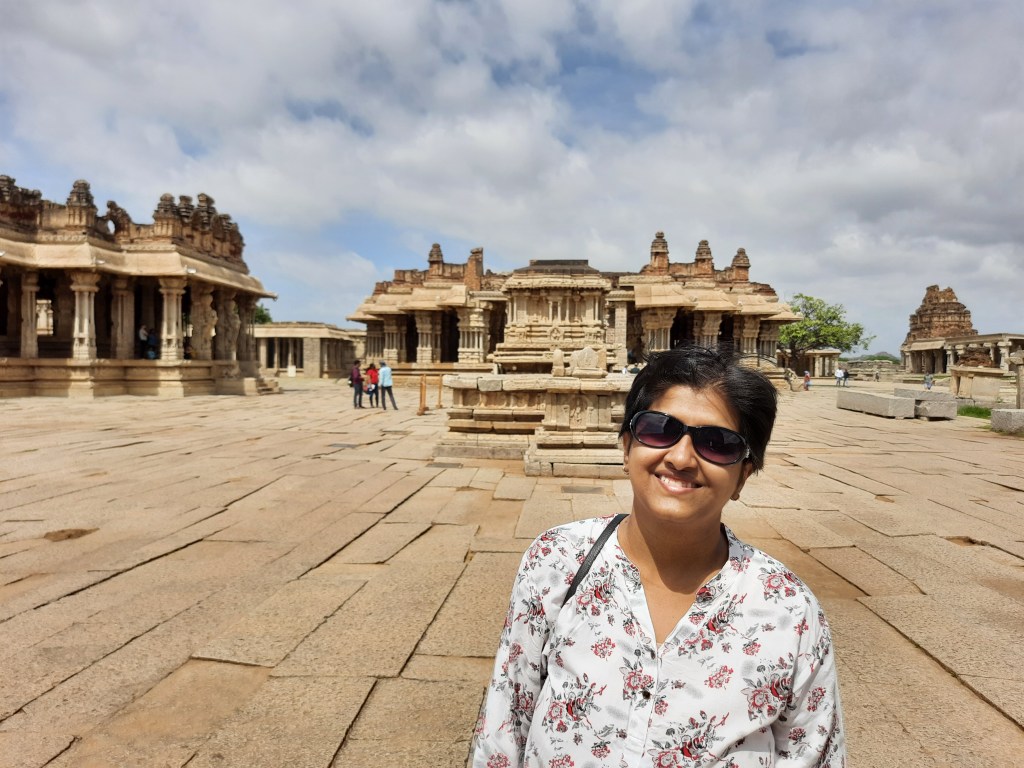
The next stop was Malyavanta Raghunatha Swamy temple – according to mythology, it is here that Lord Rama and his brother Laxman waited till the monsoon season got over during their search for Sita. The recitation of Ramayan constantly goes on in this temple and the devotees of Lord Ram will definitely find peace and solace here. This is the only hilltop in Hampi where you can reach by a vehicle. The views needless to say were spectacular from the vantage point.
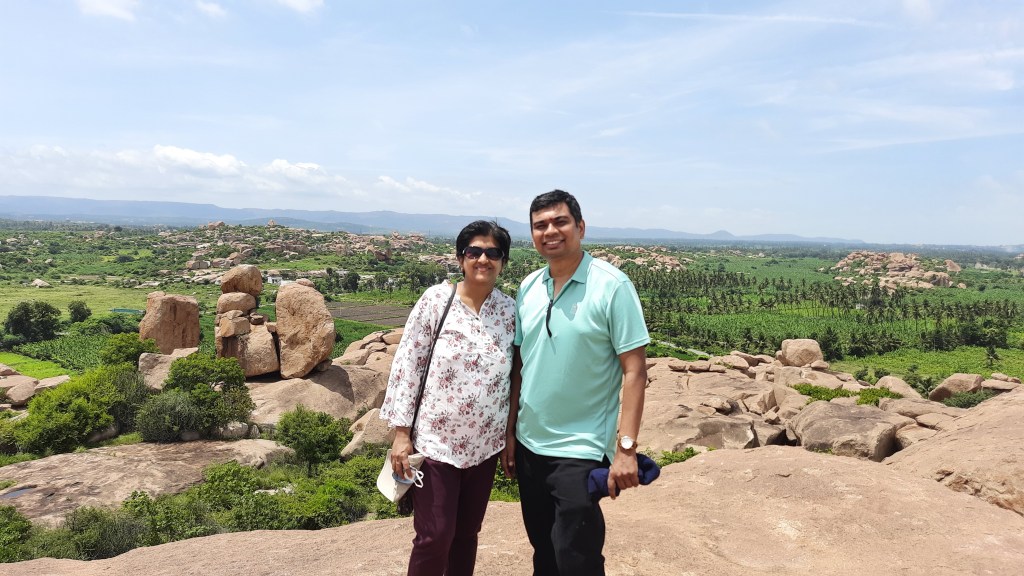
The next few attractions I found to be quite pedestrian – Elephant Stables ,Lotus Mahal, Stepped Tank and Dasara Dibba. These may be of interest to students of medieval architecture, but it is just a photo opportunity for rest of us.
A truly fascinating monument is the Hazara Rama Temple – this has numerous panels depicting the story from the epic Ramayana. The stone engravings are bigger and more prominent than in any other temple I had seen earlier.
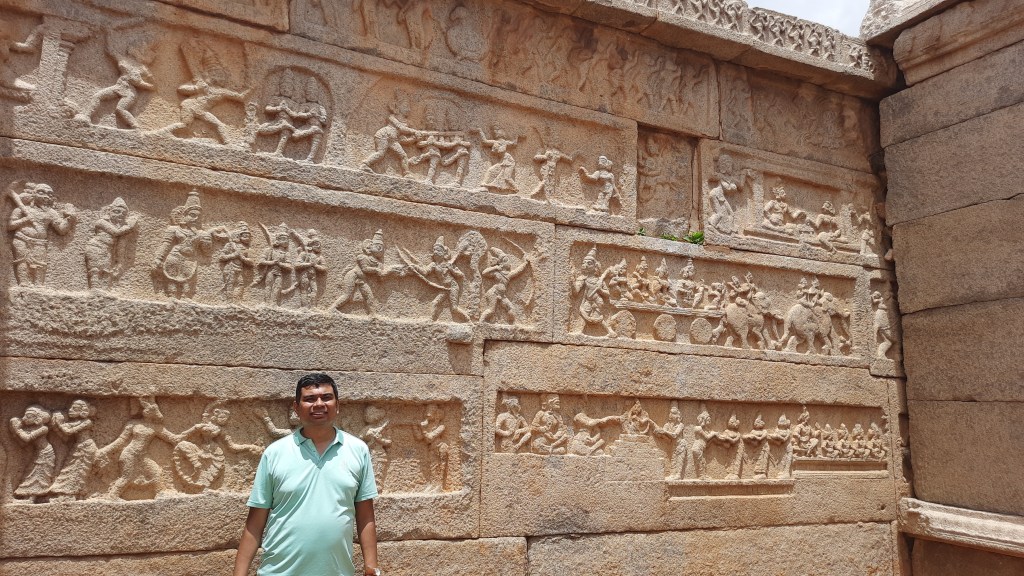
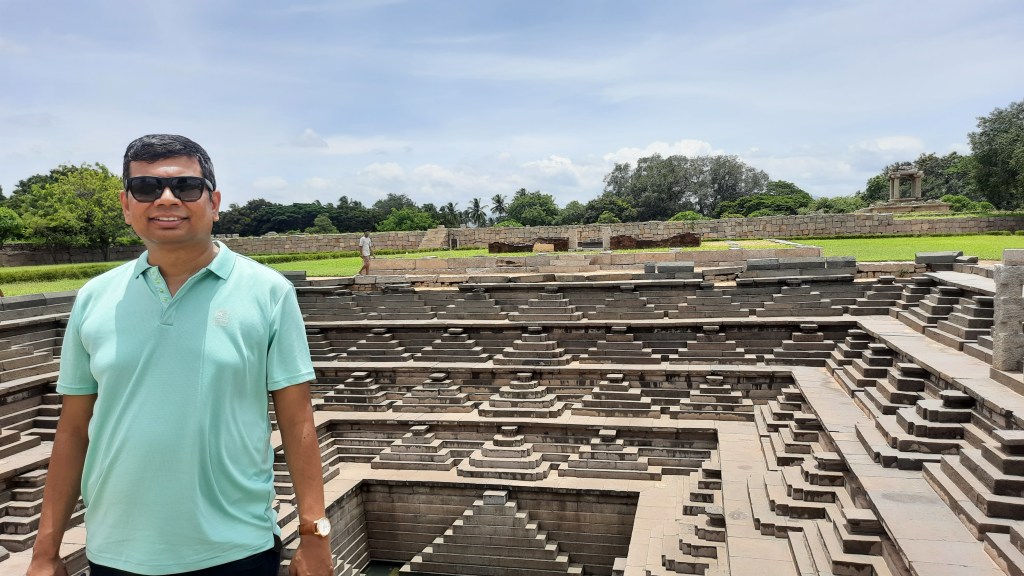
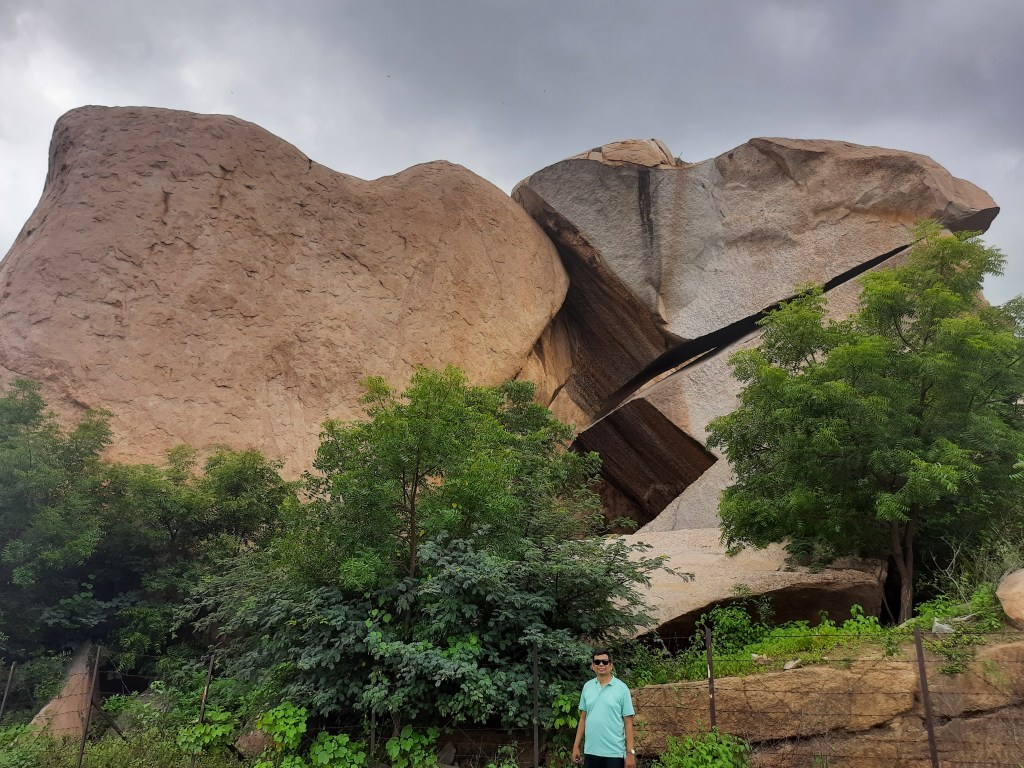
There are huge statues of Lord Ganesh and one of Narasimha quite close to the Virupaksha temple . Kadalekalu Ganesha is so called because the belly of Ganesha resembles a Bengal gram (known as Kadalekalu in Kannada). One can get close to the idol and seek the blessings from the remover of obstacles. Close by is Sasivekalu Ganesha is about 8 feet high and was built by mustard traders from Andhra Pradesh (Sasive means mustard in Kannada)
The biggest statue in Hampi is that of UGRA NARASIMHA, which depicts Lord Narasimha in angry form. Though vandalized by Bahamani sultans (like most monuments in Hampi), it is quite fearsome and awe inspiring.
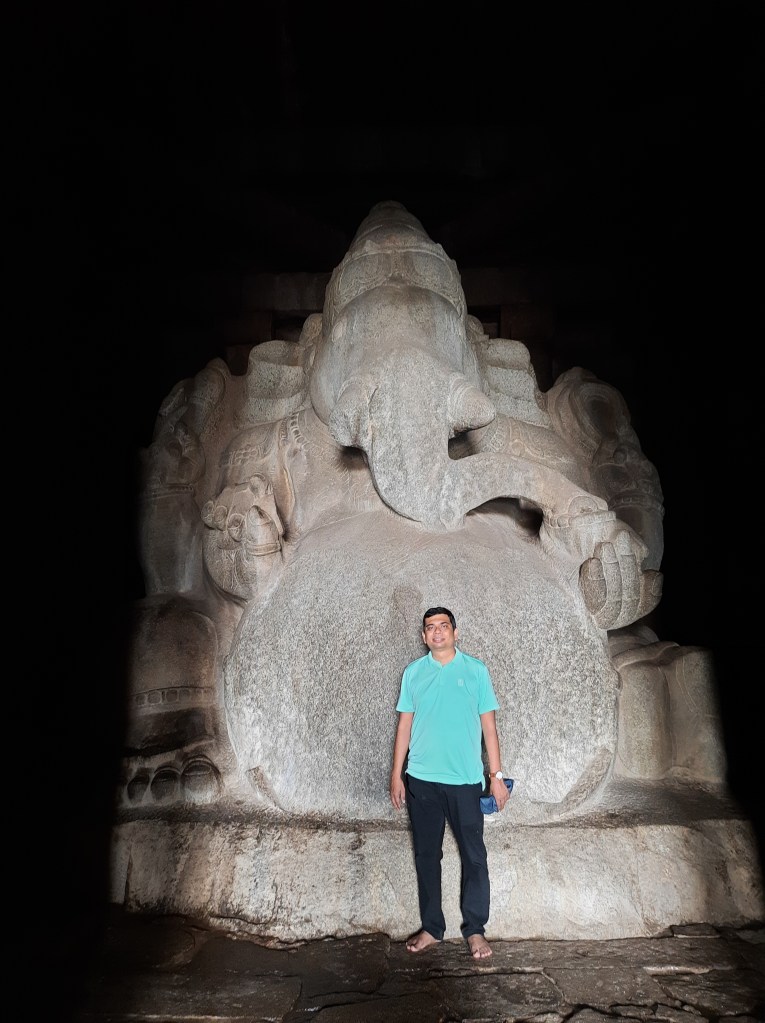
We ended our second day with another visit to the Hemkuta hill to see the sunset.
11-Sep-21
The day was bright and sunny and we had our breakfast at the nearby Sagar hotel. This restaurant is run my three middle aged ladies and they do a fabulous job of serving idly, dosa, pooris and paddus.
I was determined to explore Hampi on foot and set out towards the Vijaya Vittala temple on a walking trail. This time I wanted to view the ruins of Achutyaraya temple, which are accessible only by foot.
After a walk of about a kilometer, I reached the river front and started walking parallel to it. The views were spectacular and the government has done a good job in maintaining this walking trail. After paying my respects at the Kodhanda Rama temple, I walked towards Achutyaraya temple ruins.
This temple is not named after any deity but after Achutyaraya, younger brother of Krishnadevaraya. It was the last grandiose construction completed in Vijayanagar kingdome before the Bahamani invasion .
This temple complex has multiple mantaps, gopuras and smaller shrines. Many view this as the best attraction of Hampi simply because it is deserted ! It is not on motorable road and one has to trek about two kms to get here, hence there are very few tourists around. There is sense of serenity here which I did not experience in any other place in Hampi.
The video link to the Achutraya temple is given here : https://youtu.be/02IWqic5v-I
That evening, I revisited the Achutyaraya temple and also surrounding areas which are of mythological importance. The area where Devi Sita dropped her jewels which were found by Sugreev, and a cave where Sugreev did tapasya which also has footprints of Rama and Laxmana.
That day ended with beautiful view of the sunset from banks of Tungabhadra. Though sunsets top of hills are famous, the ones from river banks are no less spectacular !
The video link to the sunset from river is given here : https://youtu.be/A3YGjwFDjzw
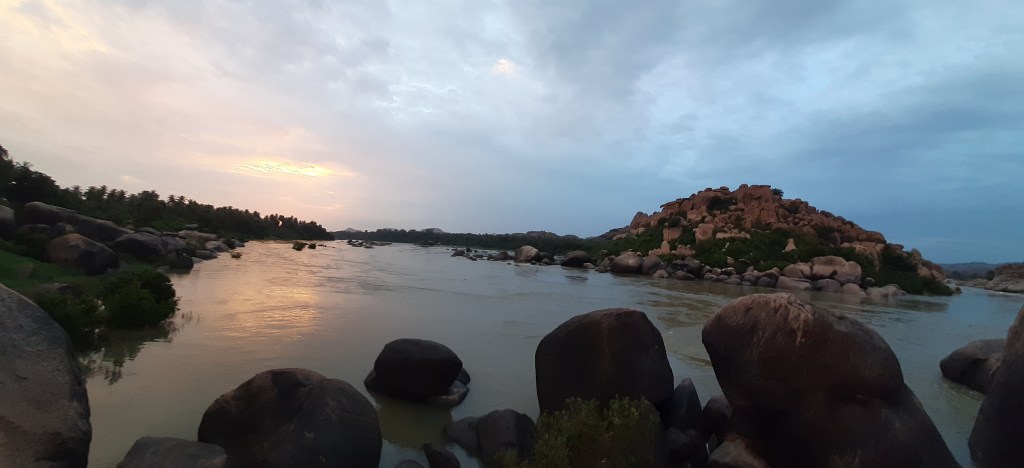
12-Sep-21
The final day in Hampi would turn out to the most memorable one of our trip. We decided to trek the famous Matanaga hill, where Sugreev took refuge after his fight with his brother Vali. Being the highest point in Hampi; this is the best spot to get an aerial view of Hampi and its surroundings.
There are three routes to reach the top, and we decided to ascent from the track next to the Nandi statue. Though there were good solid steps during initial ascent, it became increasingly difficult as we progressed near the top. There were number of outstanding views throughout the trek. As we approached the summit, the steps were replaced with rocky terrain. It was a thrilling experience to walk on sheer rocks and stones with a deep gorge (without any railings) just adjacent to us. The authorities should install some safety measures here as this is definitely an accident-prone zone.
However, the risks were forgotten when we reached the top of the hill. The entire Hampi town and all the landmarks were visible in an incredible 360-degree view. There is a small temple dedicated to Lord Matanga Veerbhadreshwara, and it is from the roof of that temple that we could see the town and the surrounding countryside. The wind was howling with such ferocity that we could hardly hear ourselves speak. These are times I am thankful for not being too slim ; no risk of being blown away by strong winds!
The video link to the Matanga hill given here : https://youtu.be/9BZI5Er0NGA
Our homestay owner had advised us to take the route which leads to the base of Achuytaraya temple. However, we noticed excellent staircase with made with solid stone. Correctly summarizing that this would leads to base at Hampi bazar ( near Kadalekalu Ganesha) we started our descent.
When we reached the base , the steps disappeared suddenly in middle of dense vegetation! Not sure about how to proceed, we made our way into a banana planation without any walking track in sight. Realizing that this is not the right path, we went back to the base of the stairs and took a right turn towards the hillock. We walked up the hillock and after tense fifteen minutes or so, we finally found an open gate that led us into a modern Jain temple. The locals there directed us to the Hampi bus stand and we heaved a sigh of relief ! Its recommended that one consults and follows suggestion of the locals during the treks to avoid any misadventures.
After some well-deserved rest, we visited our favorite Mango tree restaurant for the final time. We ordered a pizza and realized we should have stuck to the core expertise of the restaurant i.e Indian food (both south and north Indian dishes were made well)
That evening, I paid another visit to Virupaksha temple to admire the architecture splendor of the place. At leisure I could admire the smaller shrines dedicated to Lord Ganesh, many other Goddess and also to Vidyaranya Muni . I believe this is the only temple with a shrine dedicated to a philosopher and spiritual teacher like Vidyaranya Muni , who has authored Panchadasi and many other texts on Advaita Vedanta.
During this trip, we could not visit the northern bank of Hampi (called Hippie island) as the ferry services were stopped due to river currents in Tungabhadra. That will definitely part of our next itinerary during our next Hampi trip.
Around 8 PM we left for Hospet and boarded train back to Bangalore. I was reflecting on the multitude of sights and sounds I had seen during past four days. The temples, ruins, monuments and the natural beauty of river and sunset- all were magnificent. But there was unmistakable gloom in my heart on seeing the ruins. What did the Bahamani invaders gain by wrecking so much destruction? The loot of gold and silver one can understand, but deliberately setting fire to palaces and temples is sign of depravity. It is lesson for us, that while we make progress in art, culture, engineering etc the military readiness should be our topmost priority . A strong national leadership with focus on national security is need of the hour. Else, the results are for everyone to see…..
In the first part of my blog,I detailed how I started reading Champak magazine at the age of five and moved on to other children’s books gradually. By the time I entered college, Agatha Christie and P G Wodehouse had become a staple diet of mine.
In the final years of Engineering , I was focused on clearing the CAT entrance test and obtaining admission in one of the top Business Schools of India. Preparation for the test and subsequent Group Discussions piqued my interest in the world of business and finance. One of the earliest books I read on management was authored by the doyen of Indian Management :Sumantra Ghoshal. His book “Managing Radical Change – What Indian Companies Must do to Become World-Class”, is a distillation of lessons offered by people as diverse as N.R. Narayana Murthy ,Brijmohan Lall Munjal, Keki Dadiseth and Dhirubhai Ambani. The best part of the book is the focus on the Indian context and milieu.
The world of big business is intriguing, but it is even more fascinating to know the lives of the people who run these empires. Gita Piramal’s “Business Maharajas” was an excellent account about personal and professional lives of Indian industry captains like Dhirubhai Ambani, Ratan Tata, Aditya Vikram Birla , Rahul Bajaj etc. I was surprised to read that the influence of “family’ and that the destinies of companies are often decided on the promoter’s dining room rather than the board room.
In Oct 2006 ,I moved to USA and was exposed to the institution of “Public Library”. American industrialist Andrew Carnegie donated millions of dollars in late 1800s to establish and maintain public libraries throughout United States. Subsequently, these were maintained by local Municipalities and provide free and high-quality books to all residents.
In addition to the vast number of existing books, the libraries also purchase books on request by patrons. This robust infrastructure is certainly a role-model of other countries to encourage reading habit among its citizens.
My re-location to USA coincided with the Sub-Prime Mortgage crisis of 2008. The TV and the electronic media were flooded with stories, personal accounts and expert opinions on the reason and impact of this recession. However, I have always found books to be the best source of information if one needs to understand the complete context of any complex issue. “Two Trillion Dollar Meltdown” by veteran journalist Charles Morris briefly but brilliantly explains how the world got into the economic mess and the historical contexts to the credit crunch of late 2000s. On the other hand “The Big Short” by Michael Lewis takes us around Manhattan with his character-driven narrative and occasional humour. Through these books I began to understand the complex terminology like Credit Default Swaps (CDS) and Collateralized Debt Obligation(CDO)
There were numerous other books I read during this period on the theme of finance and economy like “Lords of Finance” by Liaquat Ahamed about events leading up to the Great Depression of 1920s and 30s. “Age of Turbulence” an autobiography of Alan Greenspan, longest serving chairman of the Federal Reserve Board ,takes us through the world of interconnectedness of the global economy.
However, the pinnacle of them all, the most comprehensive and detailed account of the sub-prime crisis is in “The Devils Derivative “ by Nicholas Dunbar, which tries to demystify the arcane financial tools. It is not a light reading, and many times I had to refer to internet to understand the terms and the context !
In 2010, I moved to Pune, a city I had loved since my first visit there in 2004. Right from the days of Chhatrapati Shivaji Maharaj, Pune has had enormous political, educational and historical significance. It is also called “Oxford of the East” due to the presence of several well-known educational institutions and overall culture of academia.
While moving around the “Book District” of Appa Balwant Chowk, I looked at amazement at rows of shops selling Marathi books on every subject. Looking at the historic monuments , I realized that I had very cursory knowledge on Maratha history.
The Maratha Empire was a great power that dominated a large portion of India in the 18th century. The empire was established in 1674 with the coronation of Chhatrapati Shivaji Maharaj and lasted till 1818. The Marathas were instrumental in ending the Mughal rule in India, the fact which is not taught in the school text-books.
While browsing through Crosswords bookstore I came across “The Marathas” by Stewart Gordon. This book gives a factual, unbiased and comprehensive history of Maratha empire with focus on the geopolitics of the region.
Any study of Maratha history MUST start with Chhatrapati Shivaji Maharaj and there are innumerable books written about life and times of this great warrior king. Two of the ones I liked the most were “ Challenging Destiny” by Medha Deshmukh and “Shivaji: The Grand Rebel” by Dennis Kincaid. Dennis Kincaid was a senior civil servant in British India and this book was published in early 20th century.
Reading the history books filled me with pride, but also made me realize that most Indians are unaware of the glorious historical figures of our land. In order to instill confidence and courage in our younger generation, it is imperative that they are exposed real heroes of Indian history. India is land of the brave, be it the valiant Sikhs under the Banda Singh Bahadur and Maharaja Ranjith Singh; the Rajputs who protected India for hundreds of years from Islamic invaders; and the Ahoms from Assam. Ahom warriors ruled Assam uninterrupted from 13th century till the British rule and comprehensively defeated the Mughals under Aurangzeb . In the famous battle of Saraighat ,the largest river naval battle fought in the world ,Ahoms under the capable leadership of Lachit Borphukan routed the Mughals.
The history books inspired me to deal with day-to-day challenges of life with greater confidence. Our ancestors took on impossible odds and won ! In the battle of Umberkind, Chhatrapati Shivaji accompanied by 1000 soldiers ,comprehensively defeated Kartalab Khan with his vast army of 20,000 men and heavy artillery. Such stories inspire us that through determination, intelligence and courage, we can overcome any challenges in our life.
Travelogues and traveler stories have always intrigued me. Right from the time I read about Marco Polo , I admired those who leave the familiarity and comfort of their homes to explore new places. Surprisingly, one of such fearless traveler is cousin of our family friend. Aniket Ketkar was raised in a quintessential Marathi Brahmin middle class family in Pune. From earliest years, the focus was on education and leading comfortable and stable life. Having completed his Chartered Accountancy (CA) Aniket joined a consulting firm and worked there for seven years. Then one day in 2013, he simply quit to travel the world !
His travel diary “Tales from the Road”, takes us to the countries I knew very little about. From Vietnam, to Cambodia, Indonesia, Laos and on to Myanmar. These are countries which have some cultural similarity with India but are unique in their own ways. And Aniket like a true traveler, mingles with the locals, stays in off-beat places and gives insight into life of common people of these countries. These countries are not frequented by Indian travelers and in many cases, Aniket was the first Indian the locals had seen.
If Aniket Ketkar was a first-time traveler, Michael Palin is professional, who has literally travelled the world. His books are mixture of interesting travel experiences, breathtaking pictures and characteristic British humor. I have bought most of Michael Palin travel books not in a bookshop , but at book exhibitions at Institute of Engineers ,where books are sold by weight !
One of the most memorable of Michael Palin books is “Himalayas”, where he starts his travel from Gilgit in Pakistan , onto Lahore, Amritsar, Shimla , Nepal, China , Bangladesh and Bhutan. Reading about the glory of Golden Temple and Amritsar and the magnificent beauty of the Himalayas inspired me to visit those places.
If Himalayas gave me an introduction to Amritsar, a book which I bought at Pune airport gave me an in-depth insight into political affairs in Punjab. “Amritsar: Mrs Gandhi’s Last Battle” is written by British author Sir Mark Tully in a very objective and unbiased manner. It gave me clear idea about the politics of 1970s -80s, the terrorism that gripped Punjab during those decades ,the infamous Operation Blue Star, assassination of Mrs Gandhi and the horrific riots that followed .
After reding this book, Amritsar became a must-visit destination for me. Thus inspired by my reading, in 2016 I visited Himachal Pradesh and Amritsar the details of which I penned in my blog : https://tejascogitates.wordpress.com/page/2/
India is land of tradition and this is true even in the world of Indian Business Houses. Even the Public Limited Companies are run by founder’s family as much they are by professional managers. Wanting to know more about the how Indian family business operates, I read Bhujia Barons – which details the rise of Haldiram ; Havells: The Untold Story of Qimat Rai Gupta –about India’s largest electrical goods company ; Ramanand Sagar: From Barsaat to Ramayan – life of legendary producer director Ramanand Sagar and Dare to Dream: The Life of M.S. Oberoi- who founded the Oberoi chain of hotels
These books are not regular business stories – they capture the emotions of Indian families, the support structures, the feuds , the sacrosanct nature of verbal promises, the deference to elders and behind the scene intrigues.
If some books inspire one to come out of comfort zone, books like My Journey with Vada Pav by Venkatesh Iyer details the insurmountable odds that a first-time entrepreneur faces in India. It is truly remarkable how this gritty founder of “Goli Vada Pav” dared convert an idea to a reality .
“svalpam apyasya dharmasya trāyate mahato bhayāt” – Bhagwat Gita – Chapter 2, Verse 40
Translation : Even a little progress on the path of spirituality, saves one from great fears.
I had started this blog with “I read a book one day and my whole life was changed”. In my case, that book would be “Talks on the Gita” by Vinoba Bhave – which I bought during visit to Aga Khan palace in Pune. This is collection of lectures on the great spiritual classic in a simple, lucid and intelligible manner. The talks are replete with analogies and examples which formed an instant connect with me. The wisdom and humility of Vinoba gleams through the pages as do the messages of the great saints like Tukaram and Dnyaneshwar. Truly, this book was first step on the path of my spiritual journey.
I am fortunate that I can frequently visit the Sri Ramakrishna Ashrama in Mysuru. The books shop there is a magnet for me , with its vast collection of spiritual books by various saints and intellectuals. I would highly recommend Vivekananda’s books on Karma Yog, Jyan Yog , Bhakti Yog and Raj Yog. These are relatively slim books based on lectures Swami Vivekananda delivered in USA and Europe and give excellent insights into respective spiritual topics.
As I read these books and listened to lectures by spiritual gurus like Swami Sarvapriyanand and Swami Nikhilanand, I decided that it was time to read Bhagwat Geeta – the most famous of Hindu scriptures.
I then started with The Holy Geeta – by Swami Chinmayananda, the founder of the Chinmaya Mission and hailed as the second Vivekananda. Swami Chinmayananda’s commentary in the book is relatable to modern readers. He writes about how the wisdom of the Geeta should be incorporated into daily life, and how it should be used as a guide to living.
The Holy Geeta needs to be read, re-read, and the teachings contemplated upon. Only when there is discernible change in our day-to-day behaviour, we know that the knowledge is being assimilated.
As I come to end of my blog, I reflect on the long journey of my reading: from Cheeku rabbit in Champak till the teachings of Bhagwat Geeta. As Vinoba says, we did not drop from the sky but were born into a stream of existence. Parents, society, relatives, all existed before we were born. And hence one needs to have gratitude towards each of them for any progress one makes in life. My reading started due to my parents taking membership of Panchavati library and subscribing to Chandoba magazine. My older brother exposed me to wonderful world of P G Wodehouse and doyens of management like Sumantra Ghoshal. My friends who gifted me different kinds books knowing my interests and the saints like Swami Sarvapriyanand and Swami Nikhilanand who inspired me to seek greater spiritual knowledge.
I hope this blog will inspire young readers and their parents to take up reading as a serious pursuit. Whenever I visit bookstores like Landmark or Crosswords, I see the space allocated for books shrinking and replaced with DVDs ,toys etc. Yet, I am certain that love for reading will continue to grow among all sections of the society. Everytime we visit a friends or relatives, I recommend we gift books instead of toys or chocolates. The book we gift might change the recipient’s life forever !

 Temples of Karnataka